About Euonymus fortunei (Turcz.) Hand.-Mazz.
Euonymus fortunei (Turcz.) Hand.-Mazz. is an evergreen shrub that will grow as a vine when given support; when growing as a vine, it reaches 20 m (66 ft) and climbs using small rootlets along its stems, a trait similar to ivy that is an example of convergent evolution, as the two species are not related. Like ivy, this species also has a sterile, non-flowering juvenile growth phase that grows by climbing or creeping. Once it grows high enough into tree crowns to access more light, it develops into an adult, flowering growth phase that does not produce climbing rootlets.
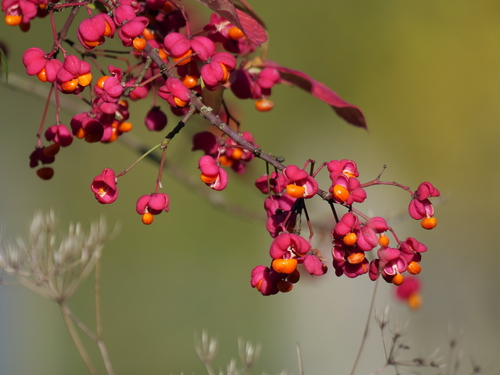
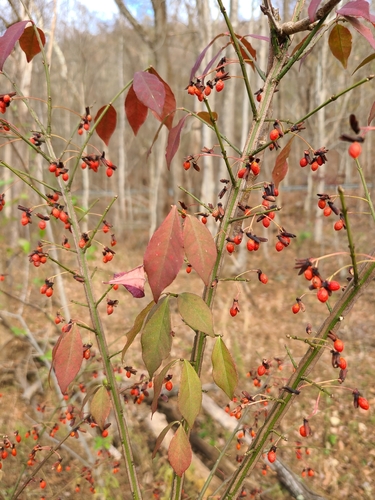
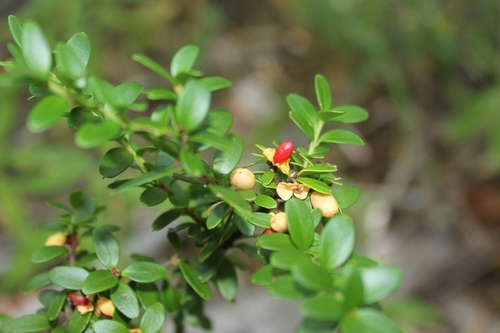
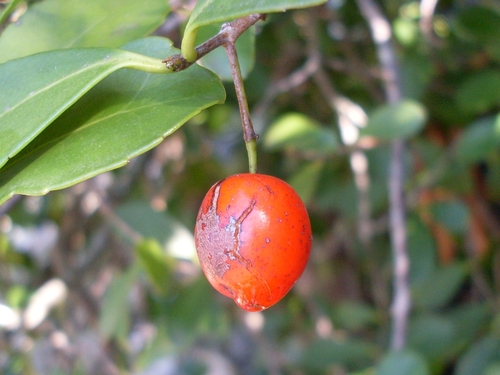
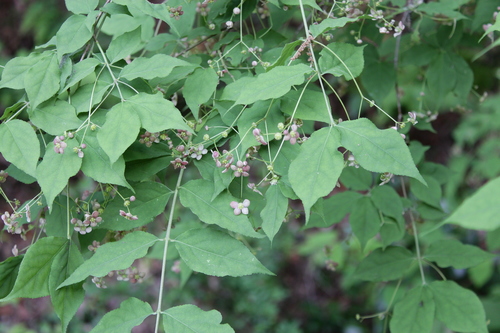
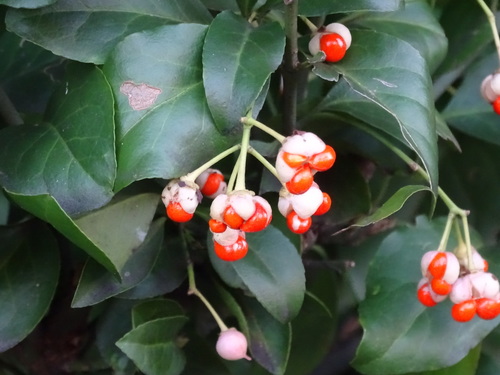
Its leaves grow in opposite pairs, and are elliptic to elliptic-ovate, measuring 2–6 cm long and 1–3 cm broad, with finely serrated margins. The flowers are inconspicuous, 5 mm in diameter, and have four small greenish-yellow petals. The fruit it produces is a smooth, dehiscent capsule that contains reddish arils. Euonymus fortunei is very similar to Euonymus japonicus, especially in cultivation. In the wild, E. fortunei grows as a climbing or procumbent plant, while E. japonicus has an erect growth habit.
This species has an extensive native range that covers many parts of China (from sea level up to 3400 m elevation), as well as India, Indonesia, Japan, Korea, Laos, Myanmar, the Philippines, Thailand, and Vietnam. It grows in habitats including woodlands, scrub, and forests. It was introduced to North America as an ornamental plant, and is currently considered an invasive species across most of the Eastern United States. It also holds invasive status in other parts of the world, notably eastern United States and Canada. Euonymus fortunei resembles Euonymus japonicus, which is also widely cultivated but grows as a shrub and does not produce climbing roots. It is related to multiple similar species, including Euonymus theifolius and Euonymus vagans, as well as several named "species" that are only found in cultivation and are better classified as cultivars.
Euonymus fortunei is widely cultivated as an ornamental plant, with many cultivars selected for traits including yellow foliage, variegated foliage, and slow, dwarfed growth. It is used as a groundcover, or as a vine for climbing walls and trees. The cultivars 'Emerald Gaiety', 'Emerald 'n' Gold', 'Emerald Surprise', 'Kewensis', and 'Wolong Ghost' have received the Royal Horticultural Society's Award of Garden Merit. Plants propagated from mature flowering stems, which were formerly sometimes classified as f. carrierei, always grow as non-climbing shrubs. Some popular cultivars such as 'Moon Shadow' are shrub forms. Most cultivated plants belong to the variety var. radicans (Huxley 1992). It is generally classified as cold hardy in USDA zones 5 to 9.