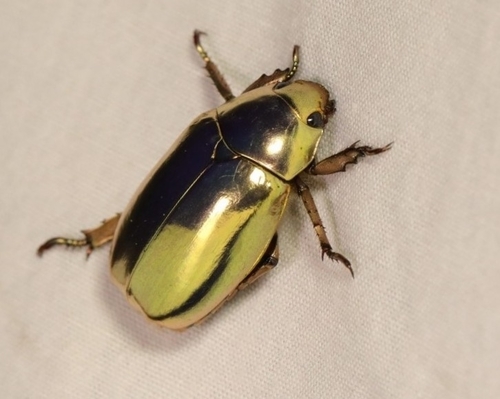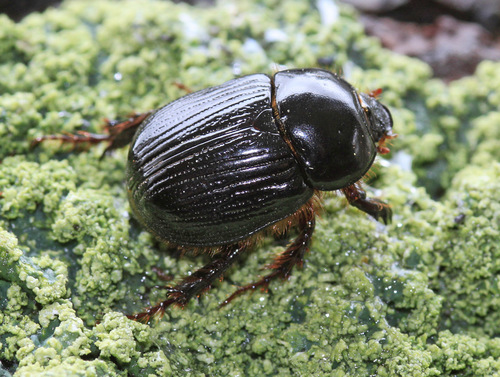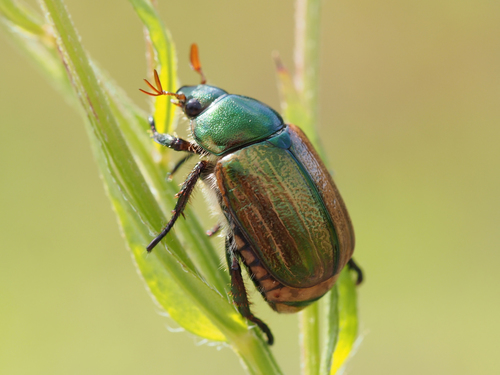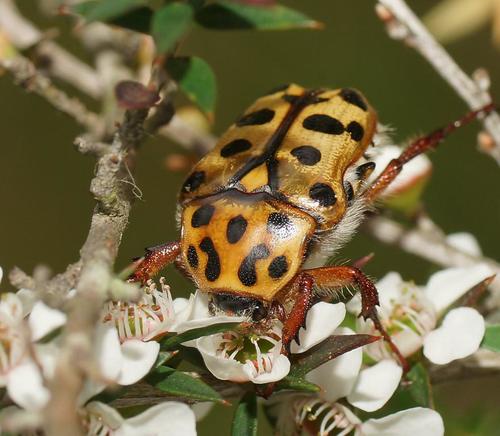
About Euoniticellus intermedius (Reiche, 1850)
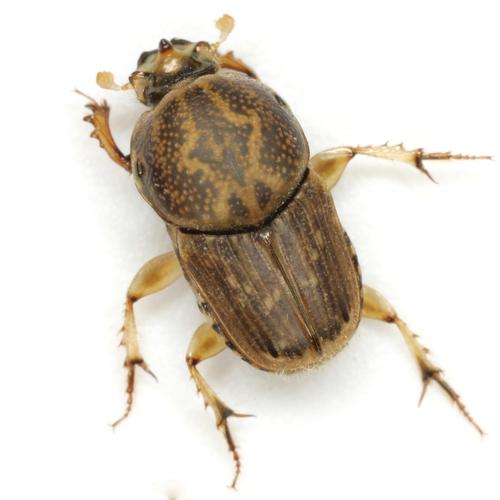
Adults of Euoniticellus intermedius are generally 6mm to 10mm long. Younger adults are typically light brown or tan, with darker thoraxes, while older adults are darker brown and more uniformly colored. Their brown coloration and dried dung that adheres to their exoskeletons help adult beetles camouflage into their surroundings. This species displays sexual dimorphism: males have blunt, curved horns that females lack, and males also have thinner, more curved fore tibia and more swollen anterior dorsal sections than females. E. intermedius is native to the Afrotropical realm, with a natural distribution spanning from Ethiopia to South Africa. It has since spread to other regions both intentionally and unintentionally. It was introduced from South Africa to Australia in 1971 for agricultural purposes, and is now found in all of Australia's mainland states except Victoria. It was later introduced to the United States for similar agricultural reasons. It was first released in Hawaii from Australia in 1974, then brought to California, Texas, and Georgia between the 1970s and 1980s. It has also been recorded in Florida, but its distribution across the rest of the United States remains unclear. The species has also spread through most of Mexico, from its northern border with the United States to its southern border with Guatemala. It was never intentionally released in Mexico, but has been identified in 15 of the country's 32 states. E. intermedius is generally found across all habitats within its introduced and native ranges, but is more abundant in areas associated with livestock or pastures. Its successful spread as an invasive species is attributed to its high fecundity, adaptability, and vagility. It is highly tolerant of hot, arid conditions. While it is attracted to fresher dung, it can complete its entire life cycle using dry feces during droughts. It can produce large brood sizes even at soil moisture below the permanent wilting point, and can resorb ovarian oocytes during stressful conditions. It tolerates a wider range of temperatures than many other dung beetle species, is highly resistant to agrochemicals, and is active during the afternoon when most other dung beetle species are dormant. Its high tolerance for extreme conditions and avoidance of competition with other dung beetle species have allowed it to become a successful invader that spreads to regions with many different climate types. Like other dung beetle species, E. intermedius feeds on dung. It has a strong preference for cow dung, and for dung that is no older than 36 hours. Adults primarily feed on the nutritionally rich particulate portion of dung. Larvae instead consume coarser, fibrous portions of dung, and both life stages have distinct anatomical adaptations that support these differing diets. Larvae have a compartmentalized hindgut, which likely holds symbiotic bacteria that aid in digesting cellulose from plant fibers; this anatomical feature is not present in adult beetles. Larvae also have ancestral, sclerotized mandibles that allow them to consume tougher dung portions, while adults have specialized soft mandibles that make eating softer dung easier. E. intermedius has been intentionally introduced to ecosystems in Australia and the United States for its beneficial contributions to agriculture.