About Euodice malabarica (Linnaeus, 1758)
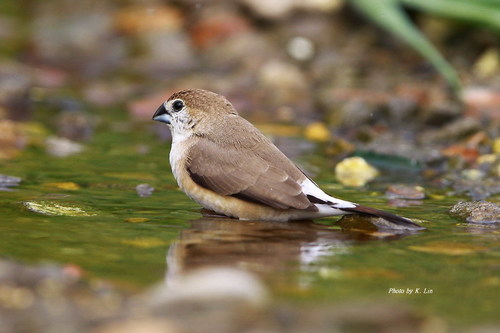
Adult Indian silverbills (Euodice malabarica) measure 11–11.5 cm in length. They have a conical silver-grey bill, buff-brown upperparts, white underparts, buffy flanks, and dark wings. Their tail is black, and their dark wings contrast with a white rump. The tail appears pointed because feather length decreases from the center outward. Adult males and females have similar plumage; immature individuals have buff underparts and a shorter tail. This species feeds mainly on seeds, but also consumes insects, and has been recorded visiting nectar-producing flowers such as those of Erythrina trees. It consumes a wide range of grass seeds, and will also feed on crop species. This bird frequents dry open scrub, fallow land, and cultivated areas, and is sometimes found near water. It is mainly found on plains, but can occur up to around 1200 m in some sub-Himalayan regions. Its native distribution includes Pakistan, Nepal, Bangladesh, India, Sri Lanka, Iran, and Israel. It has been accidentally introduced to many other parts of the world, and has established populations in Jordan, Israel, Kuwait, Oman, Puerto Rico, Qatar, Saudi Arabia, Egypt (recorded here since 2019), the United States, the Virgin Islands (possibly extinct), and Nice in southern France. While largely sedentary, some populations undertake seasonal movements. Indian silverbills are gregarious, occurring in flocks that can number up to 60 birds. They forage on the ground, or on low shrubs and grass stalks, and constantly produce a low cheeping or chirping contact call while feeding. They visit water to drink, using a rapid sip and swallow action. The breeding season occurs across different time periods that vary by region: it takes place in winter in southern India, and after summer in northern India. The nest is an untidy grass ball with a side opening, placed in low shrubs, often on thorny Acacia. This species will reuse old nests of baya weavers, sometimes even entering nests that are still occupied by the weavers. It will sometimes build its own nest below the platform nests of vultures or storks. Old nests are used year-round as dormitories for roosting. Females are known to lay their eggs in the nests of other conspecific pairs. Clutches contain 4 to 8 white eggs, which are incubated by both parents for approximately 11 days. More than two birds are sometimes seen at a single nest, suggesting that helpers may participate in breeding. Several parasitic protozoans and the coccidian species Sivatoshella lonchurae have been described from this species.