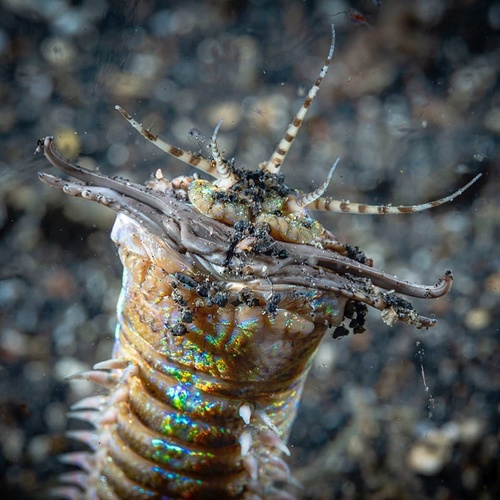
About Eunice aphroditois (Pallas, 1788)
Eunice aphroditois is an ambush predator. It has five antennae on its head that it uses to sense prey, and its entire body is covered by a hard exoskeleton. Its mandibles can be retracted into the body, and are used to strike and stun prey; these mandibles are strong enough to snap some prey in half. Most individuals have body coloration ranging from deep purple to black, with iridescent skin. The largest confirmed recorded specimen measured 299 cm (9.81 ft) in length, which makes E. aphroditois the longest known species in the polychaete class. Despite reaching these great lengths, these worms have a slim body shape, with a maximum body width of only about 25.5 mm (1.00 in).
This species can be found hunting in prey-rich coral reefs, where its natural coloration helps it blend into surroundings, and its slim body allows it to hunt in tight spaces. It also lives in a wide variety of other habitats, most commonly sandy and muddy sediments, as well as areas around rocks and sponges. It has been documented living at depths of up to 95 meters (312 ft).
The sexual reproductive organs of Eunice aphroditois have not been fully studied, so there is no clear, complete understanding of this species' reproduction, though it is thought its reproductive traits may be similar to those of other polychaetes. The typical lifespan of E. aphroditois is believed to be between three and five years. E. aphroditois is capable of limited regeneration, mostly of posterior body segments such as the tail. This is a common trait among many polychaete worms. While many other annelids can regenerate body parts after injury, there is no scientific evidence that E. aphroditois reproduces asexually by splitting into multiple segments. Claims of this asexual reproductive behavior appear to come from misinterpreting movement that occurs after injury or after the worm has died, rather than from verified observations of asexual regenerative reproduction.
Eunice aphroditois reproduces sexually. During spawning, mature individuals release sperm and eggs into the water column, where external fertilization takes place. The fertilized embryos develop into planktonic trochophore larvae that drift through open water before settling and undergoing metamorphosis into juvenile worms. This reproductive pattern matches what is seen in many other members of the order Eunicida.

