About Eunectes notaeus Cope, 1862
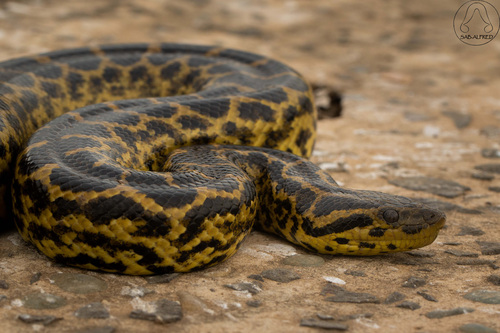
Description: Adult Eunectes notaeus (yellow anaconda) reach an average total length of 3.7 m (12 ft 1+1⁄2 in). Females are typically larger than males, with maximum reported lengths of up to 4.6 m (15 ft 1 in). Most individuals weigh between 25 and 35 kg (55 to 77 lb), though specimens over 55 kg (121 lb) have been observed. This anaconda has a base coloration of yellow, golden-tan, or greenish-yellow, patterned with a series of black or dark brown saddles, blotches, spots, and streaks. Distribution and habitat: The native range of the yellow anaconda covers the Paraguay River drainage and its tributaries, spanning from the Pantanal region of Bolivia, Paraguay, and western Brazil to northeastern Argentina and northern Uruguay. Its most suitable habitat is concentrated mostly in northern Argentina and southern Paraguay. It favors primarily aquatic habitats, including swamps, marshes, and brush-covered banks of slow-moving rivers and streams. A small introduced population, thought to originate from escaped pet anacondas, has been recorded in Florida, though it is not known if this population breeds. A 2023 proposal by Rivas et al. to synonymize Eunectes beniensis and Eunectes deschauenseei with Eunectes notaeus would expand the species’ confirmed range to also include western Bolivia, northern Brazil, and coastal French Guiana. Reproduction: Yellow anacondas are mostly sequentially monogamous. Males track the scent of female pheromones in air to initiate courtship, which most often takes place in water. This species can form breeding balls, which are groups of one female and multiple males gathered at the same time. Within a breeding ball, males compete for access to the female, and the largest male usually wins mating rights. The annual breeding period for yellow anacondas falls between April and May. The gestation period for females is six months. Yellow anacondas are ovoviviparous: females incubate eggs inside their bodies and give birth to live young. Litter sizes range from 4 to 82 young, and each newborn is approximately 60 cm long. Females abandon their young immediately after birth, leaving them to survive independently. Yellow anacondas reach sexual maturity at 3 to 4 years old. Ecology: The yellow anaconda forages predominantly in shallow water within wetland habitats. Most predation activity occurs from June to November, after flooding has partially receded, when wading birds are the most common prey. Analysis of gut and waste contents from regularly flooded areas of Brazil’s southwestern Pantanal region confirms that yellow anacondas are generalist feeders that use both ambush predation and active wide-foraging strategies. Their prey is almost entirely limited to aquatic and semi-aquatic species, including a wide diversity of mammals, birds, reptiles, amphibians, fish, and eggs. Larger yellow anaconda specimens can hunt larger animals, such as brocket deer, capybaras, and peccaries. The prey-to-predator weight ratio for this species is often much higher than that of other Boidae. Cannibalism has been observed in yellow anacondas, but the frequency of this behavior is not currently known. The yellow anaconda has very few natural predators. Juveniles, and occasionally adults, may be preyed on by spectacled caimans, tegu lizards, larger anacondas, jaguars, cougars, canids such as the crab-eating fox, mustelids, procyonids, herons, and raptors like the crested caracara. Humans also hunt this species for its skin.