About Eumomota superciliosa (Sandbach, 1837)
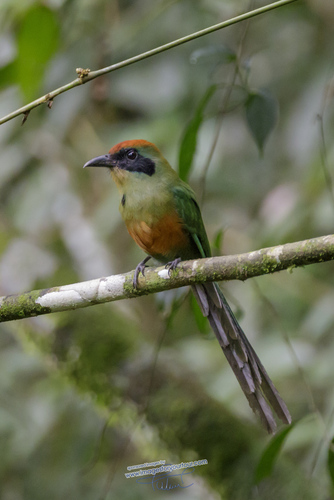
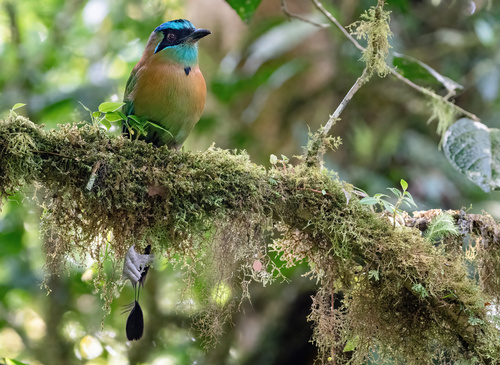
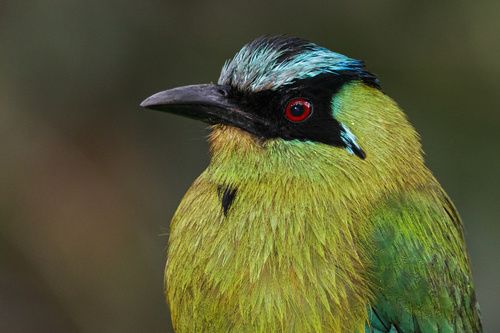
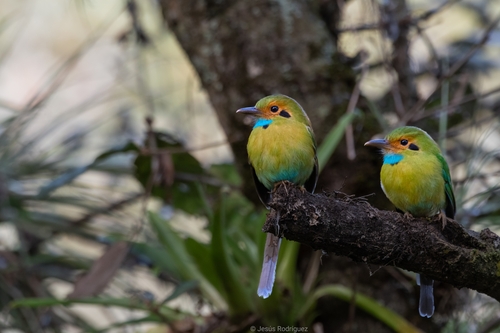
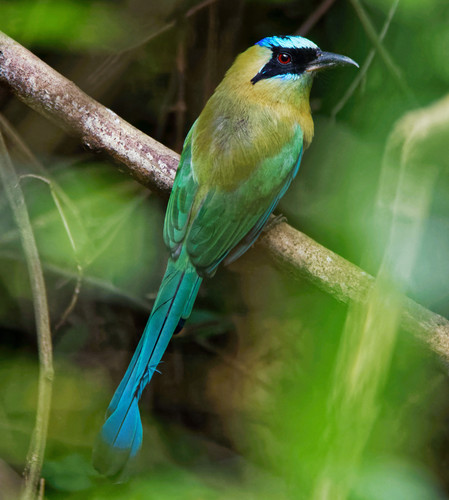
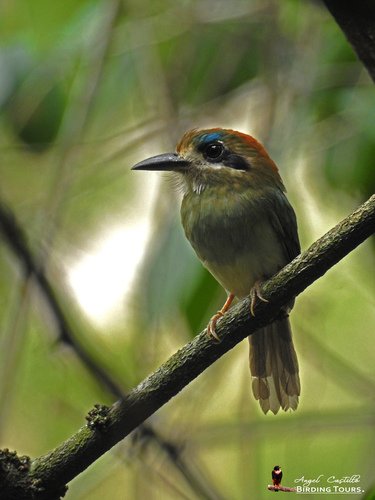
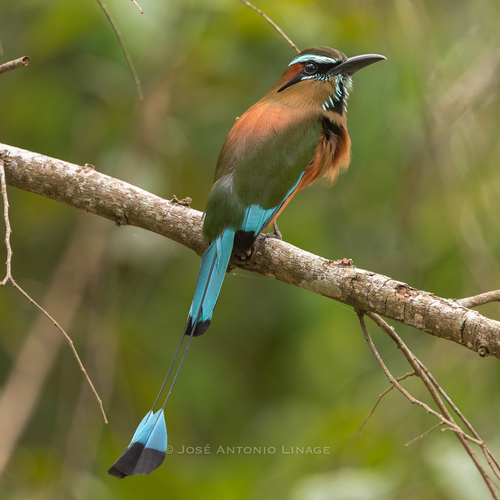
The turquoise-browed motmot, scientifically named Eumomota superciliosa, is a colourful, medium-sized bird belonging to the motmot family Momotidae. This species lives in Central America, ranging from southeast Mexico (mostly the Yucatán Peninsula) south to Costa Rica, where it is common and not considered a threatened species. It occupies fairly open habitats including forest edge, gallery forest, and scrubland. It is more easily observed than other motmots, and often perches in open locations on wires and fences. From these perches, it scans for prey such as insects and small reptiles. It lays 3–6 white eggs inside a long tunnel nest built in an earth bank, and occasionally in a quarry or freshwater well. Its common name comes from the turquoise colour of its brow. It is the national bird of both El Salvador and Nicaragua; it is called torogoz in El Salvador and guardabarranco in Nicaragua. Adults of this species measure 34 cm (13 in) in length and weigh 65 g (2.3 oz). Most of its body is grey-blue, with a rufous back and belly. It has a bright blue stripe above the eye and a black throat patch bordered with blue. Its flight feathers and the upperside of its tail are blue. The tips of its tail feathers are shaped like rackets, and the bare feather shafts are longer than those of other motmots. A common claim that motmots pluck barbs from their tail to create this racketed shape is incorrect; the barbs are weakly attached and fall off naturally due to abrasion with substrates and routine preening. Unlike most bird species, where only males develop elaborate physical traits, both sexes of the turquoise-browed motmot grow this distinctive racketed tail. Research shows the tail has evolved different functions for each sex. Males use their tails as sexual signals, and males with longer tails achieve higher pairing and reproductive success. Beyond this sexual function, both sexes use the tail to perform a wag-display, moving the tail back and forth in a pendulum-like motion. This wag-display is not performed in a mating-related context: both sexes do it when a predator is nearby. The display is thought to provide naturally selected benefits by communicating to the predator that it has been spotted, and a pursuit will not end in capture. This type of interspecific communication is called a pursuit-deterrent signal. The call of the turquoise-browed motmot is nasal, croaking, and can travel long distances. The turquoise-browed motmot is a well-known bird across its range, and has many local common names. These include guardabarranco, meaning "ravine-guard", in Nicaragua, torogoz in El Salvador (a name based on its call), and pájaro reloj, meaning "clock bird", in the Yucatán, named for its habit of wagging its tail like a pendulum. In Costa Rica, it is called momoto cejiceleste, or the less flattering pájaro bobo, meaning "foolish bird", a name that refers to its tendency to let humans approach very close before flying away.