About Eumicrotremus orbis (Günther, 1861)
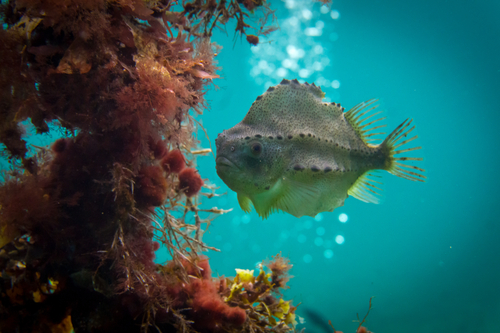
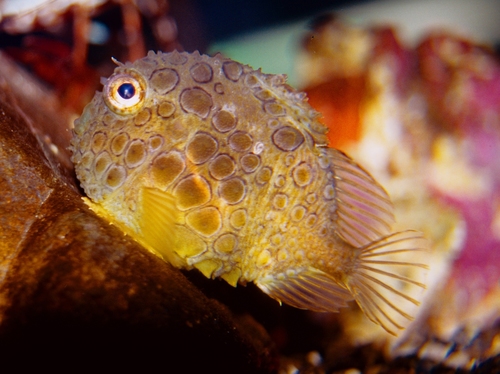
Pacific spiny lumpsuckers (Eumicrotremus orbis) are globular-shaped fish. They typically measure 1 to 3 inches (2.5 to 7.6 cm) in length, with 1 inch (2.5 cm) being the most common size, and have a maximum known length of around 5 to 7 inches (13 to 18 cm). They have a wide mouth with large lips, protruding eyes, a squared dorsal fin, a rounded caudal fin, and thin, transparent pectoral fins. Their pelvic fins have evolved into a large, fringed suction cup that allows them to attach to surfaces such as rocks or kelp, and this structure also compensates for their lack of a gas bladder. Due to their large rounded body shape and small fins, Pacific spiny lumpsuckers are ineffective swimmers, and are most commonly found attached to solid objects. These fish do not have scales; instead, their bodies are covered in cone-shaped plates called tubercles, and females have more tubercles than males. Pacific spiny lumpsuckers occur in many colors, including brown and green, often with yellow or orange highlights. Females are dull green, while males are dull orange to reddish brown. Pacific spiny lumpsuckers are distributed from northern Washington state, especially Puget Sound, to the Aleutian Islands of Alaska. They can also be found in the Bering Sea, the Chukchi Sea, and around northern Japan. This species inhabits a wide variety of habitats, including eelgrass beds, rocky reefs, kelp patches, other algae growth, shallow bays, and docks. They live in near-shore waters down to a depth of 150 meters (480 to 500 feet). This species spawns in shallow, warmer waters between July and October. Females lay large, spherical, orange-colored eggs on rocks in sheltered holes, typically laying around 2000 eggs at a time in the nest, after which males fertilize the eggs. After the eggs are laid, the male attaches himself to a nearby surface and cares for the clutch by defending it from predators and circulating water over the eggs with his fin to supply a steady flow of oxygen. Males defend the clutch for three to eight weeks before juvenile lumpsuckers hatch, and the juveniles venture out alone to find food within a few days of hatching. Fluorescence in males is an important factor for reproduction that helps attract mates. Males are typically red and females are typically green. When males are in close proximity to females, they flash their rare red fluorescence to signal that they are ready to mate. This fluorescence is an evolutionarily successful adaptation that is passed on because it increases reproductive success.