About Eumetopias jubatus (Schreber, 1776)
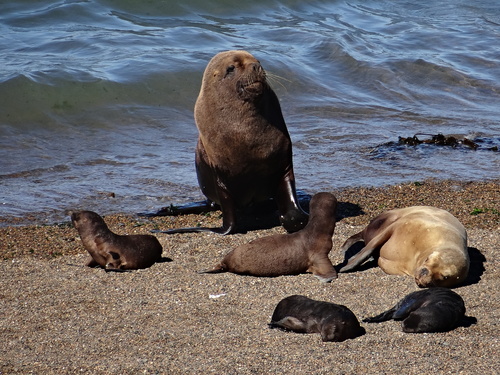
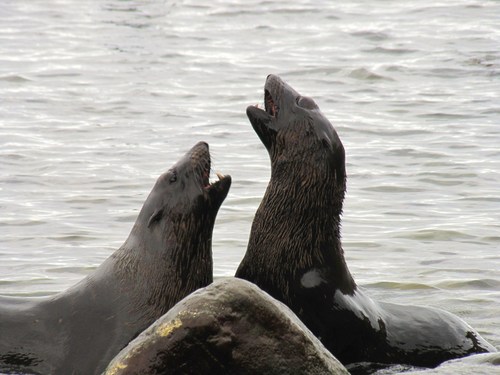
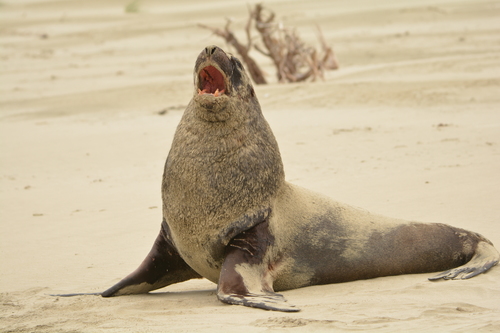
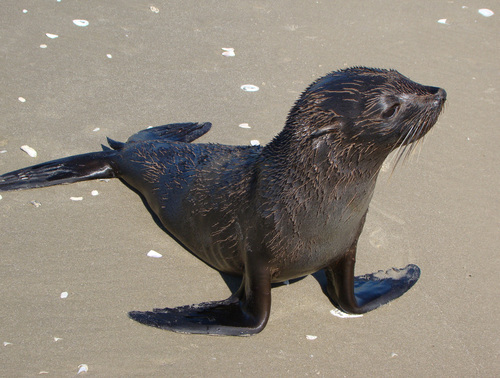
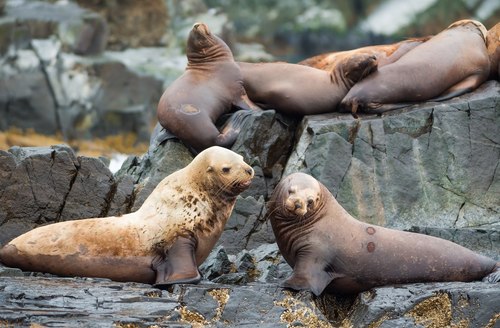
This species is Eumetopias jubatus (Schreber, 1776), commonly called the Steller sea lion. Adult Steller sea lions are lighter in color than most other sea lions, with coloring ranging from pale yellow to tawny, and occasionally reddish. Pups are born almost black, weigh around 23 kg (51 lb), and keep this dark coloration for several months. Females reach sexual maturity between 4 and 6 years of age, while males reach sexual maturity over a wider range of between 3 and 8 years of age. Both sexes grow rapidly until their fifth year, after which female growth slows considerably. Adult females measure 2.3–2.9 m (7.5–9.5 ft) in length with an average of 2.5 m (8.2 ft), and weigh 240–350 kg (530–770 lb) with an average of 263 kg (580 lb). Males continue to grow until their secondary sexual traits develop between their fifth and eighth year. Males are slightly longer than females, growing 2.82–3.25 m (9.3–10.7 ft) long with an average length of 3 m (9.8 ft). Adult males have much wider chests, necks, and overall forebody structure, and weigh 450–1,120 kg (990–2,470 lb) with an average weight of 544 kg (1,199 lb). Males are further distinguished from females by broader, higher foreheads, flatter snouts, and a thick mane of coarse hair around their large necks. The species' scientific name translates roughly to "maned one with the broad forehead". The range of the Steller sea lion stretches from the north shore of Honshu, Japan north to the Gulf of Alaska, and south to Año Nuevo Island off the coast of central California. The species formerly bred as far south as the Channel Islands, but has not been observed breeding there since the 1980s. Based on genetic analyses and local migration patterns, the global population has traditionally been split into eastern and western stocks at 144°W longitude, which runs roughly through the middle of the Gulf of Alaska. Recent evidence indicates that Steller sea lions in Russia's Sea of Okhotsk and Kuril Islands form a third separate Asian stock, while sea lions on the eastern seaboard of Kamchatka and the Commander Islands belong to the western stock. In summer, Steller sea lions tend to shift their range somewhat southward. As a result, while there are no reproductive rookeries in Japan, several consistent haul-out sites are found around Hokkaidō in winter and spring. Vagrant individuals have been spotted in the Yellow Sea, Bohai Gulf, and along the coasts of the Korean Peninsula and China. The oldest known fossil of this species was found near Kanazawa, Japan, and dates to the late Early Pleistocene, approximately 800,000 years ago. Steller sea lions typically inhabit the coastal waters of the subarctic, drawn by the area's cooler temperate climate. Like all otariids, Steller sea lions are amphibious, spending part of their time in water and part on land. They usually feed while in water, and haul out onto land to reproduce, raise pups, molt, and rest. They most often congregate on isolated islands, which are their preferred terrestrial habitat. Isolated islands allow Steller sea lions to avoid predation by terrestrial predators, easily thermoregulate via cooling winds, and access offshore prey more easily. Some haul-out sites, called rookeries, are primarily used for reproduction, while other haul-out sites are used for other purposes such as molting. Both biotic and abiotic factors can influence how much time Steller sea lions spend on land, including prey availability, predator abundance, tide levels, and weather. Steller sea lion reproduction follows a consistent seasonal pattern. Reproductively mature males gather at traditional, well-defined reproductive rookeries (usually beaches on isolated islands) in mid-spring. Larger, older males establish and defend distinct territories on the rookery. Around a week later, adult females arrive, sometimes accompanied by sexually immature offspring, and form fluid groups across the rookery. Like all other otariids, Steller sea lions are polygynous. However, unlike some other otariid species, they do not coerce individual females into harems; instead, males control spatial territories, and females can move freely between these territories. Steller sea lion males may hold aquatic, semiaquatic, or terrestrial territories, and males with semiaquatic territories have the most success defending them. Territory boundaries are defined by natural features such as rocks, faults, or rock ridges, and territories can remain stable for up to 60 days. While Steller sea lion males are generally tolerant of pups, one male filmed on Medny Island in Russia was documented killing and eating several pups, the first recorded incident of cannibalism in the species. Researchers are uncertain of the motives for these attacks, but have suggested the involved bull may have an abnormal, psychotic-like personality. Pregnant females give birth shortly after arriving at the rookery, and copulation generally occurs one to two weeks after birth. The fertilized egg does not implant in the uterus until fall, and can remain in embryonic diapause for up to three months before implanting and starting cell division. Twin births are rare. After around a week of nursing without leaving the rookery, females begin taking progressively longer and more frequent foraging trips that leave their pups behind. By late summer, both the mother and pup leave the rookery together. This pattern of maternal attendance is common among otariids. As pups age, females spend increasing amounts of time foraging out at sea, continuing until pups reach the ideal body weight and energy reserves to feed on their own. A study conducted by the University of California, Santa Cruz found that on average, male Steller sea lion pups consume more milk than female pups, which may be due to the sexual dimorphism common to otariids. Reproductive males fast throughout the reproductive season, often not entering the water once from mid-May until August. By August, the structure of reproductive rookeries breaks down, and most animals leave to disperse across the open seas within their range. Weaning age is highly variable; pups may stay with their mothers for as long as four years. There are documented incidents of mothers nursing daughters that are simultaneously nursing their own newborn pups, an extremely rare occurrence among mammals. A 1983 study at Año Nuevo found that a female's time spent with her pup is shaped by the pup's increasing nutritional demands and the pup's suckling efficiency. On average, females spent 21 hours ashore and 36 hours at sea. As pups aged, females began spending more time at sea again, but by six weeks after birth, a mother's time spent at sea declined by 30 percent. There is no relationship between a pup's activity or physical excursion and their suckling time, age, or sex, and these traits are unrelated to the pup's energy use. Labeled water studies showed that a pup's milk intake has a direct relationship to their size: pups that consumed more milk were heavier than those that did not. These findings confirm that the amount of time females spend onshore with their pups is based on the pup's suckling efficiency and nutritional demands. In the past, low pup production was linked to increased nutritional stress in females, which was believed to have contributed to the well-documented decline of Steller sea lion populations in Alaska.