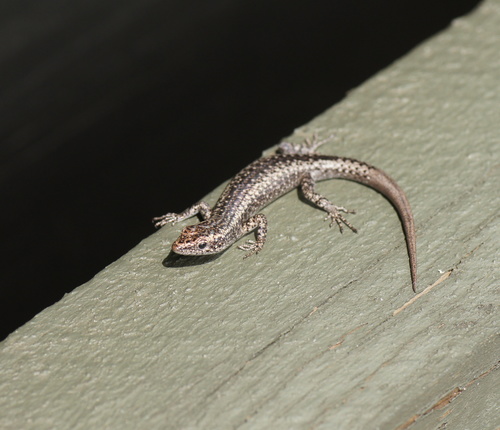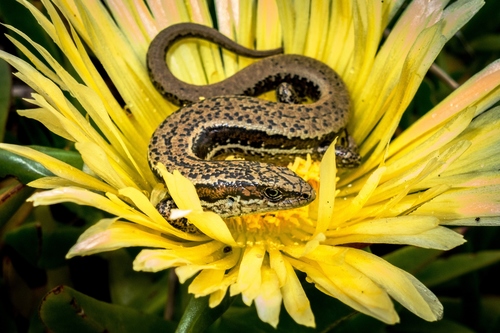
About Eumeces schneiderii (Daudin, 1802)
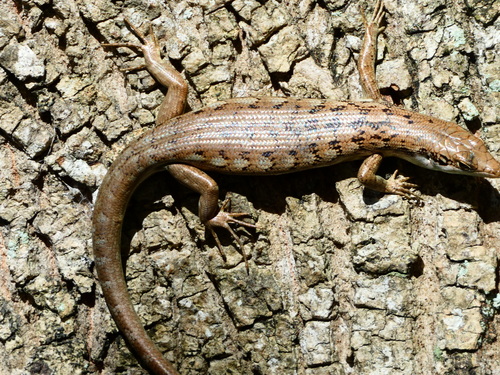
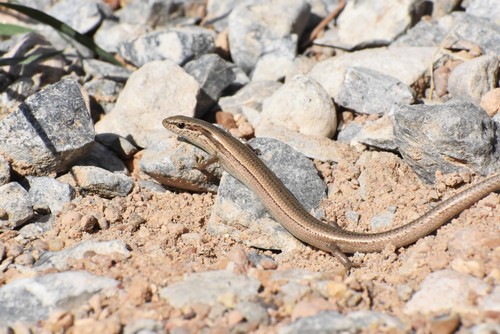
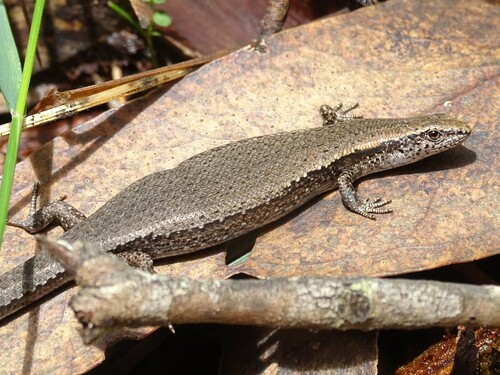
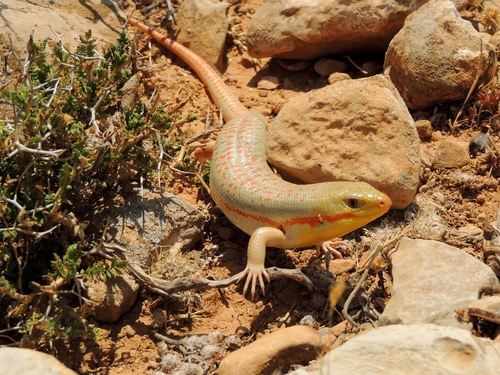
Eumeces schneiderii (Daudin, 1802) can be identified by the following morphological traits: It has a moderately sized head, with a short, obtuse snout. The nasal scale is rather large, usually divided, and in contact with the two anterior upper labials; there is no postnasal scale. It has 5 supraocular scales, with the three anterior ones in contact with the frontal scale; the parietals are entirely separated by the interparietal; there are 4 or 5 pairs of nuchal scales. The ear opening is rather large, with 4 or 5 long, pointed lobules on its anterior edge, and it has 2 azygous postmental scales. There are 22 to 28 scales around the mid-body; these scales are perfectly smooth, with the lateral scales being the smallest, and the scales of the two median dorsal series are very broad and larger than the ventral scales. The length of the hind limb is 2.5 to 3 times shorter than the snout-to-vent length. When pressed against the body, the limbs just meet or do not reach each other. It has a series of transversely enlarged subcaudal scales. Dorsal coloration is olive-grey or brownish, and may be uniform or marked with irregular golden-yellow spots or longitudinal streaks. A constant marking is a yellowish lateral streak that extends from below the eye to the hind limb. Undersurfaces are yellowish white. Adult snout-to-vent length reaches 16.5 cm (6.5 inches), and total length including the tail reaches 36.5 cm (14.5 inches), with the tail alone measuring 20 cm (8 inches). This species is distributed across Eastern Algeria, Tunisia, Libya, Egypt, Israel, Cyprus, Turkey, western Syria, Lebanon, Jordan, Iran’s Kavir desert, Iraq, Saudi Arabia, Transcaucasia, Dagestan (Russia), Turkmenistan, Uzbekistan, Tajikistan, eastern Georgia, southern Armenia, Azerbaijan, Asia Minor, Afghanistan, northern Pakistan, and northwestern India. Three subspecies are recognized: E. s. barani, found in Anatolia, Turkey; E. s. pavimentatus, found in Jordan, Lebanon, and Syria; and E. s. princeps, found in Armenia, Azerbaijan, and the Caucasus. E. schneiderii prefers natural habitats including rocky areas, grassland, shrubland, and wetlands, found at altitudes ranging from 150 to 1,800 m (490 to 5,910 ft). This species is oviparous.