About Eulychnia castanea Phil.
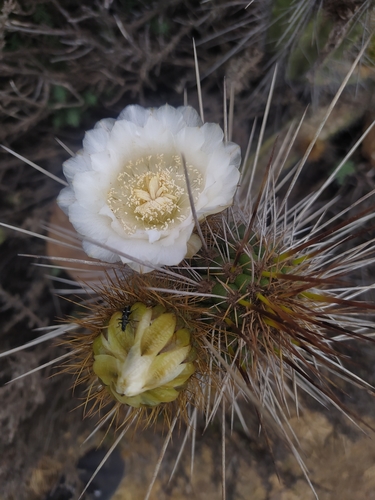
Eulychnia castanea Phil. is a cactus with a grass-green outer epidermis. It grows creeping from the base, forming thickets that can reach several meters across, while individual plants are relatively short, reaching around 50 cm in height. Stems are typically 1 to 2 meters long, lying prostrate at the base, and measure 6 to 8 cm thick. Each stem usually has 9 to 12 ribs, occasionally 8 or 13. The ribs are over 1 cm wide and around 1 cm high, with blunt, deeply notched edges. Winged grooves run down from these notches to the furrows between the ribs. Rounded areoles, around 5 mm in diameter, extend from the tubercles to the notches. They are covered in dark gray or blackish-gray felt, and spaced roughly 1 cm apart. Spines range in color from brown to yellowish-brown, sometimes have lighter or darker banding, and are straight. There are 6 to 10 radial spines, 0.5 to 2 cm long: shorter radial spines are needle-like, while longer ones are awl-shaped, and all point sideways. One to two robust awl-shaped central spines are also present, measuring 3 to 10 cm long and overlapping each other, and they are often accompanied by smaller additional central spines. Flowers grow laterally on the stems, 5 to 5.5 cm long with an opening 4 to 5 cm across. They have a faint fragrance, open fully at midday, and close partially at night. The white petals are around 2.5 cm long and 1.2 cm wide, spatulate with rounded ends, arranged to form a bowl shape where lower petals are less extended than upper petals. The grass-green ovary ranges from circular to ovoid, around 2 cm long and 2.5 cm thick at its top, with a finely tuberculate surface. This surface is covered in narrow green scales tipped with short, dry black bristles, small tufts of brown felt, and developing yellowish-brown spines. The ovary wall is thick, with a light-refracting green outer layer and a white matte inner layer. A saucer-shaped nectary receptacle, 2–3 mm high and 7–10 mm wide, is narrowed into a honey-yellow ring by the thick base of the style. The broadly funnel-shaped floral tube is around 13 mm long and reaches 2.5 cm in width at its top. White stamens are arranged in two separate groups. The lower group is numerous, inclined inwards, inserted about 5 mm above the nectary, and measures around 13 mm long. The upper group forms a ring at the edge of the floral tube, leans toward the petals, and is slightly shorter than the lower stamens. This cactus has cream-colored anthers and a white style around 4 mm thick and 2 cm long. It has 14–16 spreading yellowish stigmatic lobes that extend slightly past the anthers. The ripe fruit is yellowish-green, around 5 cm long and 4 cm thick at the top, tapering toward the base. It retains the same type of covering as the ovary, with straight, needle-like sharp spines that can reach 1 to 3 cm long. Like all members of the genus Eulychnia, the non-withering outer wall of the floral tube is retained on the fruit. The fruit pulp is white, juicy, mucilaginous, and fragrant, with a sour but pleasant taste. Ripe fruit do not open when mature, and the spiny areoles remain attached. Seeds are approximately 1.5 mm long, 1.0 mm wide, and 0.4 mm thick. They have a convex dorsal shape, no keel, and a pointed base. The seed coat is black and matte, covered in very fine tubercles. The hilum is small, located on the ventral side, oval-shaped, and white. This species is native to coastal regions of northern Chile, growing along the coastline from Los Molles in the Valparaíso region north to the Talinay mountain range in the Coquimbo region. It grows in desert and dry scrub biomes, and prefers coastal habitats including flat rocky surfaces, north-facing slopes, marine terraces, and ravines. It is typically found at elevations from sea level up to around 500 meters. The soils it grows in have varied chemical compositions, with pH levels between 6.5 and 8, meaning the species can adapt to both slightly acidic and alkaline conditions. This cactus lives in the extremely arid Atacama Desert, a region that experiences prolonged droughts of 6 to 10 months and receives minimal annual rainfall of 100-300 mm, which falls mostly in winter. The species depends heavily on coastal fog as its main source of moisture. It has special adaptations that allow it to survive high temperatures up to 50°C. In its native habitat, it grows in specialized plant communities alongside other endemic species adapted to the harsh coastal desert conditions, including Puya venusta, Vasconcellea chilensis, Myrcianthes coquimbensis, and Eulychnia breviflora.