About Euleptes europaea (Gené, 1839)
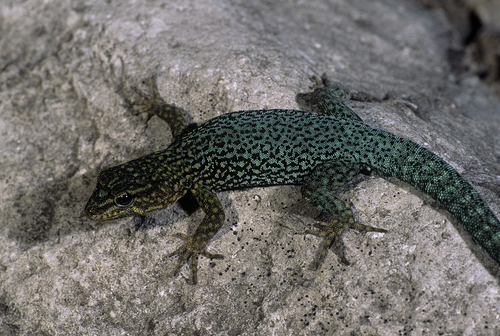
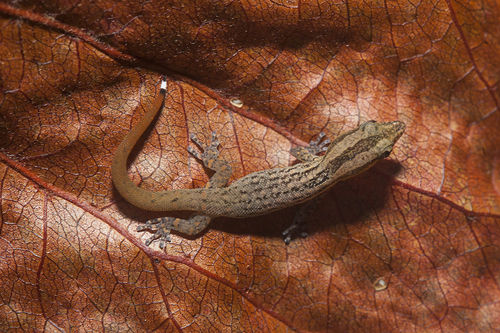
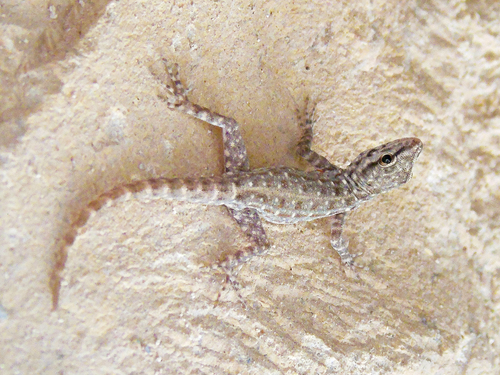
Euleptes europaea, commonly known as the European leaf-toed gecko, can reach a total length of around 8 cm (3 in), with 6 cm (2.4 in) being a more common adult size. It has a wide, somewhat flattened, diamond-shaped head, large eyes with vertical slit pupils, a fairly plump body, and short limbs relative to its body length. Squarish toe tips and the tail tip bear adhesive pads, making this species an excellent climber. The tail matches the body in length; if the original tail is lost and regenerated, the new tail can be twice as thick as the original. Its skin is slightly granular and lacks tubercles, a feature that separates this species from other European geckos. Its base color is quite variable, ranging from yellowish brown to greyish brown, patterned with yellow blotches that often form transverse streaks. Like other geckos, the European leaf-toed gecko can change its body color, becoming paler in hot conditions and darker in cooler conditions. This gecko occurs on Corsica, Sardinia, and many other Mediterranean islands including some off the coast of Tunisia, along with a small number of coastal sites in southern France and similar coastal locations in Tuscany, central Italy. Its largely current island distribution suggests its overall range has contracted relatively recently. The species is inconspicuous and primarily nocturnal, and it inhabits rocks, walls, boulders, and crags, especially granite formations. It is rarely found in occupied buildings, but may occur on ruins, or occasionally on tree trunks. It is most often found at low elevations, but can occur up to around 1,500 metres (4,900 ft) in warmer regions. During the day, it typically hides behind loose rock flakes and in rock cracks, and can reach population densities of up to 200 individuals per square metre. This species hibernates through the winter, emerging when temperatures rise in spring. Mating rituals are fairly boisterous, and include biting the partner's tail, which may result in the tail being shed. Females lay a clutch that usually contains two eggs, which are glued to rock inside cracks. The eggs take 8 to 13 weeks to hatch, and juvenile geckos measure about 3 centimetres (1.2 in) long shortly after hatching. Individuals reach sexual maturity at 2 to 3 years old, and can live up to 20 years.