About Eulemur rubriventer (I.Geoffroy Saint-Hilaire, 1850)
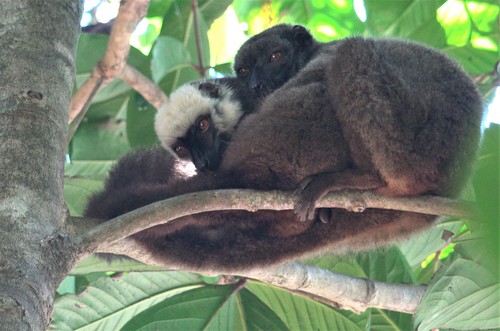
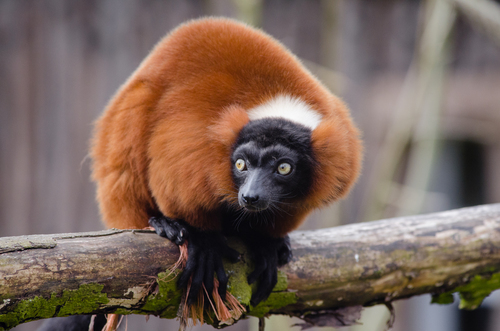
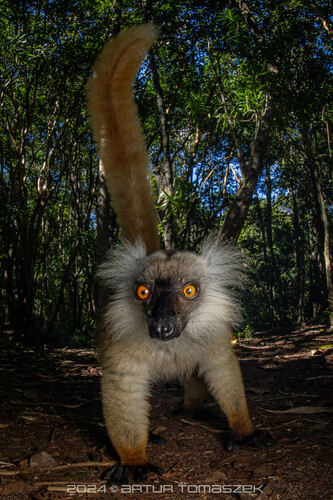
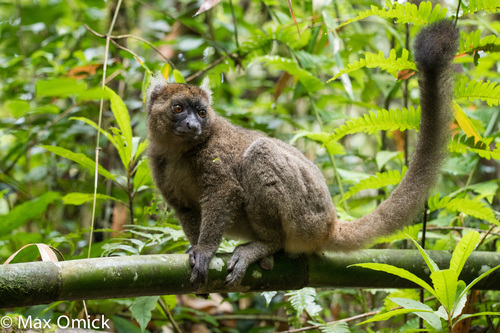
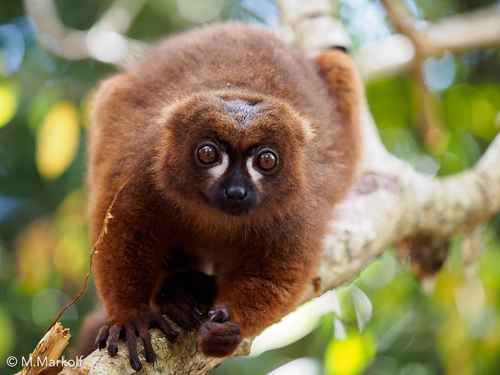
Eulemur rubriventer, the red-bellied lemur, is a sexually dimorphic primate species. Males have a medium-long, dense intense chestnut brown coat along their back, with a lighter, redder shade on their underside, and black tails, muzzles, and heads. Females share the male’s dorsal and tail coloration, but have contrasting white-cream ventral fur. Facial markings of females are similar to males, except their "tear drop" markings are less pronounced, and they lack the stiff thick cheek hairs found on males. Unlike other members of the genus Eulemur, E. rubriventer does not have ear tufts or a furry beard; instead, it has thickened fur around its ears that gives its face a fuller appearance. Adult red-bellied lemurs measure 34 to 40 cm (13 to 16 in) long from head to body, excluding the tail. The tail is almost twenty percent longer than the body, so the combined total body and tail length can reach almost 1 m (3 ft 3 in). Mature individuals typically weigh between 1.6 and 2.4 kg (3.5 to 5.3 lb). Males have scent glands on the top of their head, and both sexes can easily live longer than 20 years. E. rubriventer is native to a narrow strip of eastern Madagascar rainforest, ranging north to the Tsaratanana Massif at elevations up to 2,400 m (7,900 ft) and south to the Manampatrana River. Historically, its range extended further south to the Mananara River. This species has a sparse distribution and is restricted to intact rainforest, and it is not found on the Masolala Peninsula. The red-bellied lemur lives alongside four other Eulemur species across its range: the white-headed lemur (E. albifrons) in the extreme north, the common brown lemur (E. fulvus) in the middle of its range, and the red-fronted brown lemur (E. rufus) and gray-headed lemur (E. cinereiceps) in the southern portion of its range. E. rubriventer can be easily told apart from these related species by the male’s distinctive white eye "tear drops" and the dark rich fur that both sexes share. Within E. rubriventer, there is a geographic difference in appearance: males from the northern part of the range, north of Mantadia National Park for example, have a more distinct reddish belly than males from the southern range, such as those in Ranomafana National Park. The rainforests in E. rubriventer’s range consist of dense evergreen vegetation, with a canopy that reaches 25 to 35 m (82 to 115 ft). Common tree genera found in the canopy include Dalbergia, Diospyros, Ocotea, Symphonia, and Tambourissa. Emergent tree species include Canarium, Albizia, and Neobrochoneura acuminata. Eastern lowland forests within the lemur’s range also support a high diversity of Pandanus, bamboo, and epiphytic orchid species.