About Eulemur fulvus (É.Geoffroy Saint-Hilaire, 1796)
The scientific name of the common brown lemur is Eulemur fulvus (É.Geoffroy Saint-Hilaire, 1796).
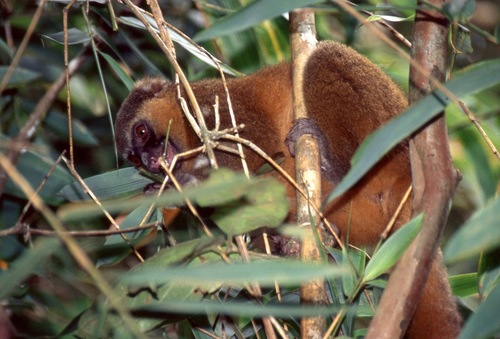
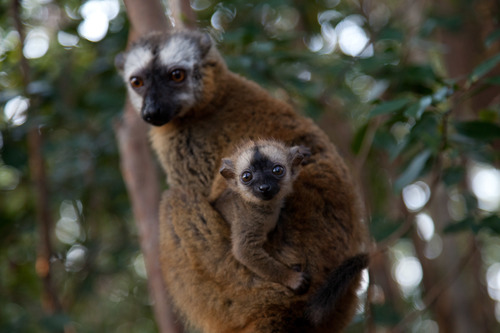
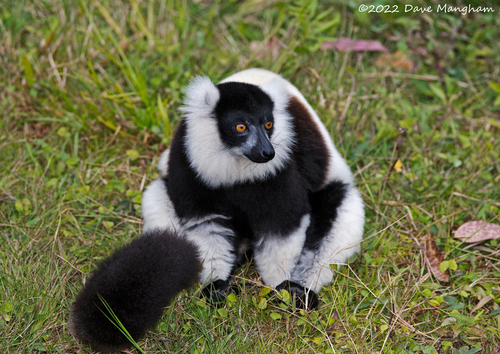
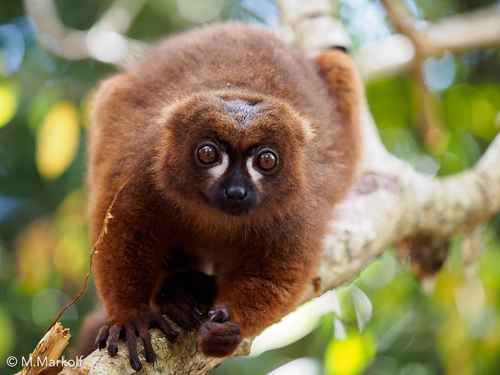
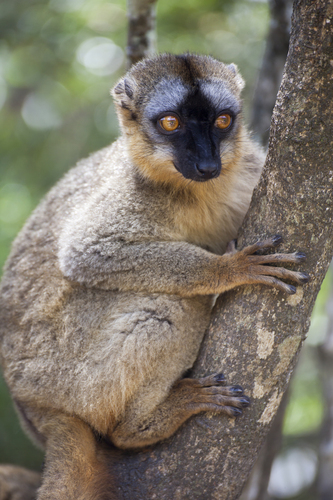
Physical description: The common brown lemur has a total length of 84 to 101 cm (33 to 40 in), which includes a tail that measures 41 to 51 cm (16 to 20 in). Adult body weight ranges from 2 to 3 kg (4.4 to 6.6 lb). Among all species in the Eulemur genus, common brown lemurs are unique in that they show little to no sexual dichromatism. For both males and females, the face, muzzle, and crown are dark gray or black, with white or tan "cheeks" that vary in thickness. Some individuals may have pale-colored eyebrow patches, and their eyes are almost always a deep orange-red. Their short, dense body fur is primarily brown or gray-brown, with a lighter gray or tan underside. The fur on the back of their hands is often a medium orange or reddish color. Their long, bushy tail is either a similar color to their dorsal body fur, or more commonly a darker shade of gray, black, or brown. Because this species historically included all other brown lemurs as subspecies, it is very commonly misidentified in images and written texts, and is often confused with other species such as red-fronted lemurs and gray-headed lemurs, as well as various unrelated hybrids. Similar lemur species that share the common brown lemur's range include the mongoose lemur (E. mongoz) in western Madagascar, and the red-bellied lemur (E. rubriventer) in eastern Madagascar. Common brown lemurs can be distinguished from these two species: E. mongoz is overall more gray in color, while E. rubriventer is more reddish. There is also range overlap with the black lemur in the Galoko, Manongarivo, and Tsaratanana Massifs of northeast Madagascar. Range overlap and hybridization also occur with the white-fronted brown lemur, E. albifrons, in the northeast portion of the common brown lemur's range.
Distribution: The common brown lemur lives in western Madagascar north of the Betsiboka River, and in eastern Madagascar between the Mangoro River and Tsaratanana. It also lives in inland Madagascar, where this inland range connects the separate eastern and western coastal ranges. The species also lives on the island of Mayotte, though this population was introduced to the island by humans.
Reproduction: The common brown lemur's mating season falls in May and June. After a gestation period of around 120 days, young are born in September and October. Single births are the most common, though cases of twins have been reported. Young common brown lemurs are weaned after around 4 to 5 months. Sexual maturity is reached at around 18 months of age, and females give birth to their first young when they are 2 years old. The maximum recorded lifespan of the common brown lemur is over 30 years.