About Euleia heraclei (Linnaeus, 1758)
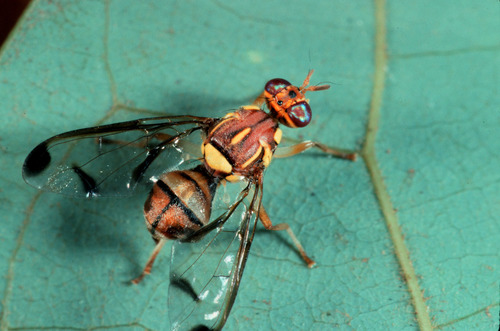
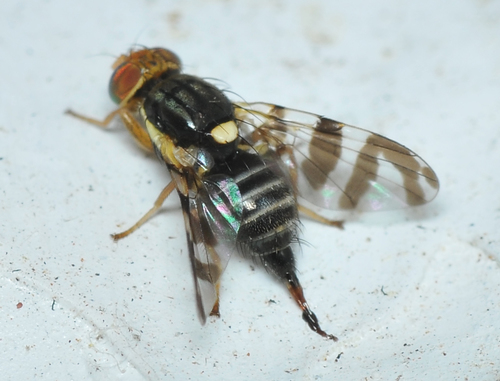
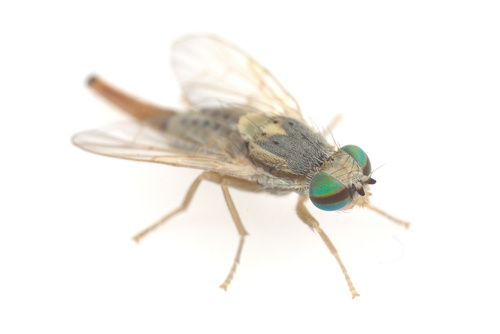
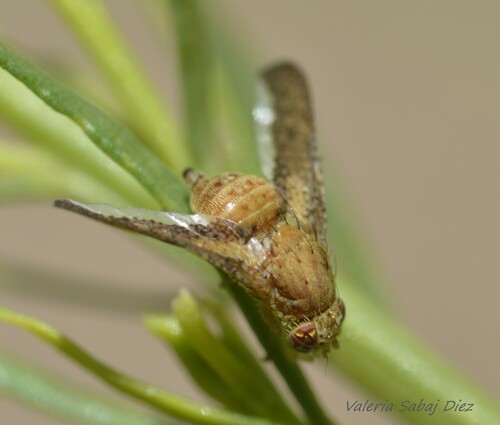
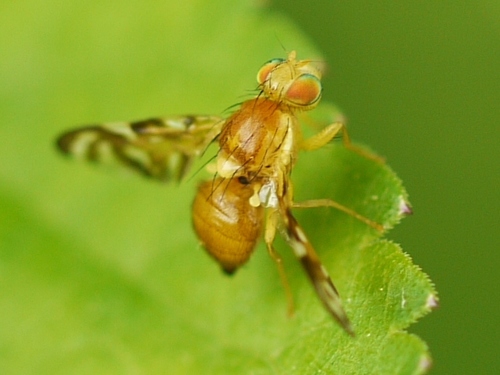
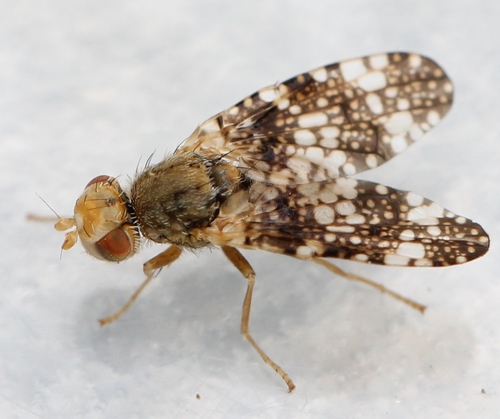
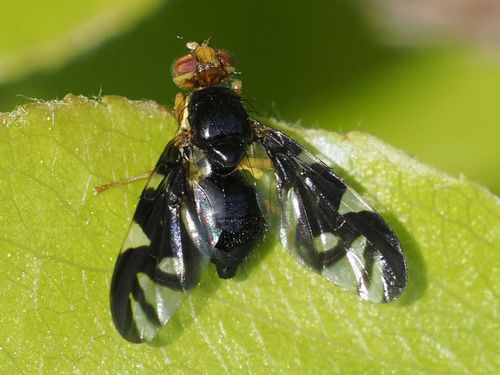
Euleia heraclei reaches a body length of 5–7 millimetres (0.20–0.28 in). This species is seasonally dimorphic, with body color varying between generations. Its thorax and abdomen may be either shiny orange-brown or blackish: winter generation flies are almost black, while summer generation flies have clear orange-brown coloration. The sides of the mesonotum bear whitish longitudinal stripes, and the postscutellum is black. The head features blue-green eyes, and the face has a raised longitudinal rib. This species has rather wide wings heavily marked with brown bands, and yellow-brown legs. Eggs are oval and white. Larvae are white, spindly shaped, and grow up to 8 mm long. This species is widespread across most of Europe, including Austria, Belgium, Bulgaria, Czech Republic, Denmark, Estonia, Finland, France, Germany, Great Britain, Greece, Hungary, Ireland, Italy, Latvia, Moldova, the Netherlands, Norway, Poland, Romania, central European Russia, Slovakia, Spain, Switzerland, Sweden, and Ukraine. It is also found in the eastern Palearctic realm, Central Asia (Afghanistan, Kazakhstan, Kyrgyzstan, Tajikistan, Turkmenistan, and Uzbekistan), Japan, North Africa (Algeria, Morocco), and the Middle East (Turkey, Armenia, Azerbaijan, Georgia, Iran, Israel). In Britain, it is widely distributed across southern and central England, while in Wales records are mostly from coastal areas. These small flies primarily inhabit vegetable gardens and open countryside where their host plants grow.