About Eulamprus quoyii Duméril & Bibron, 1839
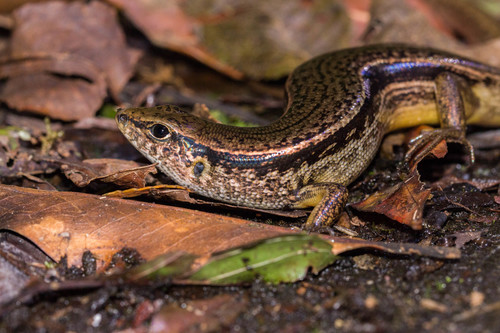
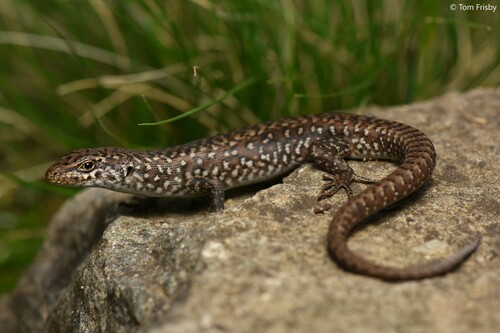
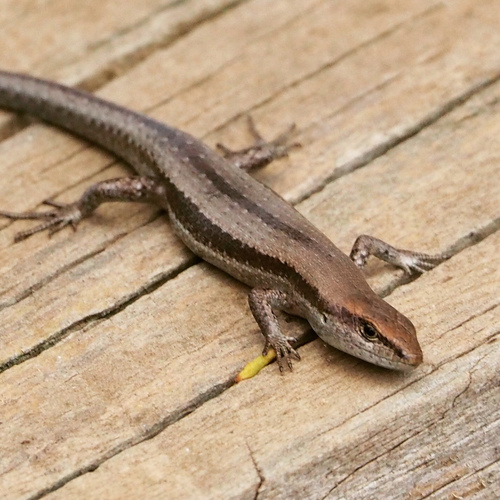
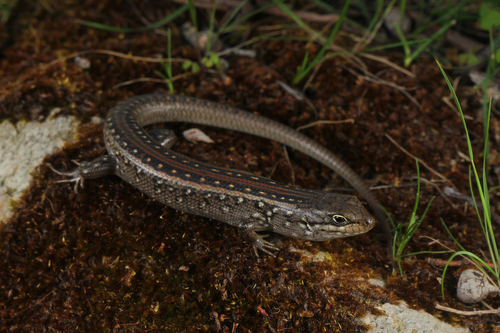
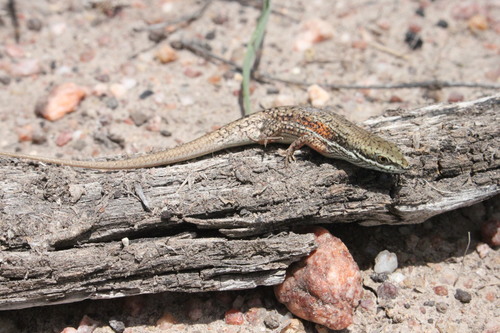
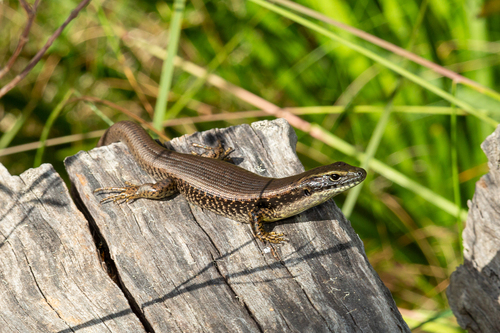
Eulamprus quoyii, also called the Eastern water skink, is a large water skink that reaches approximately 115 millimeters in snout-vent length (SVL). This species has sharply defined, narrow, pale-yellow dorsolateral stripes that run from above the eye down the length of the body, but lacks the black vertebral stripe that is typical of other species in its genus. It has a medium-sized body, a long slender tail, a blackish upper lateral zone marked with pale spots, and a moderately acute head and snout. Each of its two front limbs has five digits, and each of its two back limbs has five toes. The ventral area is cream-colored, with randomly scattered darker spots that vary between individual skinks; the throat is white with dark black patches. The species shows minor sexual dimorphism: females typically have slightly longer snout-vent length, while males have proportionately longer limbs and heads. The difference in average SVL between females and males is not statistically significant, but there are significant shape differences between sexes in both adults and neonates. Adult males usually have shorter trunk length (the distance between the forelimbs and hindlimbs) than females. Males also tend to have longer limbs, wider heads, and greater overall mass than females of this species. As SVL increases, forelimb length, head width, and overall mass increase significantly faster in males than in females; this faster rate of increase does not apply to hindlimbs or trunk length, which grow at the same rate with increasing SVL in both sexes. In neonates, body shape is very similar between sexes, with the exception that female neonates have significantly longer trunk length than male neonates. Within the Eulamprus complex, all species including E. quoyii share several consistent features. Individual skinks have medially separated nasal passages, and do not have supranasal or postnasal scales. They have two subequal loreal scales, a single preocular scale, and a moveable lower scaly eyelid. Throughout the skink’s life, the iris and pupil are both black and cannot be distinguished from one another. The Eastern water skink has three presubocular scales, one of which extends downwards in front of the upper lip and upper jaw scales. All Eulamprus species have two or three subocular scales beneath the eye, and four supraocular scales above the eye; some of the supraocular scales make contact with the frontal scales. Two or three postocular scales sit behind and in contact with the eye, positioned between the posterior supraciliary scale and the parietal eye. The E. quoyii species group shares four derived character states that separate it from other species in the Eulamprus genus. First, it has a third pair of chin shields separated by five smaller scales. Second, both male and female E. quoyii lack the inguinal fat bodies commonly found in other Scincidae species, which gives this species its characteristic slender, elongated appearance. Third, E. quoyii has a single row of distal supradigital scales, while most other related species have two or more rows. Fourth, each lamella on the underside of the toes is grooved and divided at the base. The Eastern Water Skink inhabits creekside areas, estuaries, and areas near small to medium-sized bodies of water, and also occurs in moist urban garden areas along Australia’s East Coast cities. Outside urban areas, population densities of E. quoyii are highest in open, rocky creek areas, compared to creeks or water areas with thick vegetation or cool forest. E. quoyii abundance is directly correlated with areas that have rocky outcroppings and high sunlight availability. E. quoyii selects habitat based on substrate temperature and required thermoregulation factors, not based on the amount of rocky outcroppings or vegetation. As its common name suggests, the Eastern Water Skink occurs along Australia’s temperate east coast. It has been recorded in the Australian Capital Territory, New South Wales, Queensland, South Australia, and Victoria. Millions of years ago, temperate, moist rainforest patches covered a much broader area of Australia’s east coast before arid conditions developed in the mid-Miocene. The contraction, expansion, and fragmentation of these rainforest areas are thought to have shaped the current distribution of E. quoyii, restricting it to specific regions along the east coast. Phylogenetic studies of E. quoyii mtDNA, paired with comparisons of Eastern Australia’s landscape evolution, suggest the species’ current distribution is controlled by biogeographic barriers. Population breaks correspond to areas where the Great Escarpment is absent, indicating that low topographic areas and the surrounding dry forests act as barriers to Eastern Water Skink population movement. For breeding, male and female Eulamprus quoyii mate in spring, and give birth to up to nine live young per clutch in summer. Unlike many other reptile species, the Eastern Water Skink is viviparous, meaning it produces live young after a long gestation period. Because of the long gestation period, female E. quoyii typically only mate once per year. Males fall into two distinct categories: Territorial/Resident males and Floater Males. Resident males are thought to be active over longer periods, and produce clutches with higher offspring yield. Floater males are predicted to have larger home ranges and travel greater distances when active, resulting in fewer clutches and fewer offspring per year. Unlike in many other lizard species, sexual selection in E. quoyii is not thought to be directly correlated with performance and fitness traits such as bite force or speed. Previous research has found a correlation between SVL and sexual selection in E. quoyii. However, because this species uses alternate reproductive tactics (ART), it is possible that specific performance traits are correlated with other unmeasured behavioural, morphological, or physiological traits.