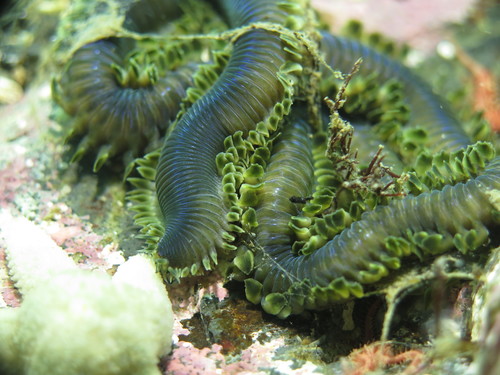
About Eulalia clavigera (Audouin & Milne Edwards, 1833)
Eulalia clavigera (Audouin & Milne Edwards, 1833) is a slender worm that grows to around 10 cm (4 inches) in length. Its prostomium, or head, has a rounded triangular shape and is somewhat wider than it is long. It bears a pair of palps and three antennae, with the central antenna located in front of its large eyes. Its eversible proboscis is covered with scattered small conical papillae. There are four pairs of tentacular cirri on the first to fourth body segments. The parapodia of the body segments bear large, paddle-shaped dorsal cirri that are roughly twice as long as they are broad, while the ventral cirri are oval in shape. This worm is bright green, and sometimes has black spots on the underside of the base of its parapodia. E. clavigera is very similar in appearance to its close relative Eulalia viridis; the main differences between the two species are in the shape and size of the dorsal cirri. Before the 1990s, E. viridis was considered to have a wide range across the northeastern Atlantic, including waters around the United Kingdom. Morphological and biochemical studies later determined that southern populations in this range were actually a separate species, E. clavigera, which forms a species complex with E. viridis. As a result, the full distribution of E. clavigera is not yet well understood, as many literature references to E. viridis may actually misapply to this species. It is confirmed to occur around the coasts of Britain, extending southwards to France and the Iberian Peninsula, and may also be found in the Mediterranean Sea. Its depth range extends from the middle shore to the sublittoral zone. It typically inhabits crevices, under stones, among the holdfasts of large seaweeds, and among mussels and barnacles.

