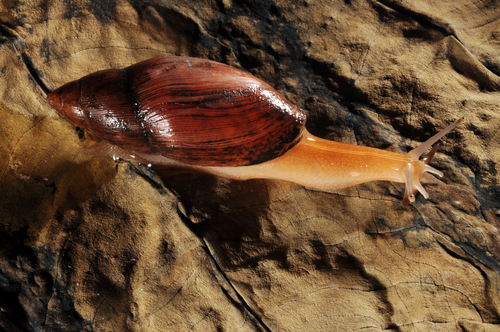
About Euglandina rosea (A.Férussac, 1821)
Euglandina rosea, commonly called the rosy wolfsnail, has an average total lifespan of around 24 months. Eggs take 30 to 40 days to hatch, and newly hatched snails are considered young until they reach sexual maturity. Sexual maturity begins between 4 and 16 months after hatching. This species moves relatively quickly at a speed of approximately 8 mm per second. The snail's body is light grey or brown, and it has long lower tentacles that almost touch the ground. Typical shell dimensions are 76 mm in length and 27.5 mm in diameter. The shell is fusiform, meaning it tapers to a point at both ends, with a narrow opening that ranges from oval to crescent-shaped, and a truncated columella (the shortened axis of the spiral shell near the opening). The shell has a brownish pink color. Full-grown adult rosy wolfsnails range from 7 to 10 cm in total length. The rosy wolfsnail is native to the Southeastern United States, including Florida and Georgia. Other species in the Euglandina genus are native to South and Central America. Individual rosy wolfsnails have also been spotted in Oslo, Norway. In its native range of the Southern United States, this species is most often found in hardwood forests and urban gardens. It is a fast, voracious predator that hunts and eats other snails and slugs. Smaller prey are either ingested whole or the snail sucks the soft body out of the prey's shell, a trait that earned the rosy wolfsnail the common nickname "cannibal snail". Rosy wolfsnails use slime trails to track both prey and potential mates, and they follow these trails more than 80% of the time they are active. The species prefers to eat smaller snails, as they are quicker and easier to consume. The rosy wolfsnail is specialized for carnivory: its entire buccal mass is contained within a beak-like, extendable rostrum. This structure allows the toothed radula to be ejected past the mouth and into the body of prey. The radula is enlarged, with its teeth modified into specialized elongated cones. Four main types of mammalian predators hunt rosy wolfsnails: rats, tenrecs, pigs, and mongooses. Rats eat the snail by chewing the top off the shell. Tenrecs crack the shell into large pieces. Pigs typically crush the shell completely. Mongooses attack the soft body of the snail. Cannibalism among adult rosy wolfsnails has been observed, but it has only been recorded in captive populations and is a rare occurrence. Diseases also impact rosy wolfsnail survival. One known disease affecting the species is caused by the pseudomonad bacterium Aeromonas hydrophila. Infection occurs when the snail ingests bacteria-contaminated food, or through contact with another already infected individual. Infection reduces digestive function, leading to emaciation even when food is abundant, and ultimately causes slow death by starvation. The rosy wolfsnail is a hermaphroditic oviparous species. Courtship begins when one snail follows the slime trail of another. The pursuing snail then mounts the rear side of the other snail's shell. After mounting, the pursuing snail performs a head-waving display, vigorously shaking its head for 15 minutes. This display ends with a short period of inactivity, during which the mounted snail turns its head to face its own shell. Copulation occurs next, while one snail remains mounted on the other's shell. The two heads are brought together and twisted around each other's necks to enable genital contact. Copulation can last up to four hours. An adult rosy wolfsnail lays 25 to 35 eggs in a shallow soil pocket, and eggs hatch after 30 to 40 days of incubation. The species enters hibernation during winter and emerges in April or May.


