About Eugerres plumieri (Cuvier, 1830)
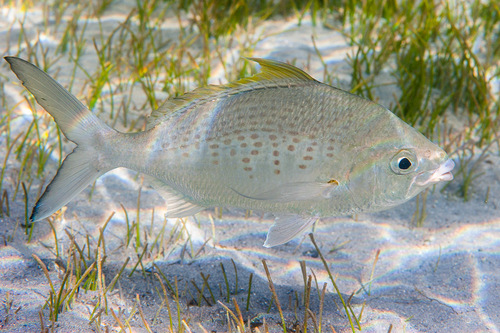
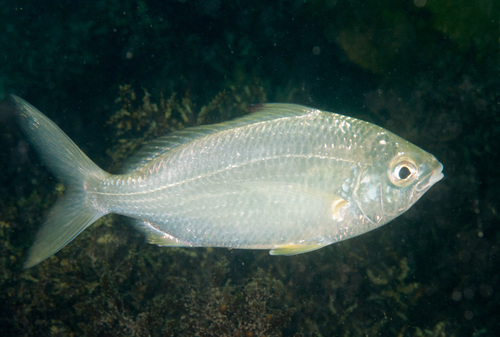
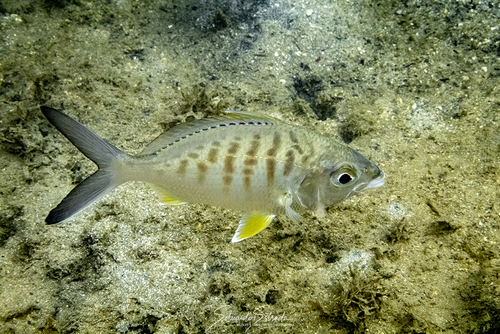
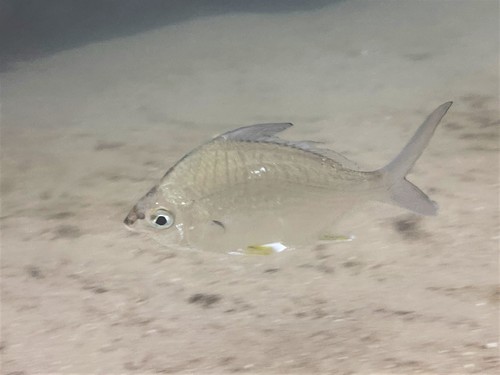
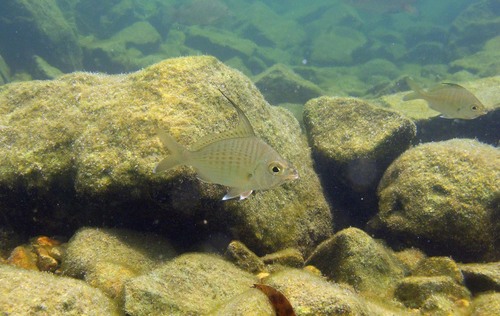
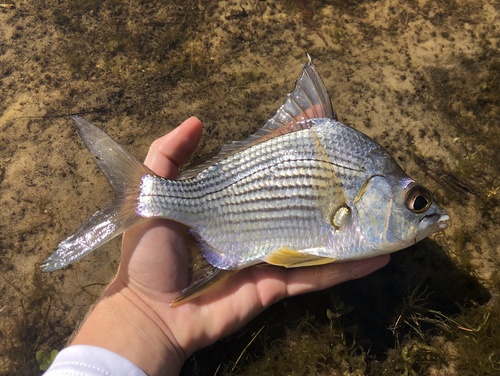
Eugerres plumieri (Cuvier, 1830), commonly called the striped mojarra, has a compressed, rhombus-like body shape that supports efficient movement through its native habitats. Its body is dark olive with a light yellow underbelly, a silver-like overall sheen, and dark stripes at the center of each scale. Its dark grey forked dorsal fin usually has nine spines and ten rays. The light yellow-brown anal fin has three spines and eight rays. The pelvic and pectoral fins match the color of the fish's body. A dark, continuous lateral line runs from the gills to the caudal fin, with 32 to 38 scales along this line. Recorded lengths for this species range from a minimum of around 4.8 centimetres (1.9 in) to a maximum of 28 cm (11 in), and individuals weigh between 1.5–279.5 grams (0.053–9.859 oz). It has a pointed mouth and a protrusible jaw, giving the appearance of having a mouth inside a mouth. While teeth are not visible externally, it has small brush-like teeth, with molar-like teeth at the back of the mouth that it uses to crush the shells of the benthic invertebrates it feeds on. The striped mojarra is a euryhaline organism, meaning it can tolerate a wide range of salinity levels. This tolerance lets it live in coastal waters, mangrove creeks, and lagoons, and it is most commonly found in brackish waters. Its native range extends along the south coast of the United States from South Carolina down to western Florida, and continues from the Gulf of Mexico south to Brazil. It stays near the water bottom where it feeds on benthic invertebrates. During the dry season (January and February), these fish aggregate in rivers and canal outlets, where food and refuge are more accessible. During the wet season (September through November), they typically aggregate closer to the Caribbean Sea. Striped mojarra are oviparous: females lay eggs that are fertilized by milt from males. This species has high fecundity, with females producing between 85,345 and 953,870 eggs. They are annual spawners with a main spawning season running from May to July, and carry out a partial spawn during the Western Atlantic rainy season from September through November. They reach sexual maturity at around 20 centimetres (7.9 in) in length, and peak maturity occurs during the dry season from January to February. A 2022 study of striped mojarra suggests the species displays sexual dimorphism during spawning season, creating a visible difference between males and females. During spawning periods, males are smaller than females. Males also show solid black coloration across their dorsal fins and posterior bodies, while females have lighter overall coloration.