About Eugenes fulgens (Swainson, 1827)
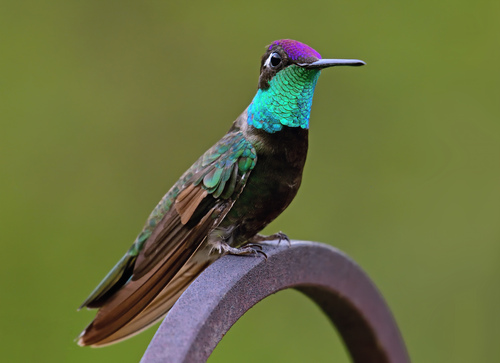
Rivoli's hummingbird, scientifically named Eugenes fulgens (Swainson, 1827), measures 11 to 14 cm (4.3 to 5.5 in) in length and weighs 6 to 10 g (0.21 to 0.35 oz), with males usually slightly larger than females. It has a wingspan of 18 centimetres (7.1 in). Among hummingbird species found in the United States, Rivoli's hummingbird is one of the two largest, with only the blue-throated hummingbird matching its size. Its black bill is long, and ranges from straight to slightly decurved. Both sexes appear very dark unless sunlight hits the plumage's iridescence, making bright colors visible in the light. For most of the year, this species wears the "definitive basic" breeding plumage described below. It has a protracted molt between this breeding plumage and a duller non-breeding plumage. Minor clinal variations exist in bill length and the color of the vent area. Adult males are green-bronze on their dorsal side, with more bronzing on the black-tipped tail. The crown is violet, the throat gorget is bright blue-green, and the rest of the head is black aside from a white spot behind the eye. The chest is green-bronze, and the belly is grayish. Females are bronze-green dorsally, with dull gray ventral coloring. They have a white stripe behind the eye. Immature birds resemble females, but are darker and browner. This hummingbird breeds in mountain habitats from the southwestern United States to Honduras and Nicaragua. It lives in the interior, edges, and clearings of pine-oak forest and cloudforest from roughly 1,500 m (4,900 ft) up to the timberline, as well as in more open secondary forest and some grasslands. It regularly visits bird feeders.