About Eudyptula minor (J.R.Forster, 1781)
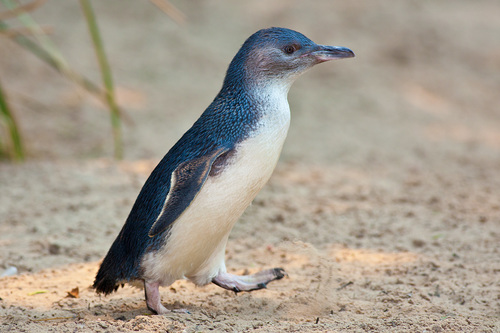
Like all penguins, species in the Eudyptula genus have wings that have evolved into flippers adapted for swimming. Members of this genus typically reach 30 to 33 cm (12 to 13 in) in height and weigh an average of 1.5 kg (3.3 lb). Their head and upper body are blue, with slate-grey ear coverts that fade to white from the chin down to the belly. Their flippers are also blue. They have a dark grey-black beak 3–4 cm long, pale silvery-grey, bluish-grey, or hazel irises, and pink upper feet with black soles and webbing. Immature individuals have shorter bills and lighter-coloured upperparts. Like most seabirds, Eudyptula species have long lifespans: the species average is 6.5 years, but flipper ringing experiments show that in very rare cases, they can live up to 25 years in captivity. Eudyptula minor lacks the distinct bright blue feathers that distinguish Eudyptula novaehollandiae (Australian little penguin). Additionally, vocalization patterns differ between the New Zealand lineage of Eudyptula minor on Tiritiri Matangi Island and the Australian lineage located in Oamaru, and females are known to prefer the local call of the New Zealand lineage. There are also behavioural differences that help distinguish these penguins. Australian lineage penguins swim together in large groups after dusk and walk along the shore to reach their nesting sites; this is likely an effective predator avoidance strategy from traveling in a large group at the same time, and this behaviour has not been observed in the New Zealand lineage. Eudyptula minor has only recently encountered terrestrial vertebrate predators, while Eudyptula novaehollandiae evolved alongside carnivorous marsupials. Australian Eudyptula novaehollandiae also practice double brooding: after their first clutch of eggs has successfully fledged, they lay a second clutch to try to increase their reproductive success. This behaviour may also occur in response to increasing sea surface temperatures and changing available food sources, and double brooding has never been observed in New Zealand Eudyptula minor. Distribution and habitat: Australian little penguins are native to southern Australia. This species also colonized the Otago region of New Zealand after the endemic species Eudyptula minor underwent a human-caused population decline. Records of tagged or banded birds that were later recaptured or found dead show that individual penguins can travel very long distances over their lifetimes. In 1984, a penguin tagged at Gabo Island in eastern Victoria was found dead at Victor Harbor in South Australia. In 1970, another little penguin was found near Adelaide, after being tagged the previous year at Phillip Island in Victoria. In 1996, a banded penguin that had been banded in 1991 at Troubridge Island in Gulf St Vincent, South Australia was found dead at Middleton. Compared to flying seabirds, the foraging range of Australian little penguins is quite limited in distance from shore. Habitat restoration: Multiple habitat restoration efforts have been carried out to improve breeding sites for Australian little penguins on Kangaroo Island, including adding artificial burrows to augment available habitat and conducting revegetation work. Knox School's habitat restoration efforts were filmed and broadcast in 2008 by the program Totally Wild. In 2019, concrete nesting "huts" were built for the little penguins of Lion Island, located at the mouth of the Hawkesbury River in New South Wales, Australia. The island had been damaged by a lightning-started fire that destroyed 85% of the penguins' natural habitat. Weed control carried out by the Friends of Five Islands in New South Wales helps improve breeding success prospects for seabirds including the little penguin. The main problematic weed species on the Five Islands are kikuyu grass and coastal morning glory. The weeding work has led to an increase in the number of little penguin burrows in the treated areas, and allowed the white-faced storm petrel to return to breed on the island after a 56-year breeding absence. Reproduction: Australian little penguins reach sexual maturity at different ages: females mature at two years old, and males mature at three years old. Between June and August, males return to shore to renovate existing burrows or dig new burrows, and perform courtship displays to attract a mate for the breeding season. Males compete for mates through these displays. Breeding happens annually, but the timing and duration of the breeding season varies between locations and between years. Breeding occurs during spring and summer, when oceans are most productive and food is plentiful. Australian little penguins stay faithful to their partner during the breeding season and while hatching eggs. At other times of the year, they generally switch burrows. They show site fidelity to their nesting colonies and nesting sites across successive years. Little penguins can breed as isolated pairs, in full colonies, or semi-colonially.