About Eudyptes robustus Oliver, 1953
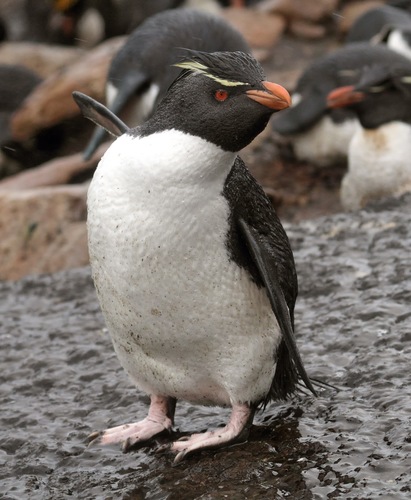
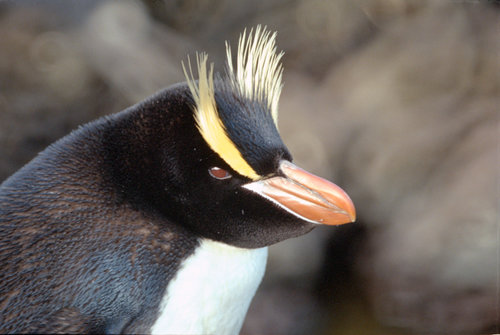
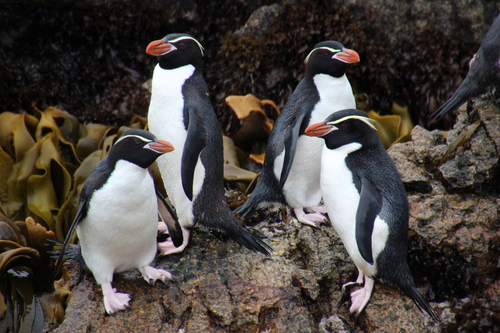
The Snares penguin (Eudyptes robustus) is a member of the crested penguin genus Eudyptes, and is closely related to the Fiordland penguin (Eudyptes pachyrhynchus). It can be distinguished from Fiordland penguins by a patch of bare skin at the base of its beak. This species has similar coloration to many other penguins: it has a black head, back, and flippers, paired with a white belly. A bright yellow crest starts at the base of its bill, runs along the upper sides of the head, and ends at the back of the head. It has a thick reddish-brown bill, with pale pink skin along the base of the bill. Its eyes are typically a bright red-brown, though this color can vary a bit between individual penguins and under different lighting conditions. Underwing color patterns differ between individuals, so this trait cannot be used reliably to identify the species. Snares penguins produce a wide range of vocal sounds, which are hard to describe in words; these sounds include hisses and explosive cries when the penguin feels threatened, as well as rhythmic braying and trumpeting calls that can be heard from far away out at sea. The Snares penguin gets its name from its primary breeding location, the Snares Islands — a small island group off the coast of southern New Zealand. Little is known about their range and migration outside of the breeding season, but researchers do not believe they travel far during the winter. Occasional sightings of the species have been recorded on the coasts of Tasmania, southern Australia, the Chatham Islands, Stewart Island, and the southern New Zealand mainland. Currently, there are approximately 25,000 living breeding pairs of Snares penguins. Snares penguins build nests and breed in dense colonies, located either under the tree cover of Olearia forests or on coastal rocks. To make their nests, penguins dig shallow holes in the ground, line the base with grass, leaves, twigs, peat, or pebbles, and add a small rim of mud around the edge to raise the nest above ground level. Dense nesting activity kills vegetation at the site over time, so colonies move to new nesting areas periodically. Colonies located near streams get the benefit of a nearby source of water for drinking and bathing, but proximity to a stream is not required for nesting, and many colonies are located far from any running water. The foraging patterns of breeding Snares penguins follow a clear, consistent schedule. After both parents share incubation duties, males leave on two-week-long foraging trips that are synchronized with spring plankton blooms, which are reliable predictors of abundant food. When the males return, females leave on shorter foraging trips that last less than a week, and return just before the chicks hatch. During the chick guard stage, the female is the sole provider of food for the chicks, making short foraging trips that only take one to three days. Males on long foraging trips can dive as deep as 120 meters to catch prey, while birds feeding chicks usually use shallow pursuit diving, with average dive depths between 20 and 40 meters.