About Eudyptes moseleyi Mathews & Iredale, 1921
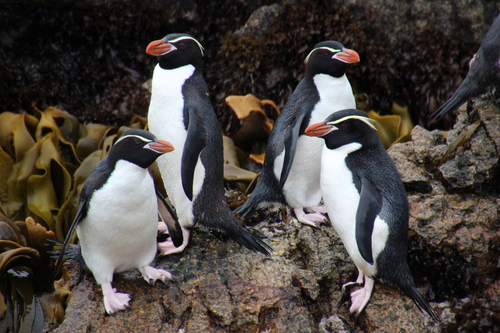
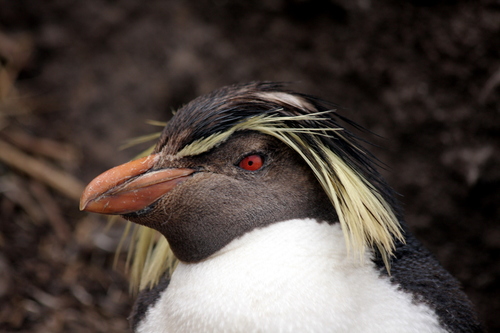
Genetic variation and morphology: In 1992, the rockhopper penguin (Eudyptes chrysocome) was divided into three distinct subspecies: southern rockhopper penguin (E. c. chrysocome), eastern rockhopper penguin (E. c. filholi), and northern rockhopper penguin (E. c. moseleyi, which has the scientific name Eudyptes moseleyi Mathews & Iredale, 1921). The three subspecies can be distinguished by several physical differences: the length of their crest tassels, the size and color of the fleshy margin of the gape, the color pattern on the underside of the flipper, and the size of the superciliary stripe in front of the eye. Additionally, the northern rockhopper penguin is larger than the other two subspecies. Evidence confirming that the three subspecies were truly distinct, beyond just reproductive isolation and some morphological features, was found in mitochondrial sequence analysis. This analysis showed that E. c. filholi and E. c. chrysocome are genetically less different from each other than E. c. moseleyi is from either of the other two subspecies. The level of genetic differentiation between these subspecies matches the level of genetic difference seen in other penguin subspecies groups. Scientists also can distinguish the different rockhopper penguin subspecies by the parasitic chewing lice that feed on each group. Penguins are parasitized by 15 species of chewing lice from two genera: Austrogoniodes, and the monotypic genus Nesiotinus. Among rockhopper penguins, the host-specific louse Austrogoniodes keleri only occurs on southern rockhoppers; the multi-host louse Austrogoniodes concii only parasitizes northern rockhoppers; and Austrogoniodes hamiltoni only parasitizes eastern rockhoppers. Natural cross-contamination of lice between subspecies is not possible. Chewing lice have limited mobility and depend heavily on their host for survival, so they can only be transmitted between species through close physical contact. Distribution and habitat: More than 99% of northern rockhopper penguins breed in late spring or early summer on Tristan da Cunha and Gough Island, located in the south Atlantic Ocean. Smaller breeding colonies are also found on Amsterdam Island and St Paul Island, which are part of the French Southern and Antarctic Lands. Landings on the Australian continent are extremely rare for this bird, but a northern rockhopper was sighted at Robe, South Australia in 2006, and an underweight individual was found at Goolwa Beach, South Australia in July 2023. Reproduction: This species breeds in colonies, at locations ranging from sea level and cliff sides to sometimes inland areas. The northern population found on Amsterdam Island and Gough Island is reproductively isolated from populations on Crozet and Kerguelen islands. Northern rockhopper penguins are monophyletic, meaning their split from southern rockhopper penguins forms two distinct clades in mitochondrial DNA trees. The northern and southern subspecies also differ in their mating rituals: they use different songs and different head ornaments in their mating signals. Reproductive isolation has led to both physical and behavioral differences between the groups. Adult northern rockhopper penguins feed their chicks prey from a lower trophic level than the prey the adults consume themselves. During breeding season, adults first eat zooplankton, then transition to eating fish later, which shows they prioritize the success of future reproduction. Food and feeding: The northern rockhopper penguin feeds on krill and other marine life including crustaceans, squid, octopus, and fish.