About Eudyptes chrysolophus (Brandt, 1837)
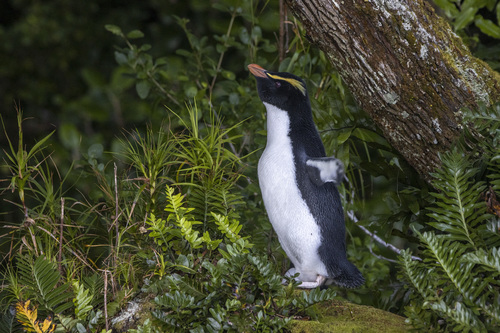
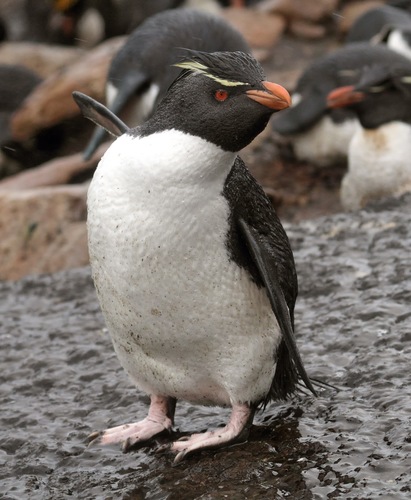
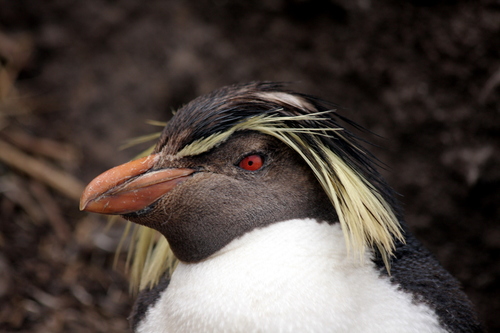
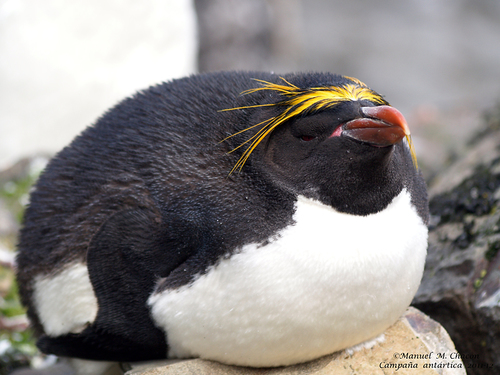
The macaroni penguin (Eudyptes chrysolophus) is a large crested penguin, sharing a similar appearance with other members of the genus Eudyptes. Adult macaroni penguins have an average length of around 70 cm (28 in). Their weight varies noticeably based on season and sex. After incubation, males average 3.3 kg (7 lb); after moult, they average 3.7 kg (8 lb), and they reach up to 6.4 kg (14 lb) before moult. For females, weight ranges from an average of 3.2 kg (7 lb) after incubation or moult to 5.7 kg (13 lb) before moult. Among standard body measurements, the thick bill measured from the gape is 7 to 8 cm (2.8 to 3.1 in), while the culmen is approximately one centimeter shorter. The wing, measured from shoulder to tip, averages around 20.4 cm (8.0 in), and the tail is 9–10 cm (3.5–3.9 in) long. The head, chin, throat, and upper body are black, with a sharp border separating these areas from the white underparts. Fresh black plumage has a bluish sheen, while older black plumage becomes brownish. The species' most distinctive feature is a yellow crest that starts from a patch on the center of the forehead and extends horizontally backward to the nape. The upper surface of the flippers is blue-black with a white trailing edge; the underside is mostly white, with a black tip and black leading edge. The large, bulbous bill is orange-brown. The iris is red, and a patch of pinkish bare skin extends from the base of the bill to the eye. The legs and feet are pink. Males and females have similar plumage, but males are usually slightly larger, and have relatively larger bills on average: male bills average around 6.1 cm (2.4 in), compared to 5.4 cm (2.1 in) for females. This bill size difference is commonly used to distinguish between the sexes. Immature macaroni penguins can be identified by their smaller overall size, smaller duller-brown bills, dark grey chin and throat, and absent or underdeveloped head plumes, which often only appear as a scattering of yellow feathers. The crest becomes fully developed when birds are three to four years old, which is one to two years before they reach breeding age. Macaroni penguins moult once a year, replacing all of their old feathers during this process. They spend around two weeks building up fat stores before moulting, because they cannot feed during the moult—they cannot enter the water to forage without intact feathers. The moult process typically takes three to four weeks, which the penguins spend resting on shore. Once moulting is complete, they return to the sea, and come back to their colonies to mate in the spring. Overall species-wide survival rates are not well understood. Over three years of study, the successful return rate of breeding adult macaroni penguins at South Georgia Island ranged between 49% and 78%, and around 10% of the penguins that did return did not breed in the following year. A 1993 review estimated that the macaroni penguin is the most abundant penguin species, with a minimum of 11,841,600 breeding pairs worldwide. Macaroni penguins have a range extending from the Subantarctic region to the Antarctic Peninsula. At least 216 breeding colonies across 50 sites have been recorded. In South America, macaroni penguins are found in southern Chile, the Falkland Islands, South Georgia and the South Sandwich Islands, and the South Orkney Islands. They also occupy much of Antarctica and the Antarctic Peninsula, including the northern South Shetland Islands, Bouvet Island, the Prince Edward and Marion islands, the Crozet Islands, the Kerguelen Islands, and the Heard and McDonald Islands. While foraging for food, groups will range as far north as the islands off the coasts of Australia, New Zealand, southern Brazil, Tristan da Cunha, and South Africa.