About Eudynamys scolopaceus (Linnaeus, 1758)
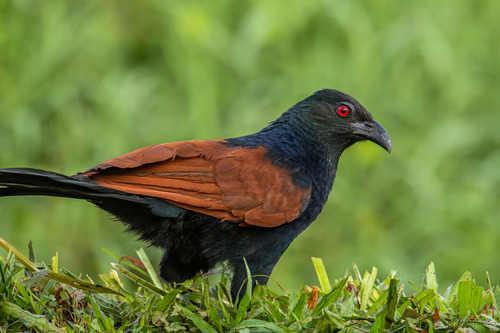
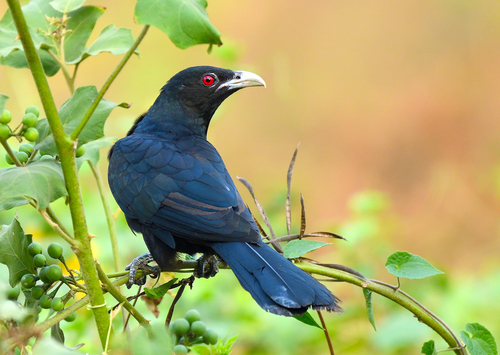
The Asian koel (Eudynamys scolopaceus) is a large, long-tailed cuckoo species. It measures 39–46 cm (15–18 in) in length and weighs 190–327 g (6.7–11.5 oz). Male nominate race individuals have glossy bluish-black plumage, a pale greenish grey bill, crimson irises, and grey legs and feet. Female nominate race individuals have brownish crowns with rufous streaks on the head; their back, rump, and wing coverts are dark brown marked with white and buff spots, while their whitish underparts are heavily striped. Other subspecies differ in both size and colouration. Juvenile Asian koels have upper plumage that more closely resembles that of adult males, and they have a black beak. Asian koels are very vocal during the breeding season, which runs from March to August in the Indian Subcontinent, and produce a range of different calls. The familiar song of the male is a repeated koo-Ooo, while the female makes a shrill kik-kik-kik... call. Calls vary between different populations of the species. This species has a moult pattern that differs from that of other parasitic cuckoos. For the outer primary feathers, moult follows a transilient (alternating) ascending sequence: P9-7-5-10-8-6. The inner primary feathers are moulted in a stepwise descending order: 1-2-3-4, as cited by Payne from Stresemann and Stresemann 1961. Asian koels inhabit light woodland and cultivation areas. They are mainly resident breeders across tropical southern Asia, ranging from Iran, Pakistan, India, Bangladesh, the Maldives, and Sri Lanka east to southern China and the Greater Sundas. The species has a high potential to colonize new areas, and was among the first pioneer bird species to colonize the volcanic island of Krakatau. It first arrived in Singapore in the 1980s, and has since become a very common bird there. Some populations undertake long-distance movements, and individuals have been found as far away as Australia.