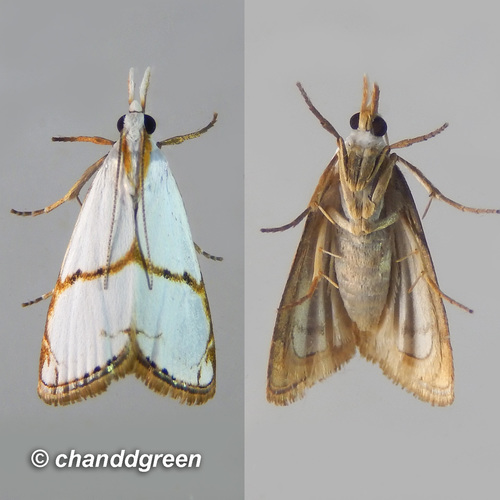
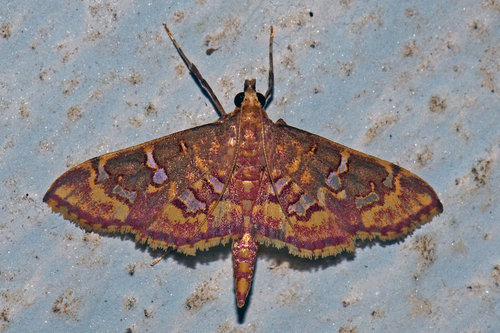
About Eudonia philerga
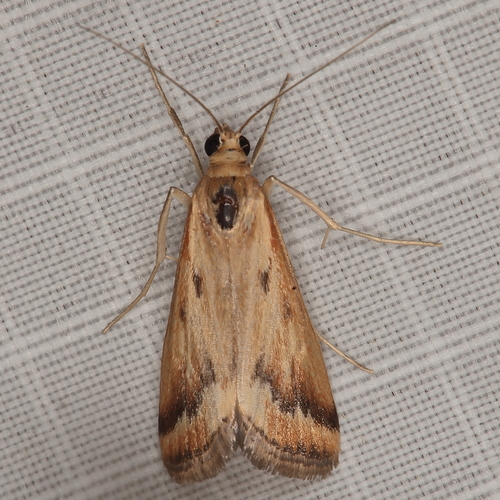
Eudonia philerga larvae are approximately 1⁄2 inch long, dull dark green in color, and have reddish brown heads. They also have large blackish green protuberances. Their coloration works as excellent camouflage, making it hard to spot stationary larvae among their host plant. The pupa develops inside moss, enclosed within a thin cocoon. G. V. Hudson described the adult of the species in the following terms: The wingspan of the adult is slightly over 3⁄4 inch. The forewings are rather narrow, dull white, and covered with black speckles and indistinct black markings. There is a short, thick black streak at the base of the forewings; the first line marking is white, with faint black edging towards the termen. The orbicular and claviform markings form an indistinct black patch. The reniform marking is 8-shaped, white with black edging, and touches a small black mark on the costa. The second line marking is white, distinct, and edged with black. The terminal area is black, except for the sub-terminal line, which is often broken and frequently meets the second line near the middle of the wing. A terminal row of white dots runs along the edge of the forewing. The hindwings are pale yellowish-white, with strong grey shading towards the termen. The cilia on all wings are dull white with a darker central line. Hudson observed that the adult moth's coloration also provides excellent camouflage when the moth rests on trees or rocks, protecting it from predators. This species is endemic to New Zealand, found across the entire country, and considered a common species.