About Eudonia diphtheralis
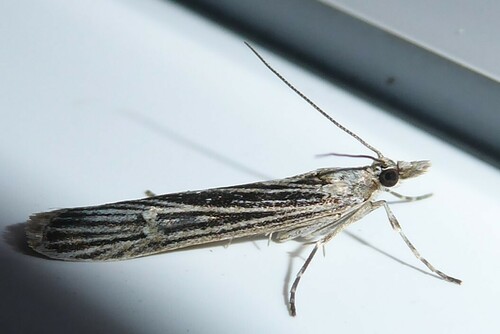
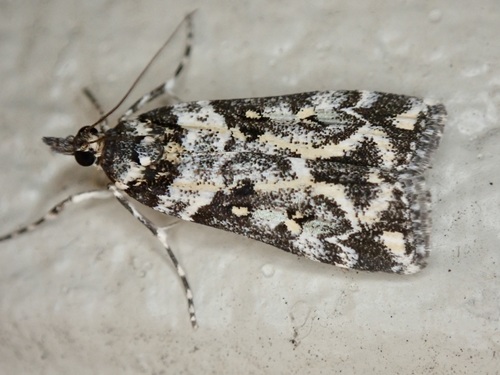
This description of Eudonia diphtheralis was originally published by Edward Meyrick in 1884. Both males and females have a wingspan of 23–26 mm. The head is pale ochreous, and the face is black. The palpi measure 2+1⁄4 units in length; they are black mixed with white, with a white basal joint. The antennae are black, and ochreous-whitish on their underside. The thorax is white, with black suffusion across its anterior half, a square central spot, and its posterior extremity. The abdomen is whitish-ochreous, lightly sprinkled with grey, and segmental margins become more ochreous towards the base. The legs are white, thinly sprinkled with black, with black bands on the tibiae and tarsi. Forewings are elongate triangular, with a barely arched costa, rounded apex, and a sinuate, slightly oblique hindmargin. They are white, irregularly sprinkled with black scales that are ochreous at their base. A triangular blackish spot sits on the costa at the base; its apex extends outward to form a smaller spot, but does not quite reach the inner margin. Below this spot, the inner margin is whitish-ochreous. A broad, cloudy white line runs close to the first line, and is more or less confluent with it above. The first line is broad, cloudy, white, oblique, barely curved, and somewhat irregular, with a blackish margin along its posterior edge that forms a cloudy triangular blackish spot toward the costa. A pale ochreous-yellowish streak runs along the submedian fold from the basal spot to the anal blotch. The orbicular spot is roughly round, whitish-ochreous, with a broad black margin, and detached. The claviform spot is small, oblique, black, sometimes pale-centered, and detached. The reniform spot is 8-shaped, whitish-ochreous, black-margined, and connected to the costa by a small blackish spot; a whitish suffusion fills the area between this spot and the second line. The space between the orbicular and reniform spots, and the space between the reniform spot and the second line, are covered with uniquely appressed brassy prismatic scales that give the appearance of being transparent. The second line is broad, white, and blackish-margined. The entire terminal space is suffused with black. The subterminal line is broad and white, more or less pale ochreous-yellowish on the veins, and is generally interrupted above the middle; the apex of the lower portion of the line touches the second line. A row of white dots runs along the hindmargin. The cilia are grey, with two darker lines; the basal third is lightly barred with whitish, and the tips are whitish. Hindwings have a ratio measurement of 1+1⁄2, are whitish-ochreous, and partially sprinkled with grey. The lunule, postmedian line, and a fairly distinct hindmarginal band are rather dark grey. The cilia are ochreous-whitish, with two dark grey lines. This is a distinct species that differs from all other known species by the unique prismatic-scaled areas before and after the reniform spot. Specimens have been collected from Hamilton, Palmerston, Napier, Wellington, Christchurch, and Otira Gorge, active from December to March, usually found close to forest. It is common where it occurs, but Meyrick never collected specimens except at lamps, and all of his captured specimens were female. He personally saw only one male, collected by Mr. R. W. Fereday, alongside approximately sixty females.