About Eudocimus ruber (Linnaeus, 1758)
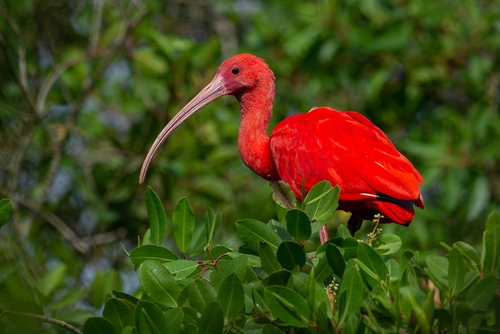
Description: The adult scarlet ibis (Eudocimus ruber) has plumage that is almost entirely scarlet. While individual feathers can show a range of tints and shades, only the wingtips differ from this signature red color. This small, consistent marking—rich inky black, or occasionally dark blue—appears only on the longest primary flight feathers; the rest of the bird’s coloration is a vivid orange-red with an almost luminous quality. Scarlet ibises have red bills and feet, though the bill is sometimes blackish, particularly near the tip. They have a long, narrow, decurved (downward-curving) bill, with long legs and a neck that stays fully extended during flight. Juvenile scarlet ibises have a mixed plumage of grey, brown, and white. As they mature, the scarlet adult coloration develops from a heavy diet of red crustaceans. This color change begins with the juvenile’s second moult, around the time it first starts to fly. It starts on the back, spreads gradually across the body, and increases in intensity over a period of about two years. The scarlet ibis is the only red-colored wading bird in the world. Adult scarlet ibises measure 55 to 63 centimetres (22 to 25 inches) in total length. Males are slightly larger than females, typically weighing around 1.4 kilograms (3.1 pounds), and their bills average roughly 22% longer than female bills. In the wild, the scarlet ibis has a life span of approximately sixteen years, while captive individuals live around twenty years. The wingspan of an adult scarlet ibis is about 54 centimetres (21 inches). Though the species spends most of its time walking or wading through water, it is a very strong flyer. It is highly migratory and fully capable of long-distance flight, and flocks travel in a classic V formation. Distribution and habitat: The scarlet ibis has an extremely large range, with breeding colonies found across extensive areas of South America and the Caribbean islands. Native populations occur in Brazil, Colombia, French Guiana, Guyana, Suriname, Venezuela, the Netherlands Antilles, and Trinidad and Tobago. Flocks congregate in wetlands and other marshy habitats, including mud flats, shorelines, and rainforest. Outlying colonies have been recorded in coastal areas of the Brazilian states of Espírito Santo, Rio de Janeiro, São Paulo (including the Santos-Cubatão mangroves of the Baixada Santista district), Paraná, and Santa Catarina. In recent years, colonies have been observed as far south as the coastal areas of Joinville and the island of São Francisco do Sul in Brazil. The highest concentrations of scarlet ibis are found in the Llanos region of western Venezuela and eastern Colombia. The fertile, remote tropical grassland plain of the Llanos provides a safe habitat far from human encroachment. Alongside its relative the bare-faced ibis, the scarlet ibis is remarkably prolific and easily observed in this region. Vagrant scarlet ibises have been recorded in Belize, Ecuador, Panama, Aruba, Cuba, Dominica, Grenada, Jamaica, and even the United States. The species may have occurred as a natural vagrant along the U.S. Gulf Coast in the 19th century or earlier; in *The Birds of America*, John James Audubon briefly noted three E. ruber specimens he encountered in Louisiana. However, almost all modern records of the species in North America involve introduced or escaped captive birds. A well-documented example from 1962 saw scarlet ibis eggs placed in white ibis nests in Florida’s Greynolds Park; the resulting population hybridized easily, producing "pink ibises" that are still occasionally seen.