About Eucryphia cordifolia Cav.
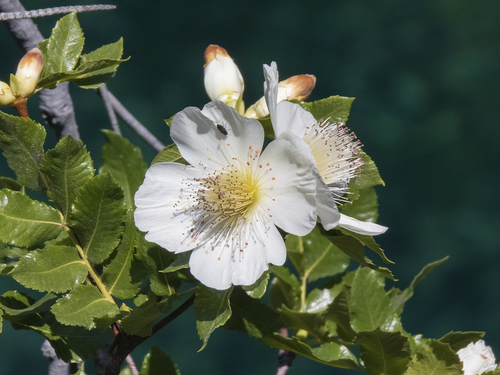
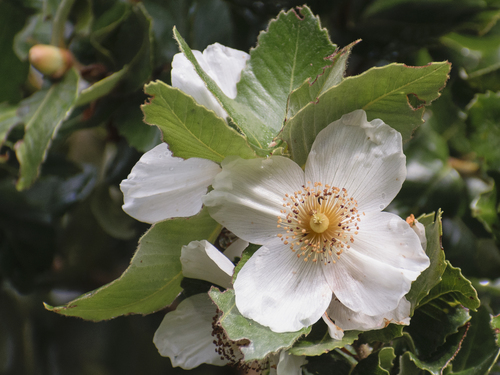
Eucryphia cordifolia Cav., commonly known as ulmo, is a tree species belonging to the family Cunoniaceae. It is native to Chile and Argentina, and grows naturally along the Andes Range between 38°S and 43°S, at elevations up to 700 meters (2300 ft) above sea level. This species is currently threatened by logging and habitat loss. E. cordifolia is an attractive tree with a thick trunk and broad crown, and mature individuals can grow over 12 m (39 ft) in height. It blooms between February and March, with flowering timing varying based on latitude and altitude. Its fruit is a capsule that reaches about 1.5 cm (0.6 in) in length. Its flowers produce aromatic nectar that is highly valued. Introduced European bees harvest this nectar, which is used to produce commercially sold ulmo honey (miel de Ulmo). The tree’s wood ranges from light brown to brown; it is heavy, moderately firm, rather hard, and quite resistant to decay. Locally, the wood is used for construction, and it is also very widely harvested for use as firewood. In cultivation, E. cordifolia grows well on the western coast of Scotland in the United Kingdom, where several notable specimens grow. One cultivated example at Inverewe Garden is possibly the most northerly cultivated individual of this species. The tree does not tolerate cold winters. It can also be found growing in cultivation in southern England, on the island of Ireland, and has been planted on the North Pacific Coast of the United States.