About Eucrossorhinus dasypogon (Bleeker, 1867)
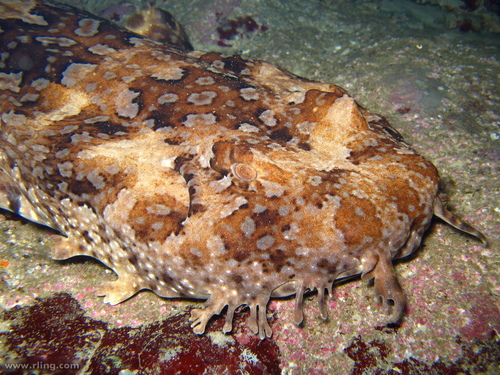
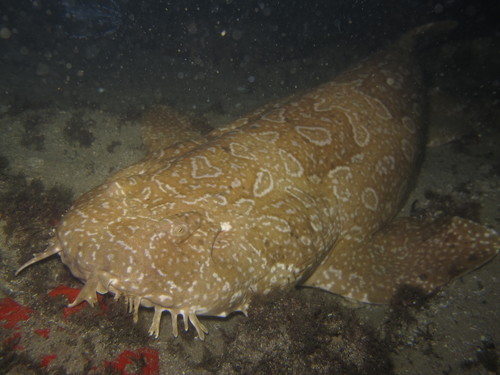
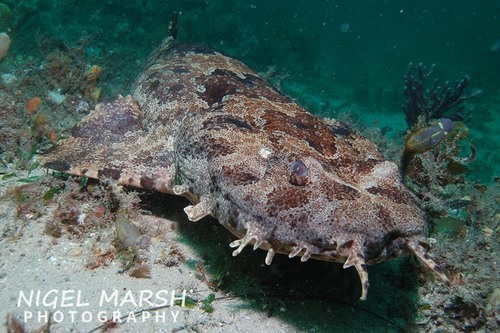
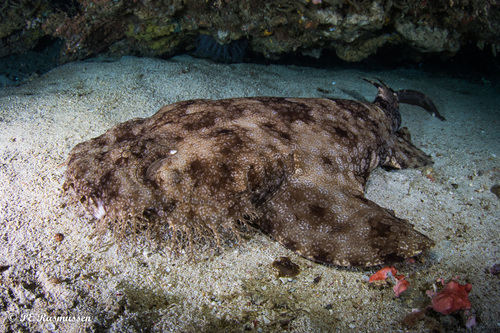
The tasselled wobbegong (Eucrossorhinus dasypogon) is a very broad, moderately flattened shark. Its head is wider than it is long, and has a distinctive fringe of branching dermal lobes that runs almost continuously from the tip of the snout to the origins of the pectoral fins, including a beard-like structure on the chin. Its nostrils have long, branching barbels, and grooves that surround the nostrils and connect them to the mouth. Tubercles are present above the eyes but not on any other part of the body, and larger spiracles sit behind the eyes. The large mouth is positioned ahead of the eyes, almost at the very end of the head. Furrows run along the lower jaw, extending out from the corners of the mouth and along the jaw’s midline. There are 23 to 26 upper tooth rows and 19 lower tooth rows; each tooth has a single slender, pointed cusp. The three upper and two lower rows of central symphysial teeth are especially long and fang-like. The five pairs of gill slits on this species are short. Its pectoral and pelvic fins are large and rounded. The dorsal fins have short bases and are fairly tall; the first dorsal fin is slightly larger than the second, and originates over the latter quarter of the pelvic fin bases. Behind the pelvic fins, the body tapers rapidly to a short caudal peduncle. The anal fin originates behind the midpoint of the second dorsal fin, and grows to no more than half the size of the second dorsal fin. The caudal fin is short, lacks a lower lobe, and its upper lobe has a strong ventral notch near the tip. This species has a mosaic-like dorsal color pattern made of many small, dark blotches and lines over a gray- or yellow-brown background; darker bands may also be present. The pattern extends onto the underside of the tail, and the ventral margins of the pectoral and pelvic fins. The rest of the shark’s ventral surface is white. The maximum confirmed length of a tasselled wobbegong is 1.8 m (5.9 ft); most authors consider an older record of a 3.7 m (12 ft) individual to be incorrect. The tasselled wobbegong’s range covers the northern Australian continental shelf from Ningaloo Reef in the west to Bundaberg in the east, and also includes New Guinea, Waigeo, and the Aru Islands. Additional reported sightings from Malaysia have not been confirmed. This common bottom-dwelling shark lives in coral reefs, possibly exclusively, found in both inshore and offshore waters from the intertidal zone to around 50 m (160 ft) deep. It is most often found in reef channels and reef faces, or on top of coral heads. Considered the most specialized member of its family, the tasselled wobbegong’s ornate coloration and complex dermal fringe give it excellent camouflage, and it is likely a slower swimmer than other related species. It is solitary, and spends most of the day lying motionless inside caves or under ledges with its tail curled. Individual tasselled wobbegongs have small home ranges that contain several preferred resting spots, which are used repeatedly. This species becomes more active at night, when it swims out onto the reef to hunt. The tasselled wobbegong feeds on bony and cartilaginous fishes, crustaceans, and cephalopods. Its large mouth allows it to swallow sizeable prey; there is one documented record of a 1.3 m (4.3 ft) long individual consuming a 1.0 m (3.3 ft) long brownbanded bamboo shark (Chiloscyllium punctatum). During the daytime, this species is an opportunistic ambush predator. It preys on schooling nocturnal fishes such as squirrelfishes, soldierfishes, and sweepers, which often shelter in the same cave. Tiny fishes and crustaceans will sometimes settle on the head of a resting wobbegong, attracting larger fishes that the wobbegong then attacks. Observations of tasselled wobbegongs in captivity have also shown that this species appears to engage in active luring behavior. When it detects food nearby, it begins to slowly wave its tail back and forth; its caudal fin resembles a small fish, and even has a dark eyespot at its base. The shark typically rests with its head elevated, which puts it within striking distance of any prey drawn in by its luring tail. The tapeworm Parachristianella monomegacantha is a known parasite of the tasselled wobbegong. This species has been observed being cleaned by cleaner shrimp (Leander urocaridella, Stenopus hispidus) and bluestreak cleaner wrasse (Labroides dimidiatus). Like other wobbegongs, the tasselled wobbegong is thought to reproduce through aplacental viviparous, where developing embryos are sustained by yolk. There is one recorded observation of mating occurring inside a cave at night. Newborn tasselled wobbegongs measure approximately 20 cm (7.9 in) long. The size at which this species reaches sexual maturity is not certain; one recorded male was found to be sexually mature at 1.2 m (3.9 ft) long.