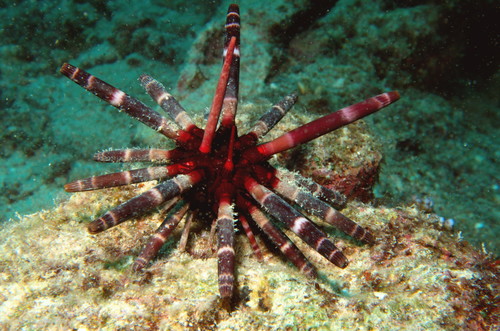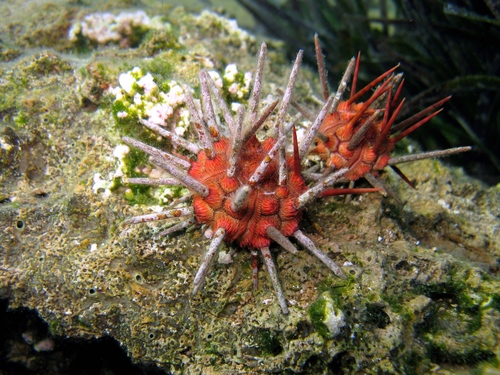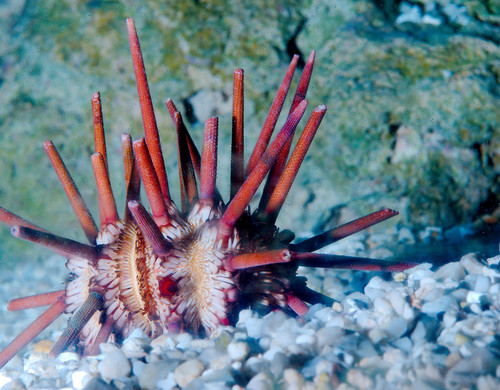
About Eucidaris tribuloides (Lamarck, 1816)
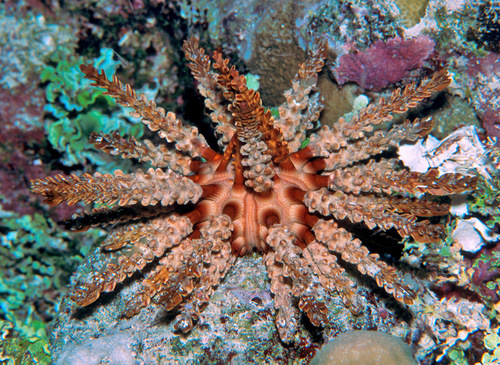
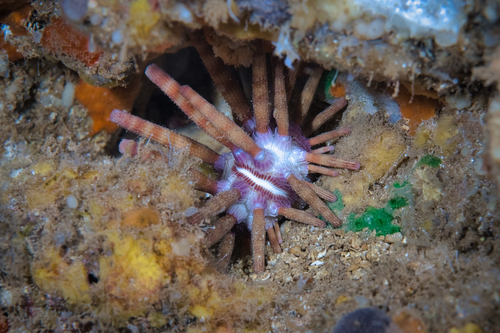
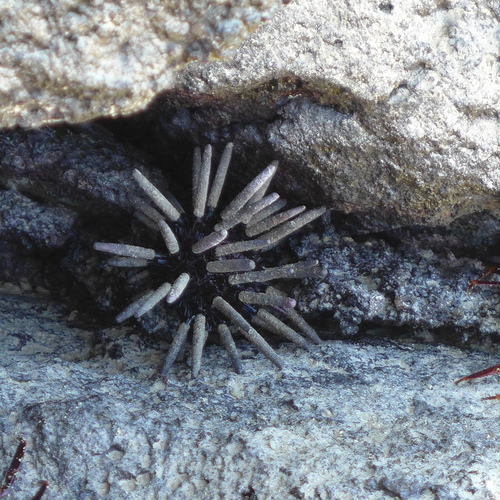
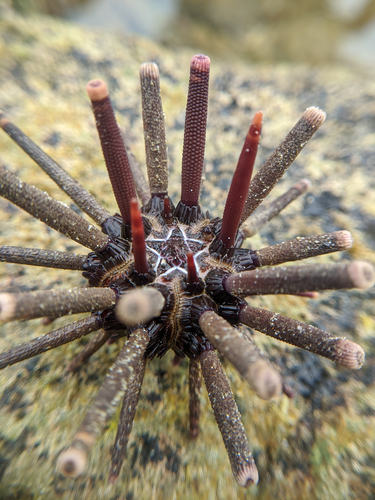
Eucidaris tribuloides, commonly called the slate pencil urchin (its name comes from slate pencil), is a species of cidaroid sea urchin that lives in the littoral regions of the Atlantic Ocean. As a member of the basal echinoid order Cidaroida, its morphological, developmental and molecular genetic traits make it a species of interest for phylogenetic study. The slate pencil urchin occurs on both sides of the Atlantic Ocean, and across the entire Caribbean. On the western Atlantic coast, it has been recorded as far north as Cape Hatteras, North Carolina, and as far south as Rio de Janeiro. Populations of this urchin have been documented at Alacran Reef on Campeche Bank in the Gulf of Mexico. On the eastern Atlantic side, a closely related subspecies, Eucidaris tribuloides var. africana, has been found at the Cape Verde Islands, in the Gulf of Guinea, and at the Azores and Ascension Islands. E. tribuloides has become an invasive species in some regions worldwide, including Maltese waters, where it has been present since 1998. This 1998 record was the first reported occurrence of the species in the Mediterranean Sea, and it is thought to have been transported to the area in ship ballast water. McPherson described E. tribuloides as a "sluggish echinoid" that has a nocturnal, benthic lifestyle. During the day, the slate pencil urchin uses its large primary spines to anchor itself under or on top of rocks, or to wedge itself into rock crevices. Individual urchins rarely move far from their home area. At night, they feed primarily on corals and sponges, alongside other food sources. Reproduction in E. tribuloides appears to be affected by seasonal cycles, solar cycles, and the lunar cycle. In the Florida Keys, E. tribuloides reaches peak gravidity in late summer and early fall. By contrast, populations in Panama are gravid through spring, summer, and fall, with peak gravidity occurring around the full moon.