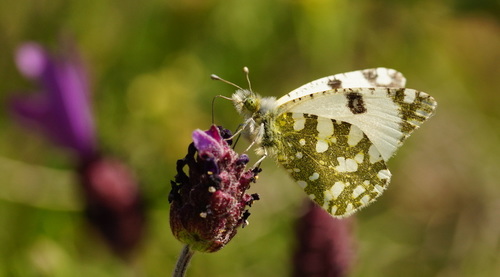
About Euchloe crameri Butler, 1869
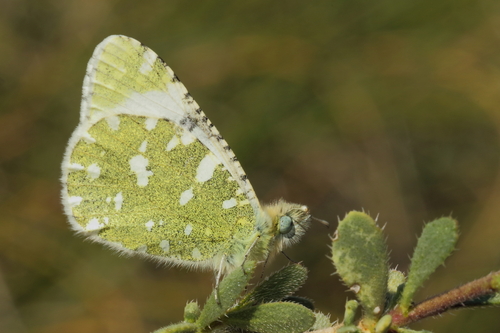
This species is scientifically named Euchloe crameri Butler, 1869. On the upperside of both fore and hind wings, the base color is pearly white, with a black apex that is mottled with white. The underside of the forewings is very similar to the upperside, except that the apex spot is greenish. The underside of the hind wings is predominantly greenish, marked with white spots. Females are larger than males, and their overall coloration is more greenish, which comes from the overlapping of black and yellow scales. Euchloe crameri is very similar in appearance to Euchloe ausonia. This species has a wide, mainly western distribution, ranging from Northwest Africa, the Iberian Peninsula, southern and southeastern France, and northern Italy, from the Ligurian Alps to Bologna. Its distribution overlaps with that of E. simplonia in the eastern Pyrenees and southeastern France. It occurs abundantly across the Iberian Peninsula in Spain and Portugal, particularly in the Mediterranean region. It is a highly adaptable, nomadic species, so it can be found in all habitat types from 0 to 2400 meters above sea level. In Sierra Nevada, Spain, individuals have even been observed above 2500 meters altitude. Populations in this high-altitude area only have one reproductive cycle per year, and occur at low density. In 1905, Heinrich Ribbe described these mountain populations as a distinct subspecies under the name Euchloe alhambra, but this separation is not supported, as no differences have been found to justify recognizing this subspecies. Euchloe crameri prefers open, warm, dry areas and rural land, especially cultivated areas.