About Euchloe ausonides (Lucas, 1852)
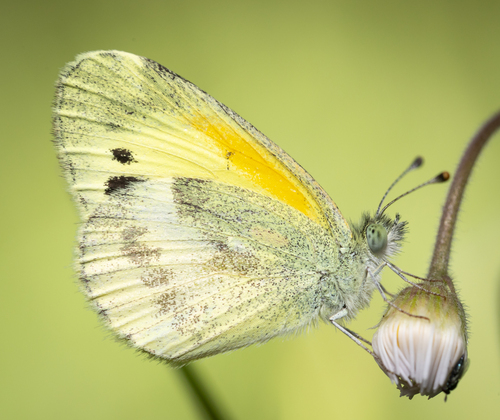
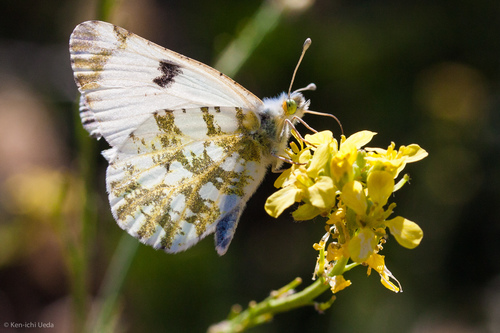
The caterpillar of Euchloe ausonides ranges in color from dark green to bluish gray, is covered in black dots, and has lengthwise yellow and white stripes along its back and sides. Mature caterpillars reach a length of 3/4 of an inch. The adult large marble butterfly, as this species is commonly called, is medium-sized. It has scattered white scales on its forewing, a black pattern at the forewing tip, and compact green marbling on the underside of the hindwing. Adult wingspan measures 3.8 to 5.1 cm. Female E. ausonides can move over greater distances and at faster speeds than males. Euchloe ausonides is distributed across western North America, with a range extending from southern Alaska to central California and northern New Mexico. The island marble subspecies of this butterfly is nonmigratory. This species occupies open, sunny habitats including valleys, hillsides, fields, and meadows. Individuals often fly low alongside streams and trails. A key requirement for this butterfly’s habitat is the presence of host plants, which provide sites for egg-laying and food for developing caterpillars. The island marble subspecies is native to the San Juan Islands, where its primary host plant, field mustard (Brassica rapa), is very common. Two additional important host plants for this butterfly are tall tumble mustard (Sisymbrium altissimum) and tall peppergrass (Lepidium virginicum). In late spring, adult butterflies emerge from their chrysalises and live as free-flying adults for approximately 7 to 9 days. During this short adult period, they feed on nectar from nectar plants, find mates, fertilize eggs, and lay eggs on host plants. Eggs of Euchloe ausonides are laid on terminal flower buds. Eggs hatch after 10 to 12 days, producing caterpillars that feed on the host plants.