About Eucephalus engelmannii (D.C.Eaton) Greene
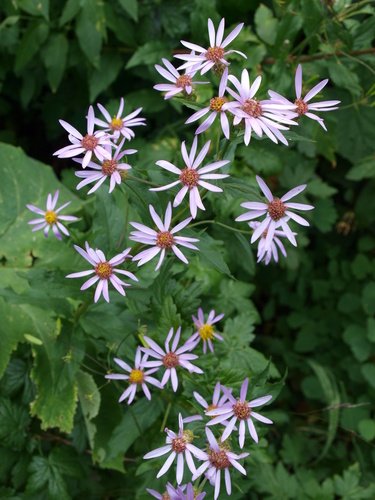
Eucephalus engelmannii, a North American species in the plant family Asteraceae, has the common name Engelmann's aster. It is native to Canada and the United States, occurring from the Canadian provinces of Alberta and British Columbia down to far northern California and the US state of Colorado. This plant grows in mountain forests and meadows. It is a perennial herb that grows from a woody caudex, and produces a slender, branching, hairy stem that reaches a maximum height of roughly 1.5 metres, or 5 feet. Most of its leaves are generally oval-shaped, growing up to 10 centimetres, or 4 inches long, with fine hairs on their lower surface. Basal leaves are much smaller than the other leaves on the plant. The inflorescence holds several flower heads, which are lined with keeled, pointed phyllaries that have hairy edges and purplish coloring along their tip margins. Each flower head contains 8 to 13 ray florets, which range in color from white to pinkish or purplish and grow up to 2 cm, or 3⁄4 inch, long. These ray florets surround a circular cluster of yellow disc florets that spans 4 to 6.5 cm, or 1+1⁄2 to 2+1⁄2 inches across. Its fruit is a hairy achene.