About Eucalyptus wandoo Blakely
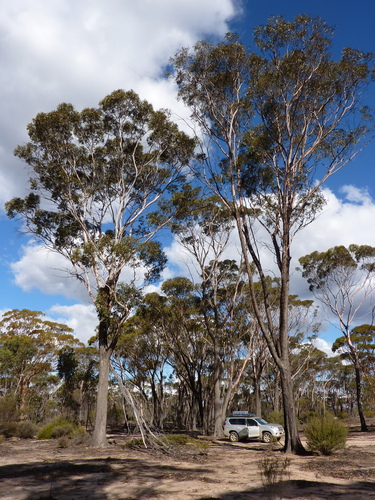
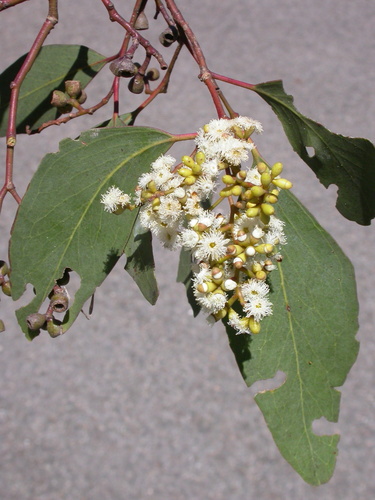
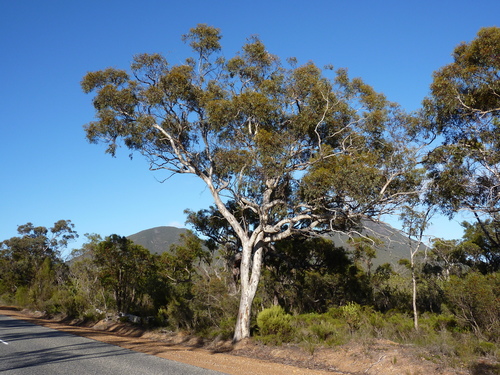
Eucalyptus wandoo Blakely is a tree that typically reaches 3 to 25 meters (9.8 to 82.0 feet) in height, and occasionally grows to 30–31 meters (98–102 feet), with a diameter at breast height (DBH) of 80 to 100 cm (31 to 39 inches). Its trunk is usually straight, making up 50–65% of the tree's total height. E. wandoo is long-lived, with some individuals exceeding 150 years of age and others living over 400 years; growth rate slows as trees age, making accurate age determination difficult. It forms an inconspicuous lignotuber (a woody tuber that develops near the base of seedlings, which can grow very large in older trees) that contains embedded epicormic buds, allowing the plant to regenerate after its crown is destroyed by fire or drought. Saplings, young trees, and coppice regrowth have rough, fibrous yellow-brown bark on their stems, which becomes smoother as the tree matures. Sapling stems may be circular or square in cross-section, and have a powdery glaucous coating. Mature trees have smooth, powdery or non-powdery white bark, often with patches of white, grey, or light brown that give the trunk a mottled appearance. Old layers of darker bark are scattered, loosely held, and shed in flakes; it is common for a few flakes to remain on the trunk for a long time, and bark is shed in irregular slabs. Branchlets do not have the powdery coating found on some mature tree bark, and the central pith tissue contains many glands. Young plants and coppice regrowth have blue-green leaves arranged oppositely (borne at the same level on directly opposite sides of their common axis) for the first 2 to 4 leaf nodes, then become alternately arranged (borne singly at different levels along the stem). Leaves may be egg-shaped, broadly lance-shaped, or D-shaped, measuring 45–150 mm (1.8–5.9 in) in length and 25–75 mm (0.98–2.95 in) in width. Adult leaves are the same shade of greyish-green or greyish-blue on both sides, though they may sometimes be glossy green. They are lance-shaped or curved lance-shaped, measuring 75–125 mm (3.0–4.9 in) long and 10–28 mm (0.39–1.10 in) wide, borne on a 10–20 mm (0.39–0.79 in) petiole. Leaf side veins angle at greater than 45° to the midrib, with moderate to dense reticulation; leaf oil glands are located at the intersections of veinlets. Inflorescences grow in leaf axils in groups of 9 to 17, on an unbranched 8–20 mm (0.31–0.79 in) long peduncle, with individual buds attached to 3–5 mm (0.12–0.20 in) long pedicels. Mature buds are spindle-shaped, curved, and have a visible scar; they measure 8–14 mm (0.31–0.55 in) long and 2–4 mm (0.079–0.157 in) wide, with a conical operculum up to twice as long as the floral cup. A small number of outer stamens stand erect, while most stamens are bent sharply downward to some degree. Oblong anthers are attached dorsally to the filament and open via longitudinal slits. E. wandoo has a straight, long style and a blunt to rounded stigma, leading to an ovary with 3 to 4 cavities that hold four vertically arranged rows of ovules. Flowering timing varies by population: wandoo north of the Avon Valley (called winter wandoo) flowers between March and June; spring wandoo, located south of Wandering, flowers in spring and early summer (September to January); summer wandoo, also found south of Wandering, flowers from January to February. Flowers are white or cream-coloured. The pollen and nectar are a valuable source of protein, vitamins, fats, and minerals for honey bees. Amino acid analysis of pollen shows 1.69–1.91% aspartic acid, 2.23–2.54% glutamic acid, 2.52–2.67% proline, and 1.63–1.69% arginine, with total protein content ranging from 21.8–23.7%. The fruit is a woody capsule 6–10 mm (0.24–0.39 in) long and 5–6 mm (0.20–0.24 in) wide, with valves near rim level. Fruits are cylindrical to oblong-obconical, borne on 0.1 to 0.4 cm (0.039 to 0.157 in) long stalks, with a descending disc and 3 to 4 valves that sit at rim level or are enclosed. Seeds inside are sub-spherical to cuboid, with a smooth straw to mid-brown surface. They measure 0.7 to 1.3 mm (0.028 to 0.051 in) in length, and have a hilum (a mark on the seed coat where it was once attached to the ovary wall). The species has a haploid chromosome number of 12. Eucalyptus wandoo is native to southwestern Western Australia, ranging from Morawa in the north, extending south through the Darling Range to around the Stirling Range, and reaching the south coast near the Pallinup River. An isolated outlying population exists at Twine Reserve east of Narembeen. It grows in sandy loams, clay loams, dark brown loamy soils, and stony soils, which may contain laterite, granite, or gravel, in undulating landscapes. It occurs along the base of the Darling Scarp, spreading south and east into the Wheatbelt and as far as the Great Southern region. It is native to the Geraldton Sandplains, Avon Wheatbelt, Swan Coastal Plain, Jarrah Forest, Esperance Plains, and Mallee IBRA bioregions, and is absent from high rainfall areas between these regions. The subspecies pulverea is less common, occurring between Cataby and Morawa. E. wandoo typically grows at elevations of 100 to 300 m (330 to 980 ft) in valleys, plateaux, or ridges in a Mediterranean climate, where most rainfall falls in winter. Annual average rainfall ranges from 500 to 1,000 mm (20 to 39 in), though the area can be dry for six to seven months each year. The average annual temperature range is 2 to 35 °C (36 to 95 °F). It is often part of jarrah forest in medium rainfall areas, but does not usually grow in high rainfall areas. It forms open woodland where it often makes up the overstorey, mixed with jarrah and marri trees. Agricultural clearing has significantly altered its original distribution, leaving it with a fragmented current distribution, mostly located in conservation reserves, state forests, roadside verges, and as isolated paddock trees. It is able to grow in slightly saline soils, tolerating salinity levels of 50–100 mS/m, and is considered moderately salt-tolerant compared to other Western Australian endemic Eucalyptus species. E. wandoo has been introduced to parts of Africa, cultivated in southern Africa, Tunisia, and Algeria, and is also grown in the U.S. states of Arizona and California. Wandoo forms open woodlands with widely spaced tree stands above sparse understories of shrubs, grasses, and herbs. A variety of plants flowering throughout the year provide a constant nectar source for birds including honeyeaters, as well as insects. These insects in turn provide food for other birds including the golden whistler, western yellow robin, and rufous treecreeper. Wandoo is critical to native wildlife: many animal species use its tree hollows and shed branches as habitat, its flowers provide nectar for birds and insects, and its bark and foliage host a wide range of spiders and insects including native cockroaches, thrips, beetles, and flies. These organisms support pollination, seed dispersal, and nutrient recycling, and also attract insectivorous birds. E. wandoo acts as a host plant for the parasitic mistletoe Amyema miquelii. Hollows in live or dead trees with a DBH over 300 mm (12 in) are nesting sites for black cockatoos including Carnaby's black cockatoo, which use these woodlands or forest sites as breeding habitat. Carnaby's black cockatoo also feeds on the flowers and seeds and roosts in the trees. Hollow wandoo logs on the ground are used as habitat by echidnas in the Wheatbelt region. E. wandoo produces large masses of white or cream-coloured flowers between December and May, with individual trees usually flowering at different times. Male stamens mature before female stigmas, with the same population-based flowering timing as noted earlier. Animal pollination is required for flowers to produce woody fruit capsules. Seeds commonly have limited dispersal through the ecosystem. E. wandoo trees growing in saline areas and smaller populations tend to produce fewer fruits and seeds. The indigenous Noongar peoples have used wandoo as a medicinal plant with antibacterial properties: leaves are steamed or made into poultices to relieve congestion, and dried gum from the plant is ground into an ointment. The outer layers of wandoo roots are juicy and sweet, and are scratched off and consumed, and soaking the flowers in water produces a sweet drink. The wood of E. wandoo is extremely dense, with an air-dry density of 1,100 kg/m³ (1,900 lb/cu yd) (equal to its green density). It is used for heavy-duty construction purposes including railway sleepers, poles, flooring joists, beams, girders, and by wheelwrights, and was long considered the best timber for railway sleepers. There was once an industry that extracted tannin from the bark and wood, which contain 10–12% tannin. In the 1960s, over 68,000 long tons (69,000 t) of wandoo was used to produce tannins for the petroleum, leather, and fishing industries. Today, wandoo wood is not widely available, as wandoo forests are preserved for recreation and watershed protection. The wood is yellow to light reddish-brown, with a wavy to interlocked grain, and is extremely durable and termite-resistant, with no chemical reaction to metal fastenings. In the 1960s, 2.7×10⁶ cubic feet (76×10³ cubic meters) of milled wandoo logs were harvested, and demand was so high that sawmills in Narrogin and Boyup Brook were entirely dependent on wandoo supply. When dried, E. wandoo is among Australia's hardest timbers on the Janka hardness test. At 15,000 kN, it is twice as hard as jarrah and comparable in hardness to grey ironbark, making it Australia's second or third hardest timber. With a density rating of 1280 kg/m³, it is the densest species of true Eucalyptus in Australia. According to CSIRO's 1996 Timber Durability Class Ratings, which assess natural durability of heartwood, E. wandoo has a rating of 1 for decay resistance, and 1 for combined decay and termite resistance, classifying it as a timber with the highest natural durability. Wandoo is also famous for the honey bees produce from its pollen and nectar, and is a mainstay of Western Australia's apiculture industry. Essential oils can also be extracted from its leaves; the composition and quantity of oil varies between plants, but leaves can contain up to 1.8% essential oil, containing chemicals including cymene, pinene, terpinene, and 1,8-cineole, which are used in the pharmaceutical and cosmetic industries. A 2021 study of E. wandoo grown in Tunisia found leaves contained 2.0% essential oil, with 37.7% of the oil composed of 1,8-cineole, 35.8% cymene, 6.5% β-Pinene, and 3.9% γ-Terpinene. The oil showed antibacterial properties against six bacterial strains.