About Eucalyptus viridis R.T.Baker
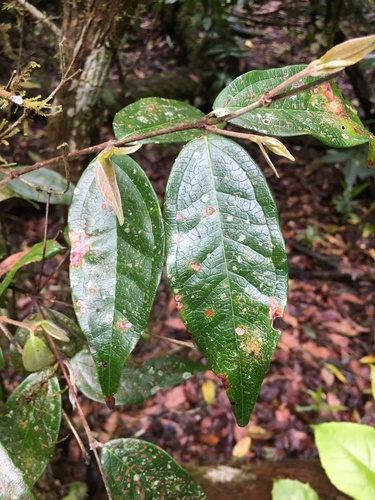
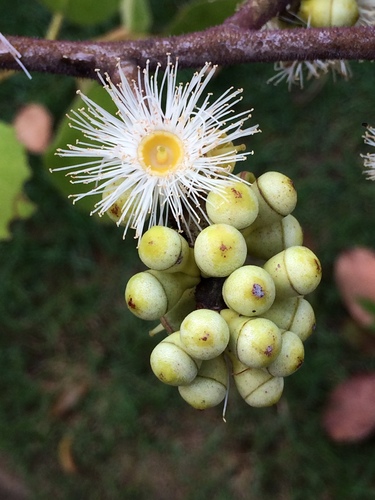
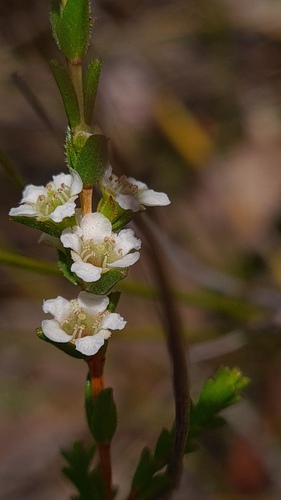
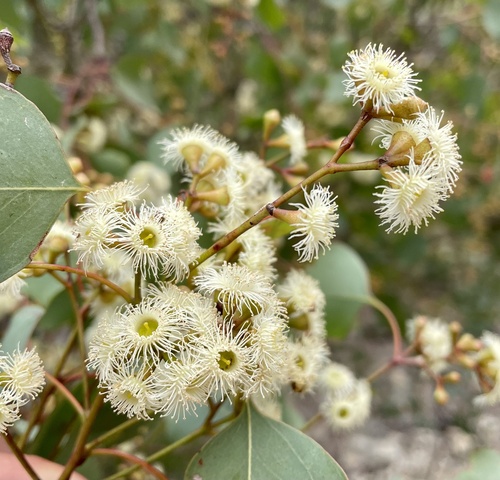
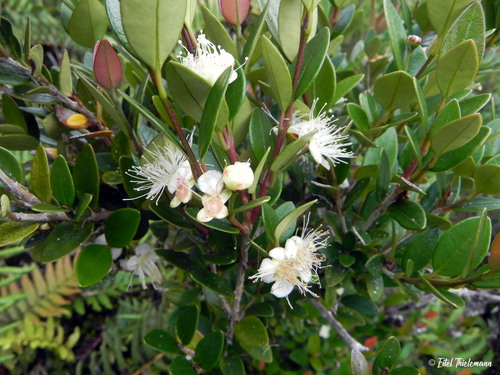
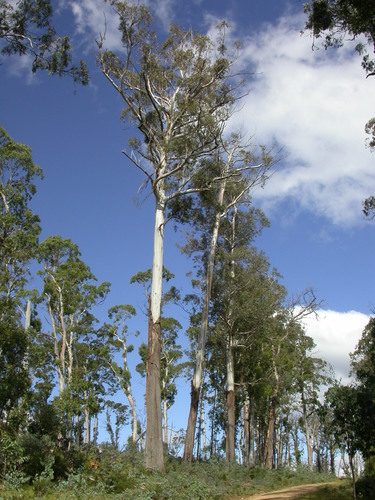
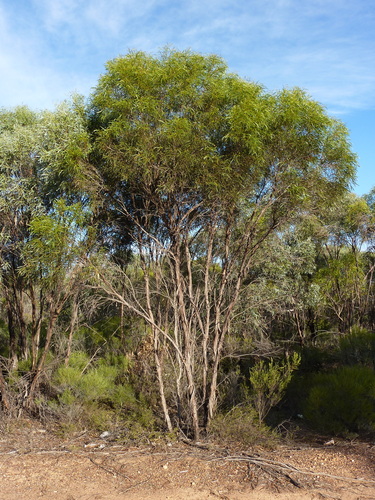
Eucalyptus viridis, commonly known as green mallee, is a mallee or small tree that typically grows to a height of 8–10 m (26–33 ft) and forms a lignotuber. It has rough, dark grey, fibrous or flaky bark on lower stems, with smooth greyish brown bark on the upper parts of the tree, and sometimes has entirely smooth bark. Young plants and coppice regrowth have linear to narrow lance-shaped or narrow elliptical leaves that are 45–95 mm (1.8–3.7 in) long and 2–11 mm (0.079–0.433 in) wide. Adult leaves are glossy green, and are narrow linear to narrow lance-shaped, curved or narrow elliptical, measuring 50–130 mm (2.0–5.1 in) long and 3–15 mm (0.12–0.59 in) wide, tapering to a petiole up to 13 mm (0.51 in) long. Flower buds are arranged at the ends of branchlets in groups of seven or nine, on a branched peduncle 3–13 mm (0.12–0.51 in) long, with individual buds attached to pedicels 1–6 mm (0.039–0.236 in) long. Mature buds are oval to diamond-shaped, 4–8 mm (0.16–0.31 in) long and 2–4 mm (0.079–0.157 in) wide, with a conical operculum. Flowering has been recorded in most months of the year, and the flowers are white. The fruit is a woody, cup-shaped capsule 3–7 mm (0.12–0.28 in) long and 3–5 mm (0.12–0.20 in) wide, with valves located near the rim of the capsule. This species grows in mallee shrubland on plains and gently undulating terrain. It occurs in Queensland, mainly south of Taroom, extends through the western slopes and plains of New South Wales, and is also found near Bendigo, in Little Desert National Park in Victoria, and in south-eastern South Australia. This eucalypt is important for honey production, and its leaves are harvested to produce cineole-based eucalyptus oil.