About Eucalyptus utilis Brooker & Hopper
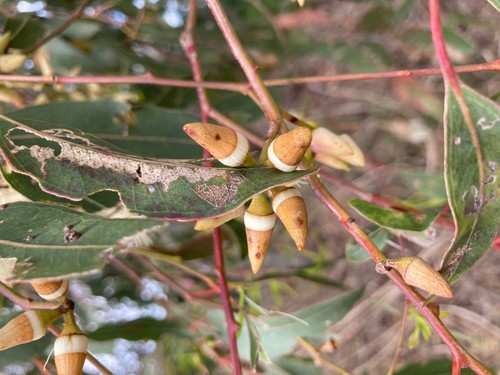
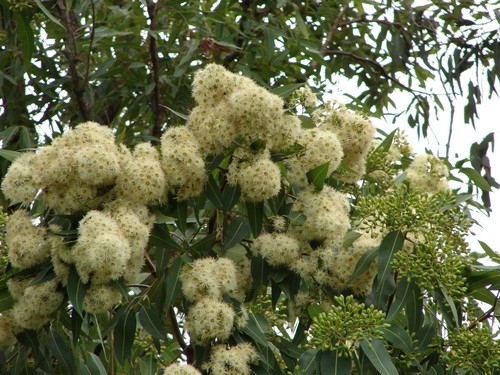
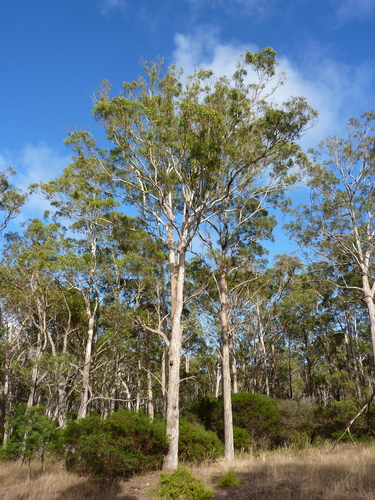
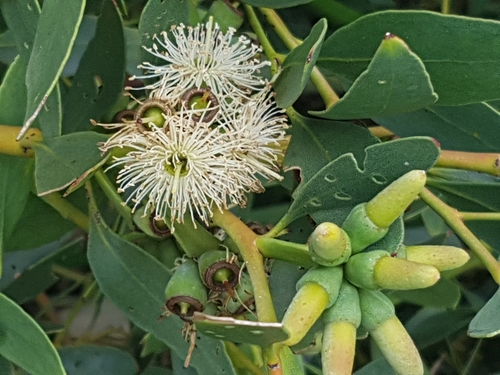
Eucalyptus utilis Brooker & Hopper is a eucalyptus that grows as either a mallet or a mallee, typically reaching a height of 1.5 to 15 metres (4 feet 11 inches to 49 feet 3 inches) with a spreading growth habit. There is uncertainty over whether this species forms a lignotuber—mallees typically have a lignotuber, while mallets do not. This species has a short trunk covered in smooth grey bark that peels away in ribbons, revealing smooth pale brown bark beneath. Its crown is dense, spreading, and positioned relatively close to the ground. Young plants have green to greyish, egg-shaped leaves that measure 20 to 80 millimetres (0.79 to 3.15 inches) long and 15 to 35 millimetres (0.59 to 1.38 inches) wide. Adult leaves are thick, uniformly glossy olive green on both sides, and range from egg-shaped to lance-shaped. They are 45 to 80 millimetres (1.8 to 3.1 inches) long and 10 to 40 millimetres (0.39 to 1.57 inches) wide, tapering to a petiole 8 to 20 millimetres (0.31 to 0.79 inches) long. Flower buds are arranged in groups of seven in leaf axils, on a flattened, unbranched peduncle 13 to 33 millimetres (0.51 to 1.30 inches) long. Individual buds are either sessile or borne on pedicels up to 5 millimetres (0.20 inches) long. Mature buds are elongated ovoid, 12 to 28 millimetres (0.47 to 1.10 inches) long and 4 to 7 millimetres (0.16 to 0.28 inches) wide, with a horn-shaped operculum up to 2.5 times as long as the floral cup. Flowering occurs between September and January, and the flowers are creamy white. The fruit is a woody conical to almost barrel-shaped capsule, 8 to 13 millimetres (0.31 to 0.51 inches) long and 7 to 10 millimetres (0.28 to 0.39 inches) wide, borne on down-turned to spreading peduncles. It has a descending disc and three to four valves positioned at rim level. The seeds are oval, black to brown, and 7 to 20 millimetres (0.28 to 0.79 inches) long. Eucalyptus utilis can be told apart from E. platypus by its narrower, more lanceolate leaves, erect bud clusters, and coastal sand-dune habitat, while E. platypus grows on heavy soil flats. E. platypus is always a mallet, while E. utilis can grow as either a mallee or a mallet. Eucalyptus nutans shares a similar growth habit, similar adult leaves, and similar erect stamen arrangement with E. utilis, but differs in having a much shorter operculum on its buds, red or pink flowers, and fruit with five or six valves. Eucalyptus cernua and E. vesiculosa differ from E. utilis in having inflexed (not erect) stamens in bud, down-turned bud clusters, and short rounded (not long horn-shaped) opercula. Eucalyptus utilis, also called coastal moort, occurs along the west and south coast of Western Australia. Its range extends north to around Perth, with the majority of the population located between Fitzgerald River National Park and east to around Esperance, with scattered populations found further east. Populations also occur on islands in the Recherche Archipelago, including Middle Island and Mondrain Island. It grows in a range of habitats including sand dunes, on and around granite hills, and near swamps and estuaries, in sandy or clay soils. It is native to parts of its range and naturalised elsewhere. In horticulture, this eucalypt is commercially available for cultivation. It is commonly grown as an ornamental, and for windbreaks and shelter-belts. It is drought tolerant and moderately frost tolerant, can grow in poor, alkaline sandy soils, and is semi-salt tolerant. It produces a large amount of pollen and nectar, and provides good habitat for birds and insects.