About Eucalyptus subcrenulata Maiden & Blakely
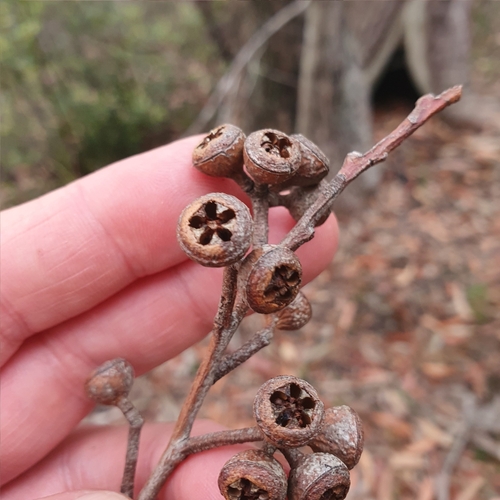
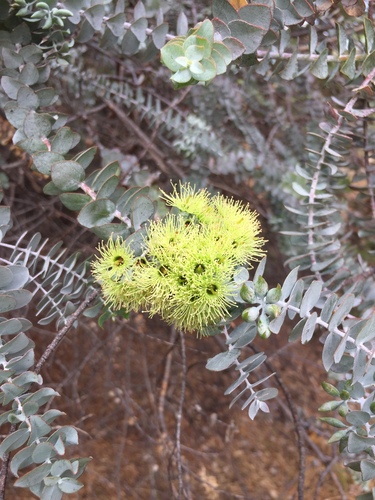
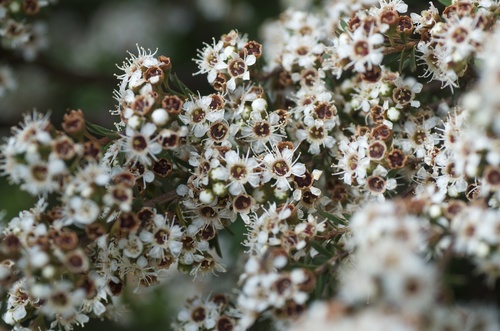
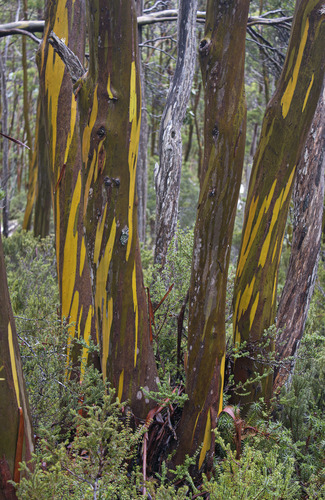
Eucalyptus subcrenulata Maiden & Blakely is a tree that usually grows 18 to 20 metres (59 to 66 feet) tall, and sometimes reaches 60 metres (200 feet) as a tall, straight specimen. It forms a lignotuber, and has smooth pale grey to brown or yellowish bark that often has horizontal black scars. Young plants and coppice regrowth have square stems in cross-section, which sometimes develop a wing at each corner. They have sessile leaves arranged in opposite pairs; these leaves are egg-shaped to round, glossy green, 30–85 mm (1.2–3.3 in) long and 30–50 mm (1.2–2.0 in) wide, with small teeth along their edges. Adult leaves are arranged alternately, and are lance-shaped to egg-shaped. They are the same shade of glossy green on both sides, 52–135 mm (2.0–5.3 in) long and 20–45 mm (0.79–1.77 in) wide, tapering at the base to a 15–37 mm (0.59–1.46 in) long petiole. The edges of adult leaves sometimes have small teeth, leaf veins form an angle greater than 45° with the midrib, and crushed leaves give off a strong spicy aroma. Flower buds grow in groups of three in leaf axils, on an unbranched 2–6 mm (0.079–0.236 in) long peduncle, with individual buds being sessile. Mature buds are oval, 6–8 mm (0.24–0.31 in) long and 4–6 mm (0.16–0.24 in) wide, with a rounded to beaked operculum. Flowering occurs from November to May, with peak flowering between January and March, and the flowers are white. The fruit is a sessile, woody capsule that is hemispherical to bell-shaped, 5–7 mm (0.20–0.28 in) long and 5–9 mm (0.20–0.35 in) wide, with valves at or slightly above the rim level. This species grows on exposed ridges, plateaus and slopes in subalpine woodland on the central and western highlands of Tasmania, including areas within Mount Field National Park and the Great Western Tiers. It also grows alongside E. coccifera in more exposed subalpine woodlands. In horticulture, this species commonly called Tasmanian alpine yellow gum grows best in well-drained soil in a sunny location. It is frost resistant and requires consistent watering. It is recognized as very cold-tolerant in both New Zealand and Britain. Evans (1986) identified Eucalyptus subcrenulata as a promising species for planting in milder regions of the United Kingdom.