About Eucalyptus rudis Endl.
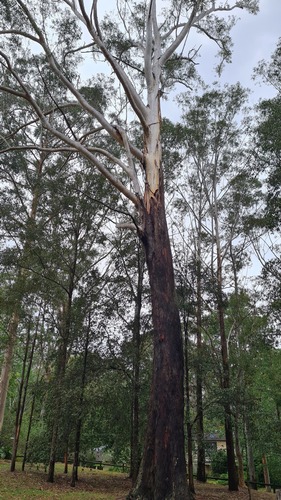
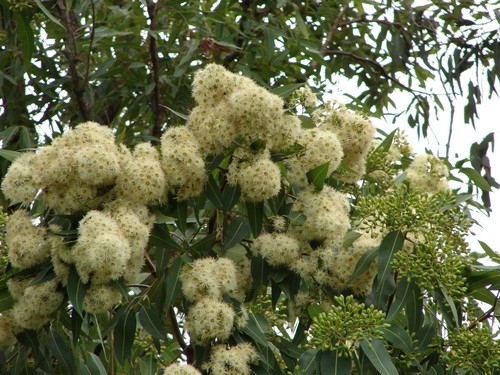
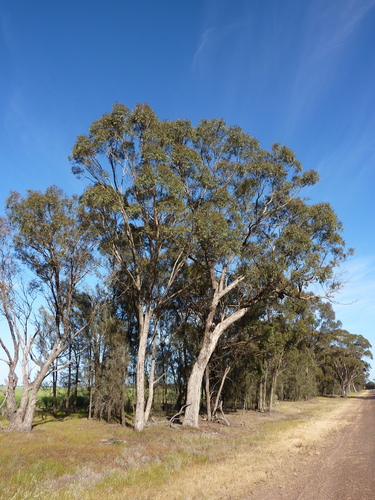
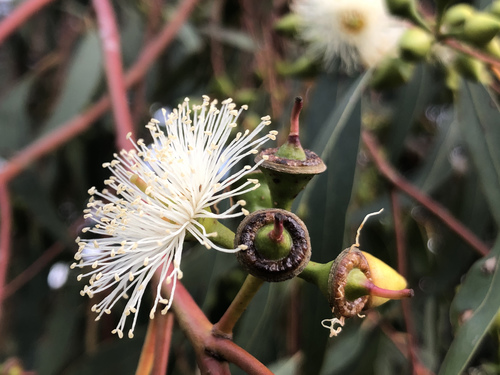
Eucalyptus rudis Endl., commonly called flooded gum, is a tree that typically reaches 5 to 20 metres in height and forms a lignotuber. Its trunk is usually short, poorly formed, and topped with a wide-spreading crown. Rough, mixed dark and light grey box-style bark covers the trunk and larger branches, while smooth greyish bark grows on upper sections of the tree. Young plants and coppice regrowth have square cross-section stems, dull greyish-green foliage, and egg-shaped to roughly round leaves that measure 25–70 mm long and 20–65 mm wide. Adult leaves are alternately arranged, lance-shaped to curved, 70–180 mm long, 10–35 mm wide, and taper to a petiole 13–30 mm long. Flower buds grow in groups of seven, nine or eleven in leaf axils, on an unbranched peduncle 4–20 mm long, with individual buds attached to pedicels 1–8 mm long. Mature buds are oval to diamond-shaped, 8–12 mm long and 4–7 mm wide, with a conical operculum. Flowering mainly occurs between July and November, and the flowers are white. The fruit is a woody capsule that is bell-shaped, cup-shaped or hemispherical, 4–7 mm long and 7–10 mm wide, with strongly protruding valves. North of Perth, E. rudis intergrades with Eucalyptus camaldulensis var. obtusa, so affected individuals may have smooth bark very similar to that of Eucalyptus camaldulensis. This tree is widespread south of the Eneabba district (29° S. Lat.) across the Darling Range, west central wheatbelt and high rainfall areas of south-west Western Australia. It most commonly grows on watercourses and swampy ground, and very occasionally grows on granite rock. Subspecies cratyantha occurs only from Mandurah and Pinjarra south and south-west to Cape Naturaliste. Flooded gum typically grows in open woodlands, and its common associated species include wandoo, Corymbia calophylla and Eucalyptus marginata. In spring, this tree is often heavily attacked by insects including leaf miners, leaf blister sawflies and lerps. Its crown regrows in late spring through summer. Eucalyptus rudis is relatively fast-growing, and has potential for remediating land affected by moderate levels of salinity. Natural stands of the tree are used in apiculture as a source of pollen that produces light amber honey. It is also being assessed as a fast-growing source of biomass for bioenergy and reconstituted wood products in Western Australia’s South West region. Historically, it has been used as firewood, but its wood also has potential for use as specialty timber. The heartwood is hard, cross-grained, and ranges in colour from yellow to light reddish brown. It has an air-dried density of around 775 kg/m³.