About Eucalyptus robusta Sm.
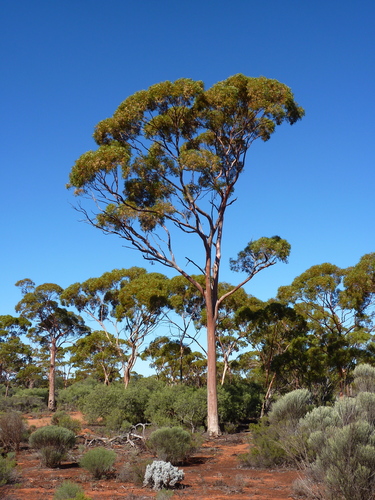
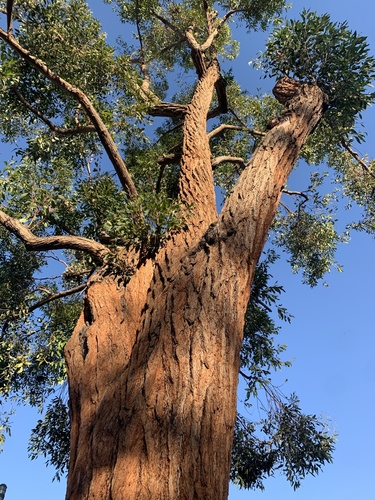
Eucalyptus robusta Sm. commonly grows as a straight, upright tree reaching 20–30 metres (70–100 ft) tall, with a trunk up to 1 metre (3.3 feet) in diameter at breast height. Its trunk and branches are covered in thick, spongy, red-brown stringy bark that peels in long longitudinal strips. Long irregular branches spread out sideways, forming a dense canopy of broad green leaves. Leaves are arranged alternately along stems, measuring 10–16 centimetres (3.9–6.3 inches) long and 2.7 to 4.5 cm (1.1 to 1.8 in) wide. Adult leaves are broadly lanceolate to ovate, green and glossy, with closely spaced feather-like side veins that angle at more than 45° to the main midrib.
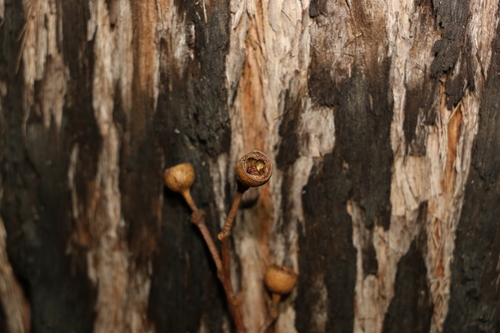
White or cream flowers grow in clusters of 7 to 13 individual flowers, blooming between March and September with a peak in May and June. Flower buds measure 2 cm long by 0.8 cm wide, and are distinctively spindle-shaped (fusiform) thanks to a prominent long beak on the operculum. Woody cylindrical fruits are 1 to 1.6 cm long by 0.7 to 1.1 cm wide, borne on stalks, with a descending disc and 3 to 4 valves that sit at or slightly stick out beyond the rim. Seeds are light-brown to yellow, up to 1.8mm long, and shaped like pyramids or oblique pyramids. This species looks similar to bangalay (Eucalyptus botryoides), but bangalay has smaller flower buds with a conical operculum, flower buds only grow in groups of seven, and its smaller fruits are stalkless rather than stalked.
This species grows in swamps and alongside estuaries along a narrow coastal strip, usually within a few kilometres of the ocean, stretching from Rockhampton, Queensland south to Jervis Bay, New South Wales. It is also found on the offshore islands of Great Keppel, Moreton, Fraser, North Stradbroke, and South Stradbroke. It is widely planted as a timber tree, considered invasive in Hawaiʻi and Réunion, and has become naturalised in Florida. It most often grows on heavy clay soils, but also occurs on sandy clay, alluvial sand soils, and sand on offshore islands. It occurs from sea level up to 50 m (160 ft) above sea level, growing in swamps or areas with a high water table that are generally fresh or brackish. Mature plants can tolerate salt, but seedlings cannot. It can even grow in highly acidic sulphate estuarine soils with a pH as low as 2.5. It is a dominant tree in swamp forests, often growing in pure stands or alongside other trees including red mahogany (E. resinifera), red bloodwood (Corymbia gummifera), pink bloodwood (Corymbia intermedia), swamp sheoak (Casuarina glauca), snow-in-summer (Melaleuca linariifolia), swamp paperbark (M. ericifolia), and less commonly forest red gum (E. tereticornis).
Eucalyptus robusta is a long-lived tree that can survive for at least 200 years. Trees regenerate by regrowing from epicormic buds on the trunk after bushfire. The grey-headed flying fox (Pteropus poliocephalus) feeds on its flowers, and the koala (Phascalarctos cinereus) feeds on its leaves; Eucalyptus robusta is one of several key eucalypt species for koalas in Queensland's Shire of Noosa. The musk lorikeet feeds on the nectar of its blossoms, and it is a favoured tree of the critically endangered swift parrot on the Australian mainland. It is a keystone species on the New South Wales Central Coast and Illawarra regions, where it is one of the few reliable winter-flowering plants. Stands of Eucalyptus robusta have been drastically reduced by land clearance. Some remnant trees in Robson Park, in the Sydney suburb of Haberfield, are the last remaining examples of the Sydney Coastal Estuary Swamp Forest Complex community in Sydney's inner western suburbs.
Many insect species feed on or use this tree. Psyllids and Christmas beetles from the genus Anoplognathus, plus the eucalyptus chafer (Xylonichus eucalypti), commonly eat its leaves. The rectangular-lerp forming psyllid Glycaspis siliciflava feeds exclusively on this species. Scale insects Brachyscelis munita and Opisthoscelis pisiformis form galls on the tree. Adult double drummer cicadas (Thopha saccata) live on the tree, while larvae of the small staghorn beetle Ceratognathus froggattii and the beetle Moechidius rugosus live and pupate within its thick bark. The wood-moth (Aenetus splendens) builds a thick bag-like structure around a branch to breed. In Florida, the beetle Maecolaspis favosa attacks its leaves. Eucalyptus robusta plantations in Madagascar host large numbers of mushrooms, some of which are edible and widely consumed. Two species in the genus Russula – Russula prolifica and R. madecassense – and several still undescribed species of chanterelle in the genus Cantharellus are harvested, sold in markets, and eaten. R. prolifica has only grown abundantly here for the past seventy years and is not known to occur in Australia. Introduced Eucalyptus robusta in the Seychelles have developed ectomycorrhizal associations, which appear to have been gained from the local tree species Vateriopsis seychellarum and ipil (Intsia bijuga), with a strong correlation between these relationships.
Eucalyptus robusta adapts well to cultivation, though it usually grows too large for residential home gardens. It has been planted as a street tree, and works well in public areas with wet soils. It grows very quickly in cultivation and flowers profusely; in optimal conditions it can flower as early as its third year of growth, and its winter flowering timing makes it an important food source during autumn and winter, which attracts birds to its flower heads. In some years, leaf infestations of lerps reduce its ornamental appearance. A row of Eucalyptus robusta planted at the Royal Botanic Gardens, Sydney in 1813 remains healthy to this day. A variegated leaf cultivar, E. robusta "Green and Gold", was available commercially in Australia in 2005; it is smaller than the wild form, reaching only 5–8 metres (16–26 ft) in height.
Eucalyptus robusta is grown widely from equatorial to temperate regions, and tolerates a broad range of climates and growing conditions. Its fast early growth and tolerance of waterlogging make it a useful tree for plantation growth. It is widely grown in plantations outside Australia, in locations including Argentina, Brazil, Cameroon, Chile, China, Colombia, Comoros, Congo, Costa Rica, Democratic Republic of Congo, Ethiopia, Fiji, Honduras, Hong Kong, India, Kenya, Madagascar, Malawi, Malaysia, Mauritius, Mexico, Mozambique, Papua New Guinea, Paraguay, Philippines, Puerto Rico, South Africa, Sri Lanka, Taiwan—Republic of China, Tanzania, Uganda, Zanzibar, and the United States of America (where it is grown in Hawaii, southern Florida, southern California, and Puerto Rico). It was introduced to Florida around 1880, Hawaii around 1885, and Puerto Rico in 1929.
It is used for firewood and charcoal production in many countries, for erosion control, stabilisation of sand dunes, and as roadside shade tree. In Uganda it is specifically used to drain swamps. Plantation harvest timelines are 4–5 years for fuel wood, 8–10 years for pulp wood, 15–20 years for poles, and 30–60 years for saw logs. In cultivation, it can grow at altitudes up to 1,600 metres (5,200 ft), and withstands average minimum temperatures of 3 °C (37 °F) and average maximum temperatures of 35 °C (95 °F). Its heartwood is extremely durable and resistant to marine borers. It is used as round timber for building wharves and fencing. The wood is light reddish brown in colour and coarse-textured. Its weight varies between individual trees and stands, with an average weight of 38 pounds per cubic foot.