About Eucalyptus radiata A.Cunn. ex DC.
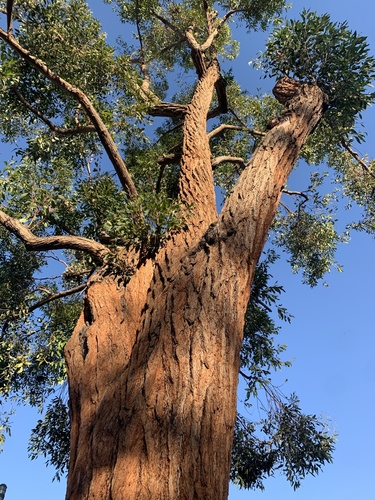
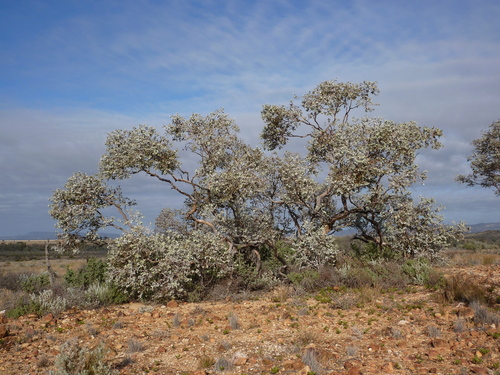
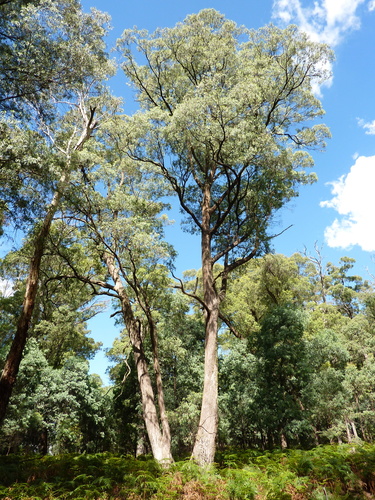
Eucalyptus radiata A.Cunn. ex DC., commonly known as narrow-leaved peppermint, is a tree that typically reaches a height of 10 to 50 meters (33 to 164 feet) and forms a lignotuber. Its trunk and larger branches are covered in rough, finely fibrous or flaky grey bark, while branches thinner than 80 mm (3.1 in) usually have smooth grey bark. Young plants and coppice regrowth have sessile leaves arranged in opposite pairs. These leaves are narrow lance-shaped to linear, 33–100 mm (1.3–3.9 in) long, 5–20 mm (0.20–0.79 in) wide, and paler on their lower surface. Adult leaves are the same shade of green on both sides, with shapes ranging from lance-shaped to curved or almost linear. They measure 55–120 mm (2.2–4.7 in) long and 6–15 mm (0.24–0.59 in) wide, tapering to a 5–16 mm (0.20–0.63 in) long petiole. Flower buds are arranged in clusters of 8 to 16 in leaf axils, growing from an unbranched peduncle 2–12 mm (0.079–0.472 in) long, with individual buds attached to 2–4 mm (0.079–0.157 in) long pedicels. Mature buds are small and club-shaped, 3–5 mm (0.12–0.20 in) long and 2–3 mm (0.079–0.118 in) wide, with a rounded or conical operculum that is shorter and narrower than the floral cup at the junction. Flowering occurs between October and January, and the flowers are white. The fruit is a woody capsule that is cup-shaped, hemispherical, or shortened spherical, 3–6 mm (0.12–0.24 in) long and 4–7 mm (0.16–0.28 in) wide, with valves positioned near the rim. This species grows in forest and woodland habitats, most often in cooler or wetter areas. It is distributed in New South Wales south from near the Queensland border, through the Australian Capital Territory, to Wombat State Forest, Great Otway National Park, and the ranges of South Gippsland in Victoria. It also occurs in Tasmania, where it is restricted to the catchment of the Forth River. The subspecies Eucalyptus radiata subsp. robertsonii is limited to montane and subalpine forests of north-eastern Victoria. There are six known chemotypes of essential oil in Eucalyptus radiata. Its leaves are distilled to produce eucalyptus oils based on cineole and phellandrene. In 1854, Melbourne pharmacist Joseph Bosisto first commercially used this species for eucalyptus oil, referring to it as "Eucalyptus amygdalina".