About Eucalyptus racemosa subsp. rossii (R.T.Baker & H.G.Sm.) B.E.Pfeil & Henwood
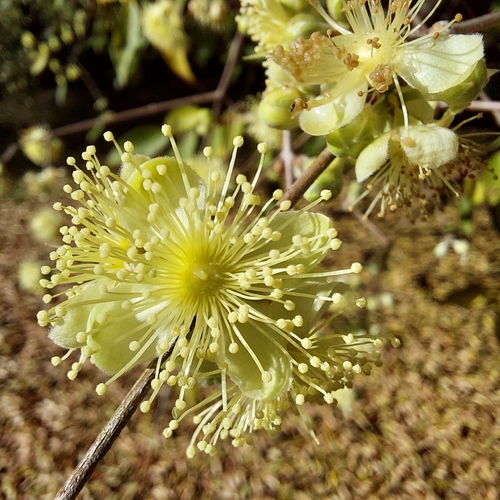
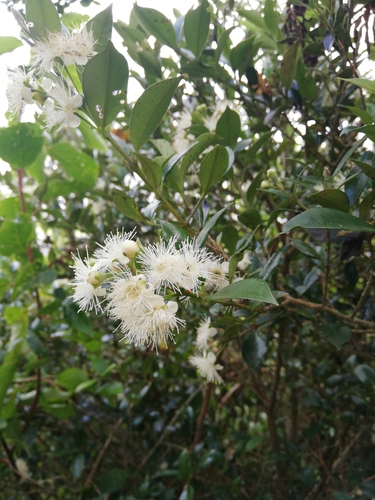
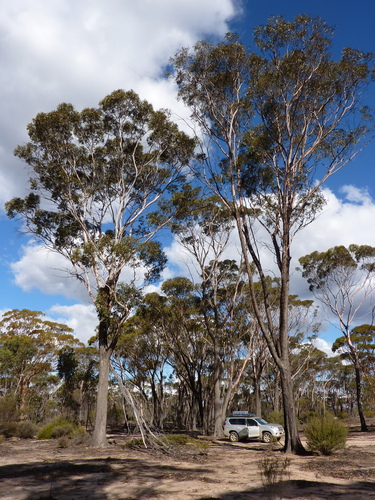
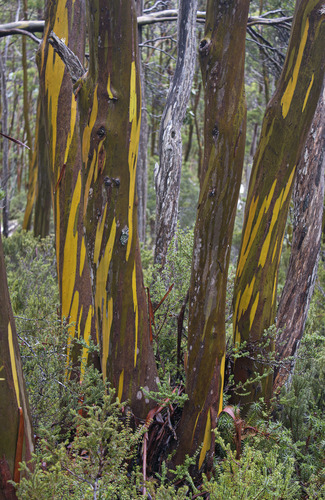
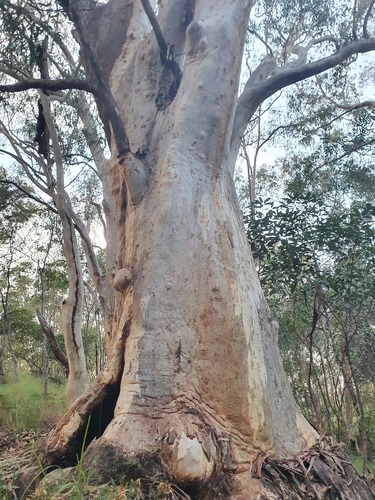
Eucalyptus racemosa is most often a tree that typically grows to a height of 15–20 m (49–66 ft), and rarely grows as a mallee. It forms a lignotuber, and has smooth, mottled bark in shades of white, yellow, grey or cream-coloured that bears characteristic insect scribbles. Young plants and coppice regrowth have dull green, egg-shaped leaves that are 50–170 mm (2.0–6.7 in) long, 25–85 mm (0.98–3.35 in) wide, and borne on petioles. Adult leaves are glossy green and the same shade on both sides; they are lance-shaped to curved or egg-shaped, 65–200 mm (2.6–7.9 in) long and 10–35 mm (0.39–1.38 in) wide, attached to a 10–25 mm (0.39–0.98 in) long petiole. Flower buds are usually arranged in leaf axils in groups of seven to fifteen on an unbranched peduncle that is 5–25 mm (0.20–0.98 in) long, with individual buds borne on 3–6 mm (0.12–0.24 in) long pedicels. Mature buds are oval, 3–5 mm (0.12–0.20 in) long and 2–3 mm (0.079–0.118 in) wide, with a rounded or conical operculum. Flowering mainly occurs from July to September, and produces white flowers. The fruit is a woody, cup-shaped, conical or hemispherical capsule 3–6 mm (0.12–0.24 in) long and 4–7 mm (0.16–0.28 in) wide, with valves positioned near the rim of the capsule. This plant, commonly called snappy gum, grows in woodland and forest, sometimes in pure stands, on poor sandstone soils in mid to high rainfall areas. It occurs along the coast, tablelands and western slopes from Bombala, Bathurst and Albury in New South Wales north to Gympie and Bundaberg in south-eastern Queensland. The distinctive scribbles often found on the bark of this eucalypt are caused by the scribbly gum moth, Ogmograptis racmosa.