About Eucalyptus pulchella Desf.
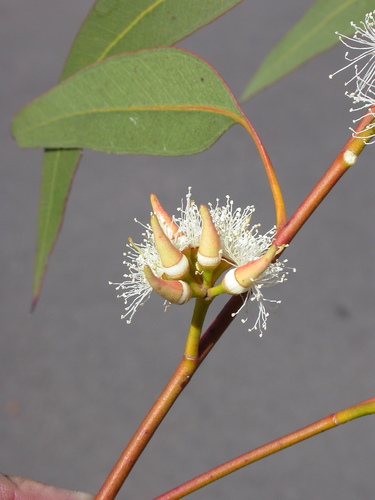
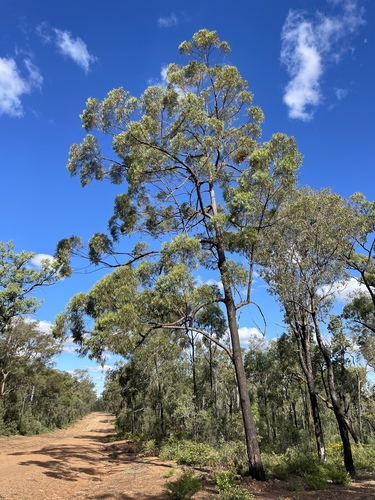
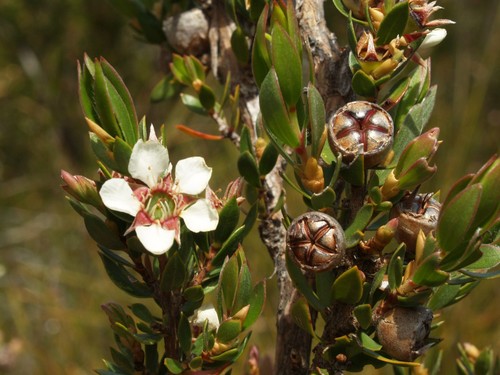
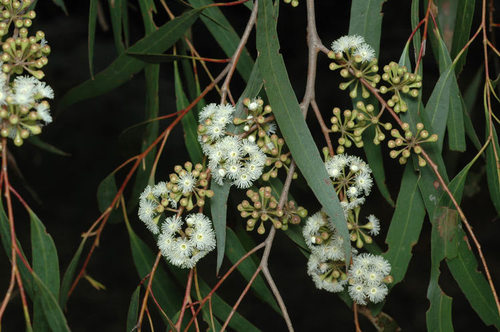
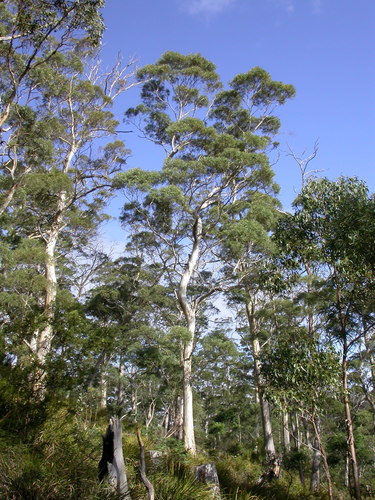
Eucalyptus pulchella Desf. is an erect tree that typically grows to 20 metres (66 feet) in height and forms a lignotuber. It has smooth white or pale grey bark; older trees sometimes have rough, fibrous greyish bark on their trunks. Young plants and coppice regrowth have narrow lance-shaped to linear leaves that are 20–35 mm (0.79–1.38 in) long and 2–4 mm (0.079–0.157 in) wide. Adult leaves are the same shade of glossy dark green on both sides, are linear in shape, 33–120 mm (1.3–4.7 in) long and 3–10 mm (0.12–0.39 in) wide, and taper to a petiole 2–10 mm (0.079–0.394 in) long. Flower buds are arranged in leaf axils in groups of nine to twenty or more, on an unbranched peduncle 2–8 mm (0.079–0.315 in) long, with individual buds attached to pedicels 2–5 mm (0.079–0.197 in) long. Mature buds are oval to club-shaped, 3–6 mm (0.12–0.24 in) long and 2–3 mm (0.079–0.118 in) wide, and have a rounded operculum. Flowering occurs from November to March, and the flowers are white. The fruit is a woody, cup-shaped to shortened spherical capsule 4–6 mm (0.16–0.24 in) long and 5–7 mm (0.20–0.28 in) wide, with valves located near the rim of the capsule.
Eucalyptus pulchella is endemic to the lowlands of south-east Tasmania, where it grows on undulating, hilly terrain at altitudes between 100 and 500 metres above sea level. The interaction of aspect, soil type, and water drainage plays an important role in determining where this species grows. It occurs on the upper north-west facing slopes of free-draining, dolerite-capped hills with shallow soils. Water availability is limited on these ridgetops due to the binding capacity of the Jurassic dolerite substrate and the shallow depth of the soil. These dry soil conditions are made more severe by slope aspect: north-west facing slopes receive high solar insolation loads and are prone to periods of drought stress. The ability of Eucalyptus pulchella to resist occasional severe drought explains its occurrence on these dry dolerite ridgetops. While it is locally widespread, Eucalyptus pulchella is only found in south-east Tasmania; this restriction may be explained by a glacial tree line that prevented the species from spreading into suitable habitats further north. While Eucalyptus pulchella has been recorded as far north as Bothwell outside its main range, its true distribution is hard to determine accurately. Field identification errors are common due to the presence of a 'half barked' intergrading form of Eucalyptus amygdalina.
Eucalyptus pulchella is a lowland species that grows on the upper slopes of well-drained sites with a Jurassic dolerite substrate, in grassy or heathy open forests. These sites typically have a north-west facing aspect, with exposure to high solar insolation loads that leads to periodic drought stress. It grows as a small to medium-sized spreading tree, and is the dominant species in grassy to heathy dry sclerophyll open forest and woodlands. These dry sclerophyll communities have an open structure, and rarely reach heights over 25 metres. The understory is most diverse in its ground cover layer, which is typically dominated by native grasses and sedges such as Lomandra longifolia. The shrub layer is sparse, and usually includes species such as Exocarpos cupressiformis; however, if the interval between fires exceeds 15 years, shrubs may become the dominant understory component. Eucalyptus pulchella is not always the dominant species: in parts of the east coast, hybrids between E. pulchella and E. amygdalina, and genetic variants of E. amygdalina, may be the dominant species instead. Eucalyptus pulchella also commonly forms mixed stands with E. globulus, E. viminalis, and E. rubida.
Like other eucalypts, Eucalyptus pulchella is a preferential outcrosser. Seed production depends on animal vectors to transfer pollen between flowers, as its pollen is not suited to wind transport. Pollinators are generally not species-specific, and include both birds and insects attracted to flowers by a nectar reward. Because birds use a close to nearest-neighbour foraging pattern, pollen is likely transferred only a short distance from its source plant. Eucalyptus pulchella flowers at high intensity for approximately two months over summer, reaching its peak flowering around November.