About Eucalyptus pauciflora Sieber ex Spreng.
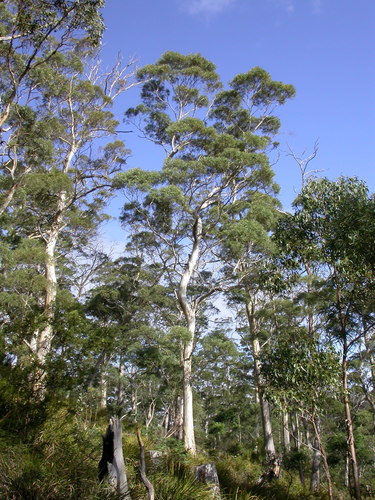
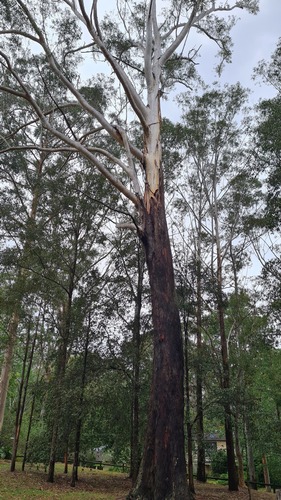
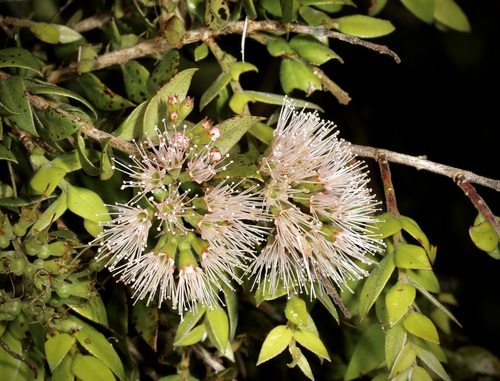
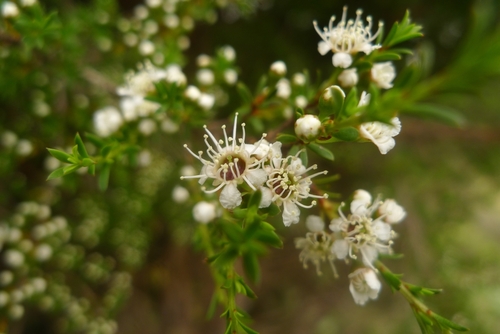
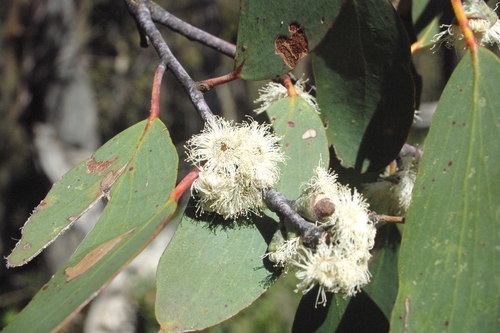
Eucalyptus pauciflora Sieber ex Spreng. is a tree or mallee that typically grows 20–30 m (66–98 ft) tall and forms a lignotuber. It has smooth white, grey, or yellow bark that is shed in ribbons, and sometimes bears insect scribbles. Young plants and coppice regrowth have dull, bluish green or glaucous, broadly lance-shaped to egg-shaped leaves, measuring 44–170 mm (1.7–6.7 in) long and 20–85 mm (0.79–3.35 in) wide. Adult leaves are the same glossy green shade on both sides, shaped as lance-shaped, curved, or elliptical, 60–200 mm (2.4–7.9 in) long and 12–50 mm (0.47–1.97 in) wide, tapering to an 8–33 mm (0.31–1.30 in) long petiole. Flower buds are arranged in leaf axils in clusters of between seven and fifteen, sometimes more, growing on an unbranched peduncle 3–15 mm (0.12–0.59 in) long, with individual buds attached to pedicels up to 6 mm (0.24 in) long. Mature buds are oval, 4–8 mm (0.16–0.31 in) long and 3–5 mm (0.12–0.20 in) wide, with a conical to rounded operculum. Flowering occurs from October to February, and the flowers are white. The fruit is a woody, cup-shaped, conical or hemispherical capsule that is 5–11 mm (0.20–0.43 in) long and wide. This species, commonly known as snow gum, grows in woodland along ranges and tablelands, in flat, cold locations above 700 m (2,300 ft). Its distribution extends from the far south-east of Queensland, through New South Wales, the Australian Capital Territory, and Victoria, to near Mount Gambier in South Australia and Tasmania. In Tasmania, the species hybridises with Eucalyptus coccifera and Eucalyptus amygdalina. A genetic study of Tasmanian Eucalyptus pauciflora populations found that chloroplast haplotypes are geographically structured, and indicate three major glacial refugial regions: Storm Bay, Tamar Valley, and the St Paul's River Valley. Snow gum is among the hardiest of all eucalyptus species, and survives the severe winter temperatures of the Australian Alps. The species regenerates from seed, via epicormic shoots growing below the bark, and from lignotubers. It is the most cold-tolerant eucalyptus species; Eucalyptus pauciflora subsp. niphophila survives temperatures as low as −23 °C (−9 °F) and year-round frosts. It has been introduced to Norway. In cultivation in the United Kingdom, Eucalyptus pauciflora subsp. niphophila and Eucalyptus pauciflora subsp. debeuzevillei have received the Royal Horticultural Society's Award of Garden Merit.