About Eucalyptus oreades F.Muell. ex R.T.Baker
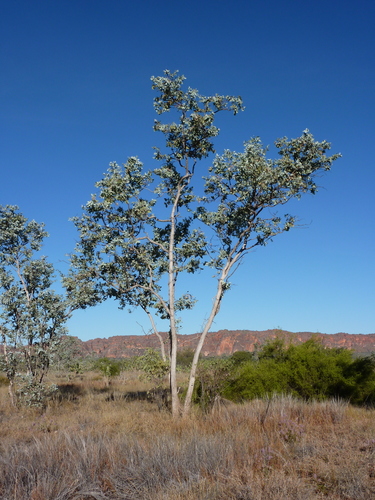
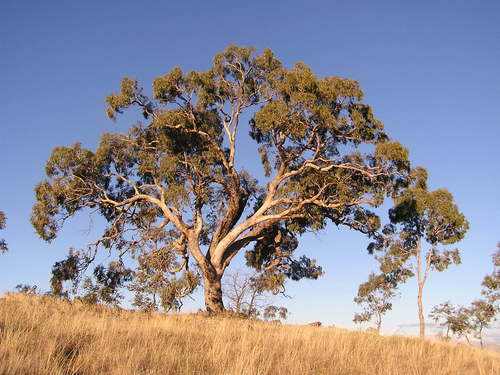
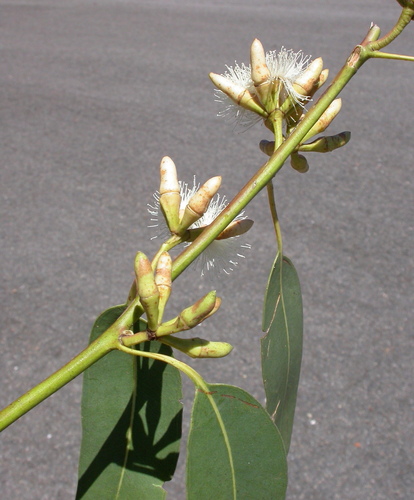
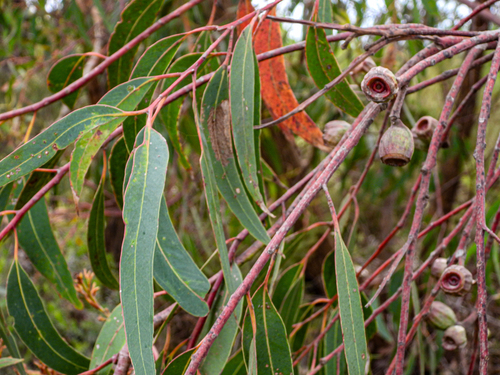
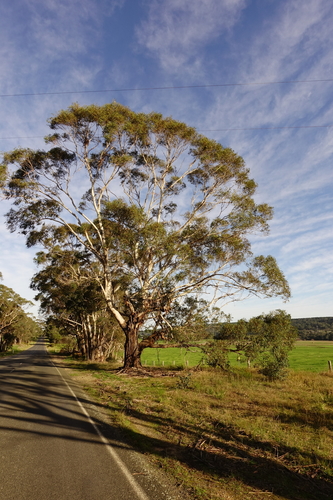
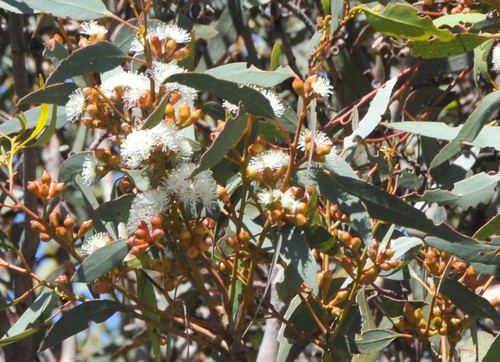
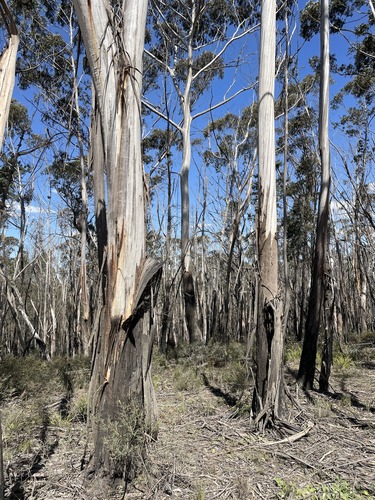
Eucalyptus oreades F.Muell. ex R.T.Baker, commonly called Blue Mountains ash, is a tree that typically reaches 40 metres (130 feet) in height, with a trunk up to 1.8 metres (5 feet 11 inches) in diameter at chest height, and does not form a lignotuber. It has smooth white or yellow bark that sheds in strips, leaving a skirt of thicker bark covering the base of the trunk up to 4 metres (13 feet) high. Young plants and coppice regrowth have elliptical to egg-shaped leaves that are the same dull greyish green shade on both sides, measuring 80–200 millimetres (3.1–7.9 inches) long and 35–100 millimetres (1.4–3.9 inches) wide. Adult leaves are the same glossy green shade on both sides, and are lance-shaped to curved. They are 75–180 millimetres (3.0–7.1 inches) long, 10–32 millimetres (0.39–1.26 inches) wide, and grow on a petiole 10–22 millimetres (0.39–0.87 inches) long. Flower buds are arranged in groups of seven in leaf axils, on a slightly flattened, unbranched peduncle 15–25 millimetres (0.59–0.98 inches) long, with individual buds attached to pedicels 2–5 millimetres (0.079–0.197 inches) long. Mature buds are diamond-shaped to spindle-shaped, about 5 millimetres (0.20 inches) long and 3–4 millimetres (0.12–0.16 inches) wide, with a conical to beaked operculum. Flowering takes place from January to March, and the flowers are white. The fruit is a woody, cup-shaped, urn-shaped or cylindrical capsule 5–10 millimetres (0.20–0.39 inches) long and 6–10 millimetres (0.24–0.39 inches) wide, with valves positioned near the rim of the capsule. Blue Mountains ash is distributed from Mittagong in the Southern Highlands of New South Wales north to Binna Burra and Springbrook in far south-eastern Queensland. It is widespread across the Blue Mountains, and has a scattered distribution in other areas. It grows on sandstone soils within the Blue Mountains, and on red clay loams outside of this region. In the Blue Mountains, it occurs on steep slopes and ridges with southern or eastern aspects, at elevations between 600 and 1,200 metres (2,000 to 3,900 ft) where annual rainfall ranges from 900 to 1,400 millimetres (35 to 55 in). Its habitat is open eucalypt forest, and common associated tree species include silvertop ash (E. sieberi), narrow-leaved peppermint (E. radiata), broad-leaved peppermint (E. dives), Sydney peppermint (E. piperita), Blaxland's stringybark (E. blaxlandii), snappy gum (E. racemosa), messmate stringybark (E. obliqua), tallowwood (E. microcorys), and New England blackbutt (E. andrewsii). Unlike most eucalypts, Eucalyptus oreades does not have a lignotuber, making it sensitive to bushfire; it often is killed by fire, and new populations regrow from seeds stored in the canopy seedbank. Mature trees older than 20 years develop a skirt of thicker corky bark that helps them resist low-intensity fires. Eucalyptus oreades grows very quickly in cultivation, and is grown in timber plantations in Australia, as well as overseas in New Zealand and South Africa.