About Eucalyptus occidentalis Endl.
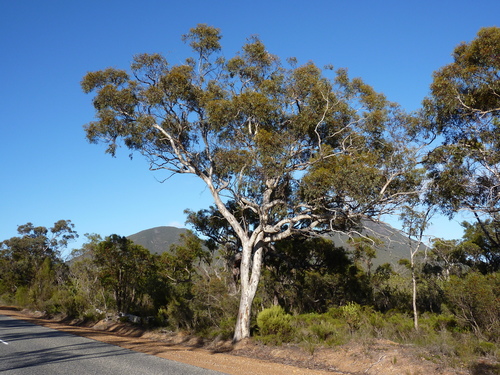
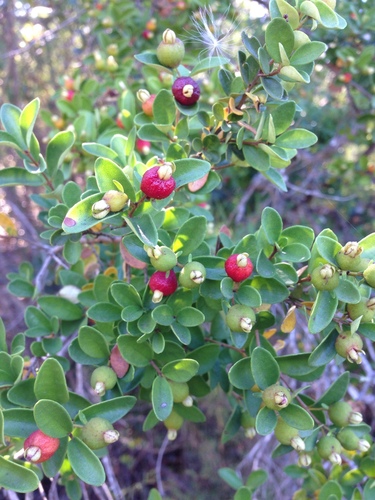
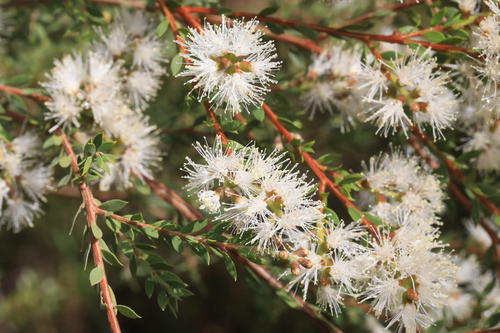
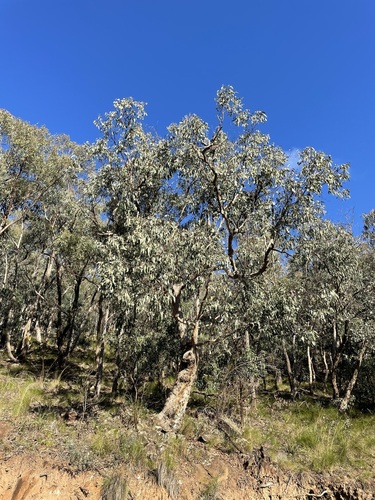
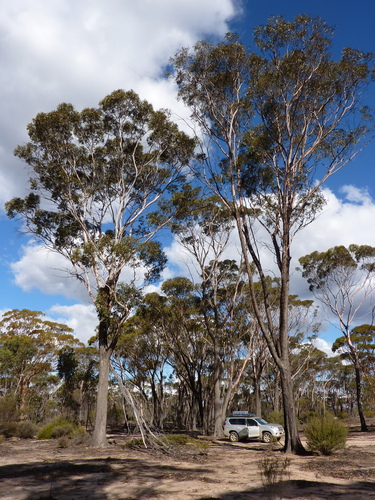
Eucalyptus occidentalis Endl. typically grows as a tree or mallee, reaching 4 to 25 metres (13 to 82 ft) in height, with a trunk diameter of approximately 0.5 metres (1.6 ft). It usually has a short trunk that branches fairly low down, producing several stout primary branches. The canopy is mostly terminal and moderately dense, giving the tree an umbrella-like appearance. Most of the trunk is covered in rough, fibrous, flaky dark grey or black bark, while the upper trunk and branches have conspicuously smooth white bark, which is sometimes powdery. Mature adult leaves are glossy green and lance-shaped. Dull blue-green, broadly ovate leaves are often visible on conspicuous seedling or coppice growth. Unlike most eucalypts, this species flowers as early as its first year of growth, producing cream-white blooms between September and May. Seeds develop inside the fruit and can be collected between October and February. The blackish-brown seeds are 1 to 2 millimetres (0.04 to 0.08 in) long, shaped like angular or flattened ovoids, with between 150 and 300 viable seeds per gram. Eucalyptus occidentalis is closely related to Eucalyptus sargentii, another rough-barked tree species that usually grows on saline sites. It differs from E. sargentii in having non-terete peduncles, larger fruit, and larger buds arranged in clusters of seven. This species is naturally distributed along the south coast of Western Australia, found in riparian zones as well as hilly and rocky areas. Its natural range extends from the Great Southern region north into the southern Wheatbelt and east into the Goldfields-Esperance regions, where it grows in sandy or clay soils. It is widely planted in the drier parts of Victoria, South Australia, and central southern New South Wales, and grows well on saline, irrigated heavier soils in northern Victoria. It is also extensively planted in other temperate regions across the world, including Italy, Morocco, Chile, Mexico, and Israel. In its natural range, Eucalyptus occidentalis usually forms part of the overstorey in woodland communities. It most often grows in pure stands, but sometimes occurs alongside Eucalyptus wandoo and Eucalyptus salmonophloia. Low-growing trees including Melaleuca strobophylla, Melaleuca cuticularis, and Acacia cyclops may also be present. Understorey associated species include shrubs such as Melaleuca acuminata and Melaleuca lateriflora, which grow over a diverse community of herbs, grasses, and sedges including Austrodanthonia setacea, Agrostis avenacea, Lagenophora huegelii, Daucus glochidiatus, and Lomandra effusa. Within its natural range in Western Australia, the tree is highly susceptible to damage from lerp psyllids (Cardiaspina spp., Glycaspis spp.), gumleaf skeletoniser moths, sawflies (Perga spp.), and termites. In New South Wales, it often experiences low levels of insect damage from leaf beetles (Chrysophtharta spp., Paropsis spp.). In Victoria, it is susceptible to Armillaria root disease and damage from sawfly larvae, which can cause defoliation and reduced growth in plantations, though most trees recover from infestation. This species is grown in wet and salt-affected areas as a soil stabilizer. It is cultivated in areas that receive an average annual rainfall of 350 millimetres (14 in), and can tolerate frosts and periodic drought. It produces durable wood suitable for use as sawn timber. In countries including Israel, Morocco, and Chile, it is used for construction, firewood, charcoal, and pulp. In Australia, it is cultivated as a windbreak, shade tree, and soil stabilizer in estuaries and wetlands. It also has potential use in apiculture for honey production. Its heartwood is hard, pale tan, straight-grained, and durable even in damp soils, making it suitable for cabinet making and construction. The air-dried density of the wood ranges from 850–1000 kg/m³.