About Eucalyptus moluccana Roxb.
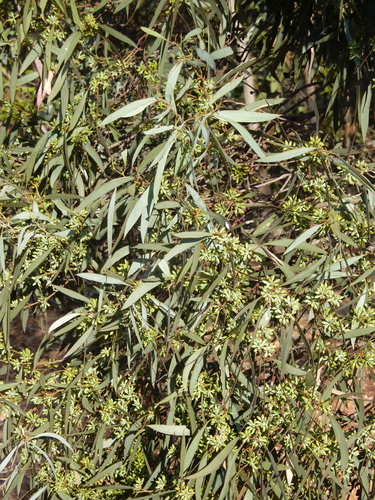
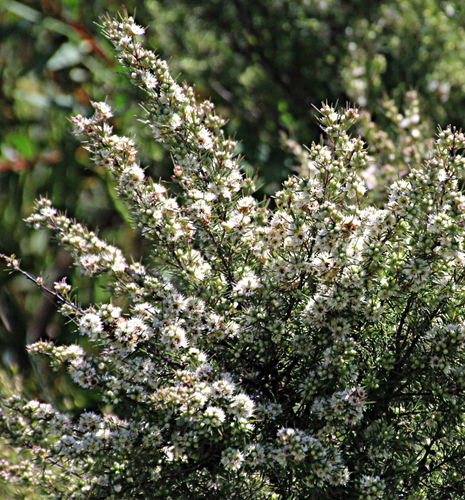
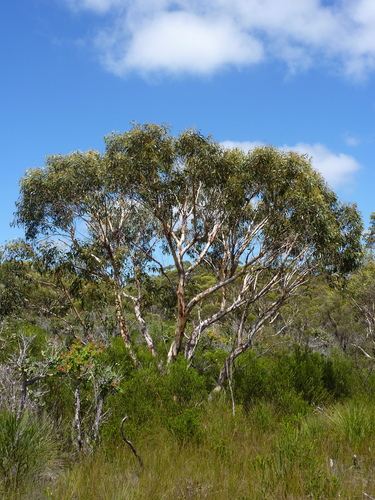
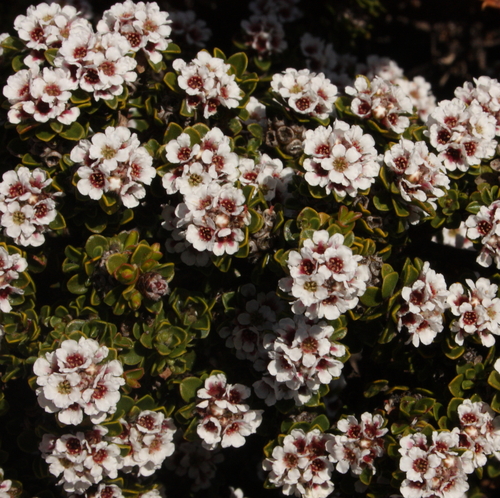
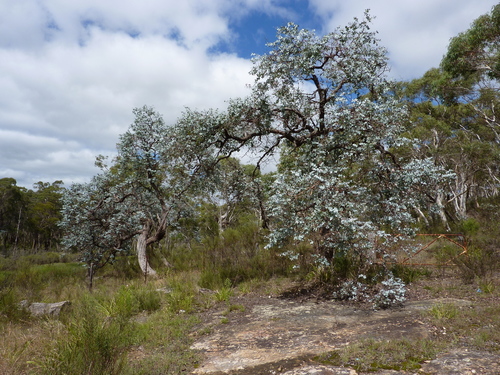
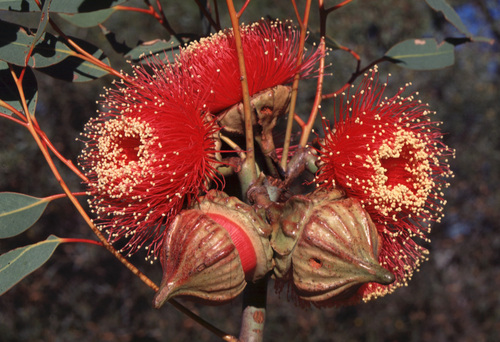
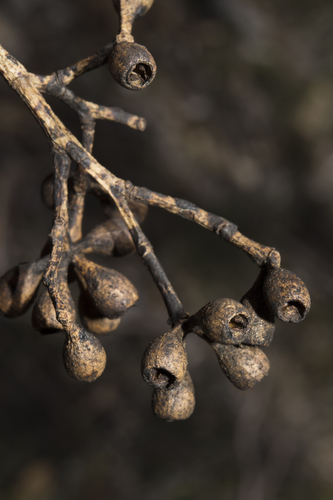
Eucalyptus moluccana Roxb. is a tree that typically reaches 30 meters (98 feet) in height and forms a lignotuber. It has persistent rough, fibrous or flaky bark covering part or all of its trunk, with smooth whitish or light grey bark above that sometimes has a shiny surface. Young plants and coppice regrowth have egg-shaped leaves that are paler on the lower surface, 40 to 80 millimeters (1.6 to 3.1 inches) long, 25 to 55 millimeters (0.98 to 2.17 inches) wide, and borne on petioles. Adult leaves are lance-shaped to broadly lance-shaped, the same glossy green on both sides, 70 to 170 millimeters (2.8 to 6.7 inches) long, 15 to 65 millimeters (0.59 to 2.56 inches) wide, borne on a 10 to 25 millimeter (0.39 to 0.98 inch) long petiole, and contain many oil glands. Flower buds are arranged at the ends of branchlets, usually in groups of seven, on a branched peduncle 6 to 13 millimeters (0.24 to 0.51 inches) long, with individual buds attached to pedicels 2 to 5 millimeters (0.079 to 0.197 inches) long. The buds are spindle-shaped to diamond-shaped, 4 to 8 millimeters (0.16 to 0.31 inches) long and 2 to 4 millimeters (0.079 to 0.157 inches) wide, with a conical operculum. Flowering has been recorded in most months of the year, and the flowers are white. The fruit is a woody cup-shaped to barrel-shaped capsule 4 to 7 millimeters (0.16 to 0.28 inches) long and 3 to 6 millimeters (0.12 to 0.24 inches) wide, with its valves enclosed. Commonly called grey box, this species is widespread on coastal plains and ranges from Jervis Bay in New South Wales north to the region between Rockhampton and Mackay in Queensland. Further north, there is a large gap in its distribution, with scattered occurrences in the ranges from west of Paluma to the southern Atherton Tableland, plus two small disjunct patches east of Clermont near Eungella Dam.