About Eucalyptus macrorhyncha F.Muell.
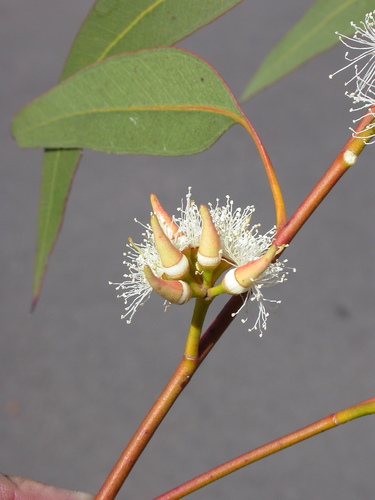
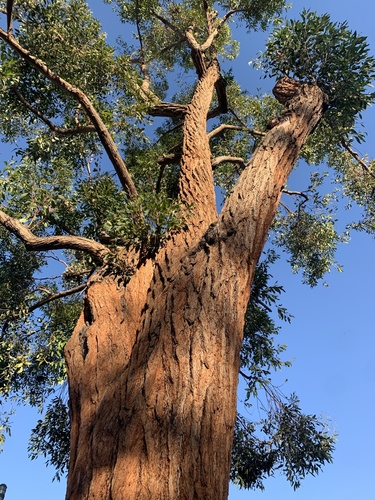
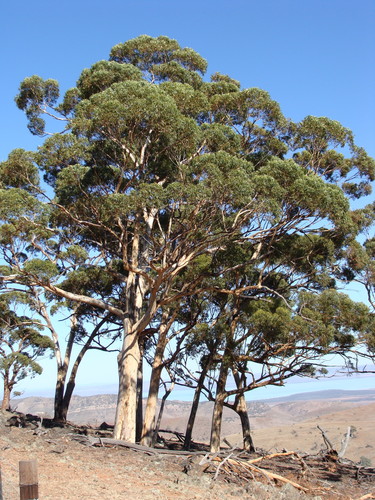
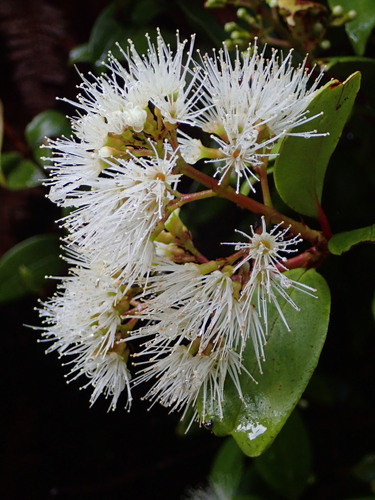
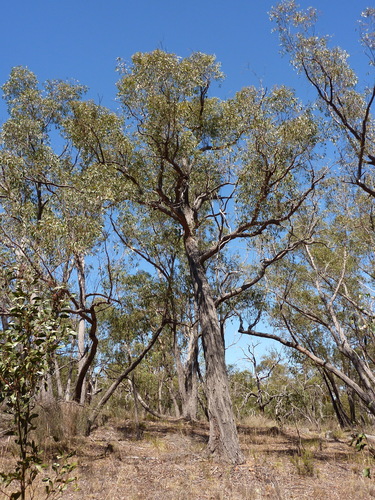
Eucalyptus macrorhyncha F.Muell. is a tree that typically reaches a height of 12–35 m (39–115 ft), and forms a lignotuber. It has rough, stringy bark, ranging from grey to reddish brown, that covers its trunk and branches. Young plants and coppice regrowth produce egg-shaped leaves that are 25–105 mm (0.98–4.13 in) long and 20–52 mm (0.79–2.05 in) wide. Adult leaves are lance-shaped to curved, are the same dull to glossy green colour on both sides, and measure 75–140 mm (3.0–5.5 in) long and 12–38 mm (0.47–1.50 in) wide, growing on a 7–20 mm (0.28–0.79 in) long petiole. Flower buds are arranged in groups of seven, nine or eleven in leaf axils, growing on an unbranched 7–18 mm (0.28–0.71 in) long peduncle, with individual buds attached to 4–6 mm (0.16–0.24 in) long pedicels. Mature buds are diamond-shaped, 5–9 mm (0.20–0.35 in) long and 4–5 mm (0.16–0.20 in) wide, and have a beaked operculum. Flowering takes place between February and July, and the flowers are white. The fruit is a woody hemispherical or shortened spherical capsule that is 3–7 mm (0.12–0.28 in) long and 6–12 mm (0.24–0.47 in) wide, with valves that protrude above the fruit's rim. Near Bundarra and Barraba, this species can be difficult to distinguish from Eucalyptus laevopinea. This species, commonly known as red stringybark, is found on ranges and tablelands of New South Wales, the Australian Capital Territory and Victoria. It also has a small, disjunct population in Spring Gully Conservation Park, south-west of Clare in South Australia.