About Eucalyptus longifolia Link & Otto
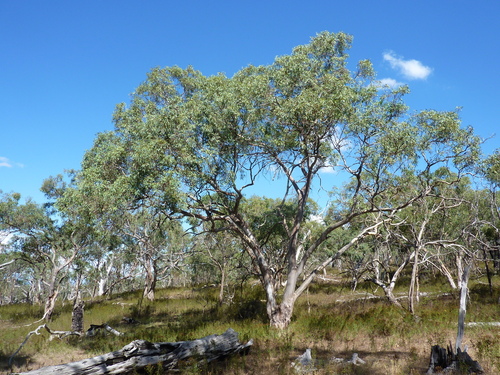
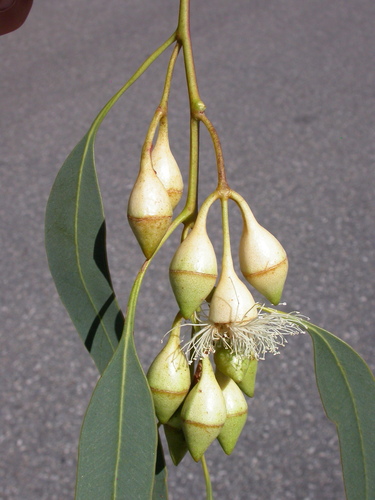
Eucalyptus longifolia, commonly known as woollybutt, is a tree that typically reaches a height of 35 metres (115 feet) and forms a lignotuber. Its trunk can grow up to 1 metre (3 feet 3 inches) in diameter, and it has rough, fibrous to flaky bark covering the trunk and all branches thicker than around 80 millimetres (3.1 inches). Young plants and coppice regrowth have stems that are roughly square in cross-section, and leaves ranging from egg-shaped to broadly lance-shaped, measuring 65–200 millimetres (2.6–7.9 inches) long and 20–90 millimetres (0.79–3.54 inches) wide. Mature adult leaves are lance-shaped to curved, are the same dull greyish green on both sides, and measure 90–250 millimetres (3.5–9.8 inches) long by 8–35 millimetres (0.31–1.38 inches) wide, borne on a 15–32 millimetre (0.59–1.26 inch) long petiole. Flower buds are arranged in groups of three in leaf axils, on an unbranched peduncle 10–34 millimetres (0.39–1.34 inches) long, with each individual bud attached to a 7–17 millimetre (0.28–0.67 inch) long pedicel. Mature buds are pendulous, oval to diamond-shaped, 16–27 millimetres (0.63–1.06 inches) long and 5–13 millimetres (0.20–0.51 inches) wide, with a conical operculum. Flowering occurs between March and June, and the flowers are white. The fruit is a woody capsule, ranging in shape from cup-shaped to cylindrical or hemispherical, 8–15 millimetres (0.31–0.59 inches) long and 9–16 millimetres (0.35–0.63 inches) wide, with valves positioned near the rim level.
The distribution of woollybutt extends from Morisett in central New South Wales south to the border of Victoria. It grows more scattered across the northern part of its range, and becomes more common from south of Nowra to Bega. This species generally grows on clay soils and floodplains, and sometimes occurs in poorly drained areas, valleys, and low-lying ground. In open sclerophyll forest, it grows alongside tree species including white mahogany (E. acmenoides), grey box (E. moluccana), forest red gum (E. tereticornis), and rough-barked apple (Angophora floribunda). In swampy areas, it occurs with swamp mahogany (E. robusta) and paperbark species including snow-in-summer (Melaleuca linariifolia), prickly paperbark (M. styphelioides) and swamp paperbark (M. ericifolia).
In ecology, woollybutt can regenerate from epicormic buds if its crown is damaged by bushfire. Individual trees can live for over one hundred years. Nectar produced by woollybutt flowers is eaten by many bird species, as well as the grey-headed flying fox (Pteropus poliocephalus) and little red flying fox (P. scapulatus).
Woollybutt has dark red timber that is hard, and resistant to water and termites. The timber has been used for railway sleepers and other general construction purposes. The species is also important for beekeeping and the honey industry, and it is useful as a shade tree or windbreak in farm paddocks. However, it grows too large to be suitable for the average residential garden.