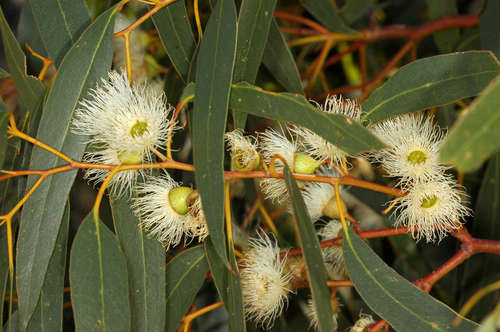
About Eucalyptus leucoxylon F.Muell.
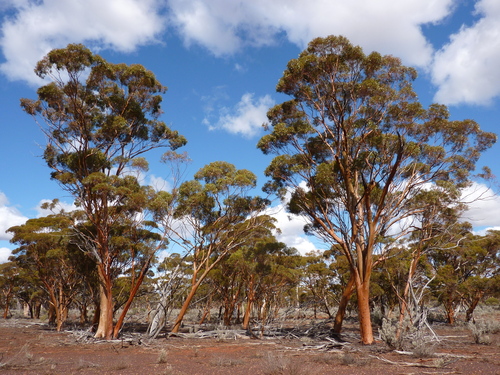
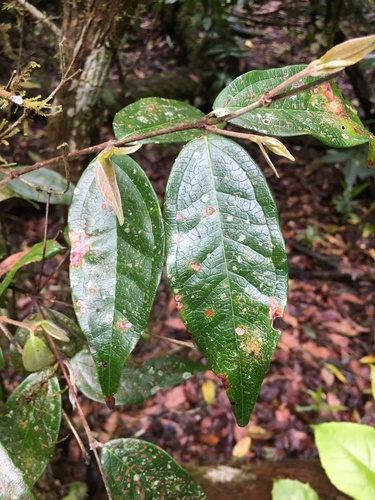
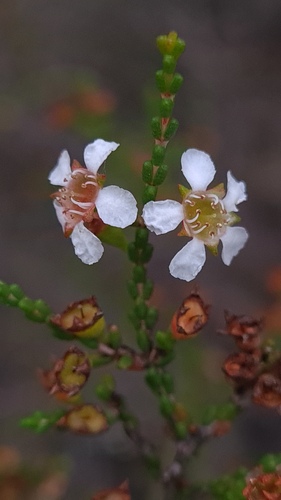
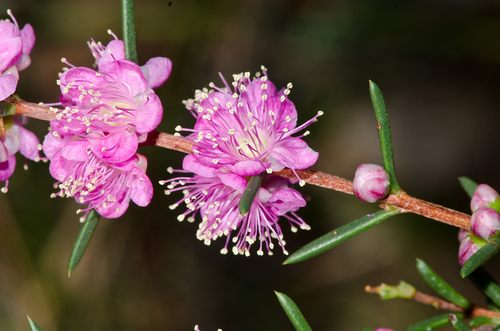
Eucalyptus leucoxylon F.Muell. is a tree that typically reaches a height of 10 to 30 meters and forms a lignotuber. Its bark is mostly smooth, white, yellow, or bluish-grey, with 0.5 to 2 meters of rough, fibrous to flaky bark usually present at the base of the trunk. Young plants and coppice regrowth have leaves that are mostly arranged in opposite pairs, are egg-shaped to broadly lance-shaped, and measure 45–105 mm long by 20–73 mm wide. Adult leaves are arranged alternately, are the same slightly glossy shade of green on both sides, are lance-shaped to curved, 60–185 mm long and 10–30 mm wide, tapering to a 9–25 mm long petiole. Flower buds are arranged in groups of three in leaf axils, on an unbranched peduncle 4–11 mm long, with individual buds attached to 2–14 mm long pedicels. Mature buds are oval, diamond-shaped, or more or less spherical, 6–17 mm long and 5–7 mm wide, with a conical, rounded, or beaked operculum. Flowering has been recorded in most months of the year, and flowers can be white, red, or pink. The fruit is a woody capsule that is cylindrical, barrel-shaped, or shortened spherical, 6–13 mm long and 6–14 mm wide, with valves enclosed below the rim of the capsule. This species is similar to Eucalyptus melliodora and Eucalyptus sideroxylon subsp. sideroxylon, but differs from them in having three buds per flower group.
This eucalypt species is native to Victoria, south-eastern South Australia, and far south-western New South Wales. All six of its recognized subspecies occur within Victoria. Subspecies bellarinensis is only known from the Bellarine Peninsula near Ocean Grove and Torquay. Subspecies connata grows on skeletal soils, mostly in the Brisbane Ranges. Subspecies leucoxylon is the most widespread subspecies, and occurs in scattered populations across Victoria and in south-eastern South Australia, including on Kangaroo Island where the tallest specimens of the species are found. Subspecies megalocarpa is a stunted tree or mallee only found in coastal areas from far south-eastern South Australia to far western Victoria. Subspecies pruinosa occurs in drier areas of South Australia, the Wimmera and Goldfields regions of Victoria, and on the Murray River floodplain near Barham in New South Wales.
In horticulture, subspecies megalocarpa, a relatively small tree with red flowers and large fruit, is often sold under the horticultural cultivar name 'Rosea'. It flowers heavily in winter, and is widely planted as an ornamental. The cultivar 'Euky Dwarf' is grown as a street and garden tree, reaching 5–6 meters in height and 3–4 meters in width. Subspecies leucoxylon has been recommended for planting in larger gardens and parklands.