About Eucalyptus lehmannii (Schauer) Benth.
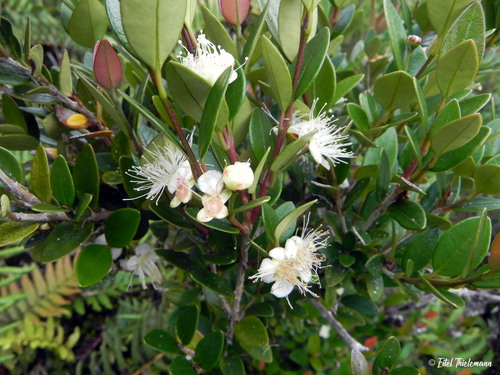
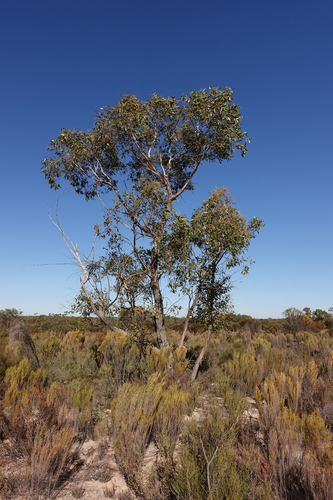
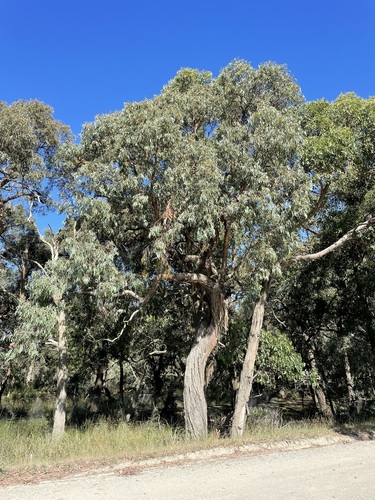
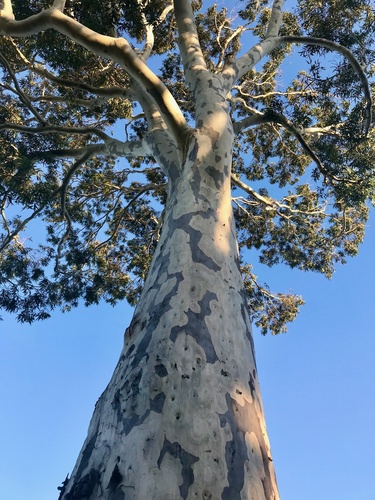
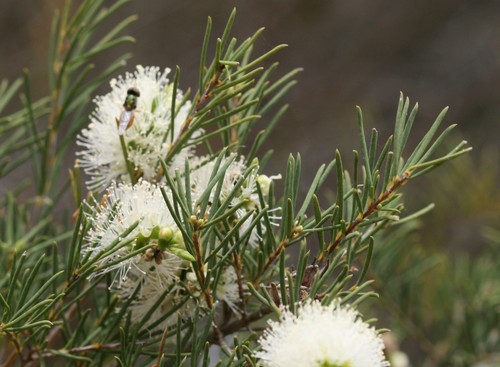
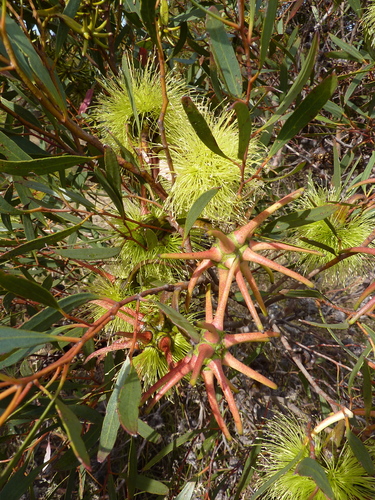
Eucalyptus lehmannii, commonly known as bushy yate, is a mallee that sometimes grows with multiple trunks. It has smooth whitish grey to grey-brown and orange-brown bark that sheds in strips. Young plant stems are initially triangular in cross-section, with alternate leaves that are oblong to elliptical or lance-shaped. These leaves are 5–8 cm long and 1–3 cm wide, glossy green on the upper surface and dull blue-green on the lower surface. Older stems are smooth and round, and also bear alternate leaves. Adult leaves have a petiole 0.1–1.5 cm long, with an elliptical to oval blade around 4.5–9.5 cm long and 0.7–2.8 cm wide. Both surfaces of adult leaves are glossy light to mid-green. Like all eucalypts, this species has oil glands in its leaves, which are either obscure or scattered. Inflorescences grow in the axils of the leaves, and have a flattened stalk 4–11 cm long that curves downwards as the flowers open. Each inflorescence can hold 11–19 or more buds, with their bases joined. When buds are ready to open, they measure about 3.3–6.5 cm long including the cap-like operculum, and are 0.5–1.0 cm wide at the base of the operculum. The stamens are erect and greenish-yellow. Bushy yate is found in southern coastal and subcoastal areas of Western Australia, ranging from east of Albany towards Israelite Bay, including the Stirling Range. It occurs in the Esperance Plains, Jarrah Forest, Mallee and Warren biogeographic regions, growing in sandy soils over granite or quartzite, often with gravel, on rocky hills and coastal dunes. Eucalyptus lehmannii, along with some other Eucalyptus species including Eucalyptus cladocalyx, Eucalyptus globulus and Eucalyptus grandis, has been described as invasive in southern Africa. In Australia, bushy yate is a useful ornamental plant, grown as a small screen, individual specimen, or grove. It has also been cultivated in other countries, including Europe and South Africa. In the United States, it is described as "a useful screen or attractive courtyard tree for areas as far north as San Francisco Bay".